

5 Bond Trading Strategies – (Video, Backtest, and Trading Rules)

Bond trading strategies are a great inclusion in a portfolio of strategies because they offer diversification and, most likely, uncorrelated returns. Bonds are complementary.
First, you might want to have a look at other articles related to bond trading strategies:
Despite being much larger than the stock market, the bond market gets much less attention from short-term individual traders. That’s a shame because bonds are great trading vehicles. This article will explore bonds and show you examples of how you can trade them. Why would you trade bond trading strategies?
This article examines Treasury bonds and shows you several backtested bond trading strategies. We don’t examine corporate bonds (which are mainly traded in the over-the-counter market) but Treasury bonds. Companies issue corporate bonds to raise capital for various purposes, such as expanding operations, acquiring equipment, or building new facilities. Bonds are used by companies, municipalities, states, and sovereign governments to finance projects and operations.
Here you can find more than 200 trading strategies similar to the above strategies.
What is a bond and how does it relate to fixed income investments?
A company or sovereign state that issues a bond (the borrower) raises capital from investors (the lenders). Investors provide capital to the borrower in exchange for a promise from the issuer to make regular interest payments on a fixed schedule for a certain period and to repay the principal value—also known as the face value or par value—at the maturity date.
Let’s give an example:
You might want to invest one million in a ten-year bond paying a 3% annual interest rate (coupon rate) semiannually. Most bonds have a face value (or par value) of $1,000, but in this example, you invest one million as the principal value. That means you get fixed interest payments of 15,000 every six months (regular interest payments) until the bond matures, and you get back the outstanding one million principal value at the maturity date.
Bonds pay fixed interest payments, typically called coupon payments, which are usually paid every six months, but can also be annual or quarterly depending on the bond’s terms. The coupon rate determines the annual interest payments to be paid to the bondholder and is based on the bond’s par value. The maturity date is the specific date when the principal value (face value) is repaid to the investor.
Bonds are categorized by their term to maturity: short term bonds have less than four years to maturity and are often used by conservative investors seeking capital preservation or liquidity; intermediate term bonds have maturities between four and ten years; long-term bonds have maturities greater than ten years and typically offer higher yields but more risk.
But investing in bonds involves risk, and you need to overcome the following three risks:
- Credit Risk: The borrower’s (issuer’s) ability to pay (creditworthiness) is assessed by rating agencies, and bond ratings represent their opinion of the issuer’s ability to repay its debt. Default risk refers to the chance that the issuer cannot pay interest or principal.
- Interest Rate Risk: If you need to raise money or sell the bond prior to maturity, the price of the bond might change. If rates are higher now than when you invested, the bond’s price is lower (and vice versa).
- Inflation Risk: Even if you hold the bond until maturity, you might “lose” due to lost purchasing power.
Types of Bonds
Bonds come in several forms, each serving different purposes and offering unique benefits for fixed income investors.
Government bonds are issued by national governments to fund public spending and are often considered low-risk due to the backing of the government.
Treasury bonds, including T-bills, T-notes, and T-bonds, are a specific type of government bond issued by the U.S. Department of the Treasury and are highly liquid, making them a staple in many investment portfolios.
Corporate bonds are issued by companies seeking to raise capital for expansion, acquisitions, or other business needs. These bonds typically offer higher yields than government bonds but come with increased credit risk, as the issuer’s ability to pay interest and principal depends on the company’s financial health.
Municipal bonds are issued by state and local governments or their agencies to finance public projects like schools, highways, or utilities. Municipal bonds can offer tax advantages, such as exemption from federal income tax and, in some cases, state and local taxes, making them attractive for investors in higher tax brackets.
By understanding the differences between government bonds, treasury bonds, corporate bonds, and municipal bonds, investors can better align their fixed income investments with their risk tolerance and investment objectives.
What is a bond trading strategy?
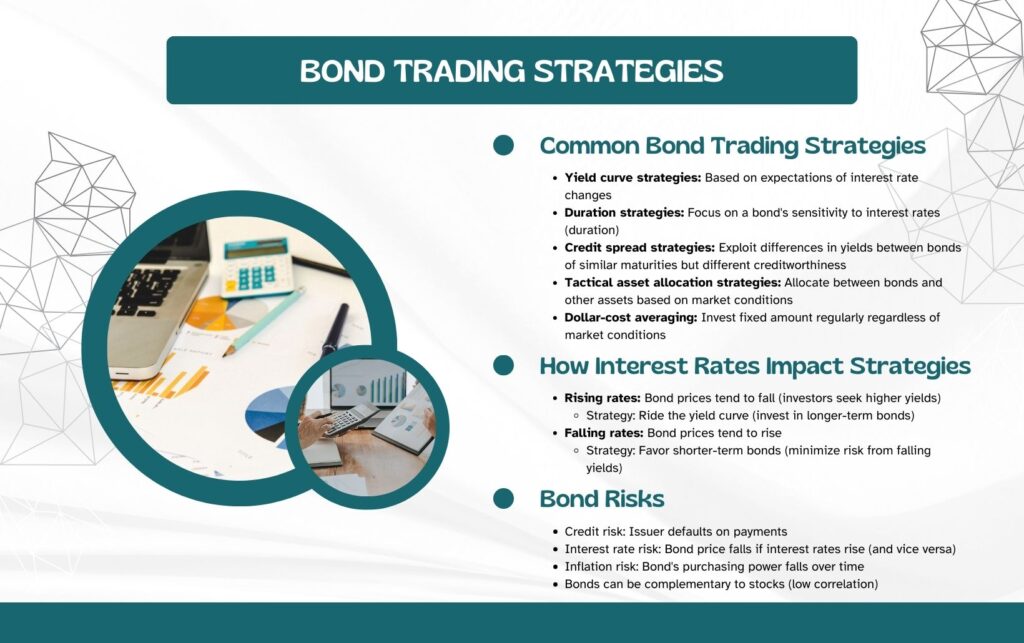
A bond trading strategy is a systematic approach to buying or selling bonds in the financial markets. These strategies are designed to achieve specific objectives such as capital preservation, income generation, or capital appreciation.
Bond investments can be made through individual bonds or pooled vehicles such as bond funds, mutual funds, and bond mutual funds. Fixed income products, including bonds and bond funds, are used in investment strategies to provide stable income and diversify portfolios.
Bond funds and mutual funds allow investors to access a diversified pool of bonds, with bond mutual funds being a specific type of mutual fund focused on bonds. Individual bonds offer direct ownership and predictable cash flows, while pooled funds provide diversification and professional management.
Cash flows from bonds consist of periodic interest payments and principal repayment, and understanding these cash flows is important for selecting the right strategy. Pooled funds, such as bond mutual funds or ETFs, offer investors a convenient and diversified way to invest in bonds.
Bond trading strategies can vary widely depending on factors such as market conditions, investor risk tolerance, and investment goals. Common bond trading strategies include yield curve, duration, credit spread, and tactical asset allocation strategies. Yield curve strategies involve taking positions based on expectations of changes
How do bond trading strategies differ?
Bond trading strategies differ based on time horizon, risk tolerance, and market conditions. Some focus on short-term gains through techniques like scalping, while others take a longer-term perspective, relying on fundamental analysis. Risk levels vary, with some strategies prioritizing high returns and others emphasizing capital preservation.
The sensitivity of a bond’s price to changes in the interest rate environment is called duration, and active duration management involves adjusting this sensitivity based on rate expectations.
Rising interest rates can negatively impact bond prices and influence trading strategies, while reinvestment risk arises when maturing bonds must be reinvested at potentially lower yields due to rate fluctuations. Liquidity risk is the risk of not being able to sell a bond easily without incurring high transaction costs or a reduction in price. Investors should analyze the risk-reward ratio between purchasing different maturity bonds to optimize their portfolio returns.
Many analysts favor the 2- to 5-year or 4- to 10-year maturity range to lock in durable yields as rates decline. In 2026, effective bond trading strategies are shifting toward intermediate-duration and high-quality credit.
Market environment also influences strategies, with some traders adopting defensive approaches in uncertain times and more aggressive tactics during economic expansions. Overall, strategies vary in their objectives and approaches to navigating the bond market.
Bond Pricing and Yield
The value of a bond in the market is closely tied to its yield, which represents the return an investor receives from the bond’s interest payments relative to its price. When interest rates rise, newly issued bonds pay higher yields, making existing bonds with lower rates less attractive—causing their prices to fall. Conversely, when interest rates fall, existing bonds with higher coupon payments become more valuable, and their prices rise.
This inverse relationship between bond prices and yields is fundamental to fixed income investing. Investors seeking higher yields may gravitate toward bonds with longer maturities or lower credit quality, but must also be mindful that as bond prices fall in a rising rate environment, the market value of their holdings can decline. Understanding how the prevailing interest rate environment affects bond pricing and yield is essential for making informed decisions when buying and selling bonds.
What are common mistakes in bond trading strategies?
Common mistakes in bond trading strategies often stem from insufficient understanding of market dynamics, overreliance on historical data without considering current conditions, and neglecting risk management principles. Traders may also fall into the trap of chasing yield without fully assessing credit risks or liquidity constraints.
Additionally, misjudging interest rate movements or failing to diversify adequately can lead to significant losses. Lack of flexibility in adjusting strategies in response to changing market conditions is another common pitfall. Fixed income portfolios should be reviewed periodically and adjusted to reflect current financial goals and market conditions.
In volatile economic environments, prioritizing investment-grade bonds—those issued by highly rated entities with low default risk—can help manage credit risk. Finally, emotional biases such as overconfidence or herd mentality can cloud judgment and result in poor decision-making. Successful bond trading requires a comprehensive understanding of the market, disciplined risk management, and the ability to adapt to evolving circumstances.
- What Happens To Stocks When Bonds Go Up? (Trading Strategy Backtest)
- What Happens To Stocks When Bonds Go Down? (Backtest)

Bond Risk and Credit Quality
Investing in bonds involves several types of risk that can impact returns and capital preservation.
Credit risk refers to the possibility that the bond issuer may fail to make scheduled interest payments or repay the principal at maturity, leading to potential losses for investors.
Interest rate risk is the risk that changes in the interest rate environment will cause fluctuations in a bond’s price—when rates rise, bond prices typically fall, and vice versa.
Another important consideration is liquidity risk, which is the risk that an investor may not be able to sell a bond quickly or at a desirable price, especially in less active segments of the bond market.
Assessing the credit quality of a bond, which is often reflected in its credit rating, helps investors gauge the likelihood of default and make more informed choices about which fixed income securities to include in their portfolios.
Bond trading example
Let’s show you how a bond’s price can vary in the secondary market.
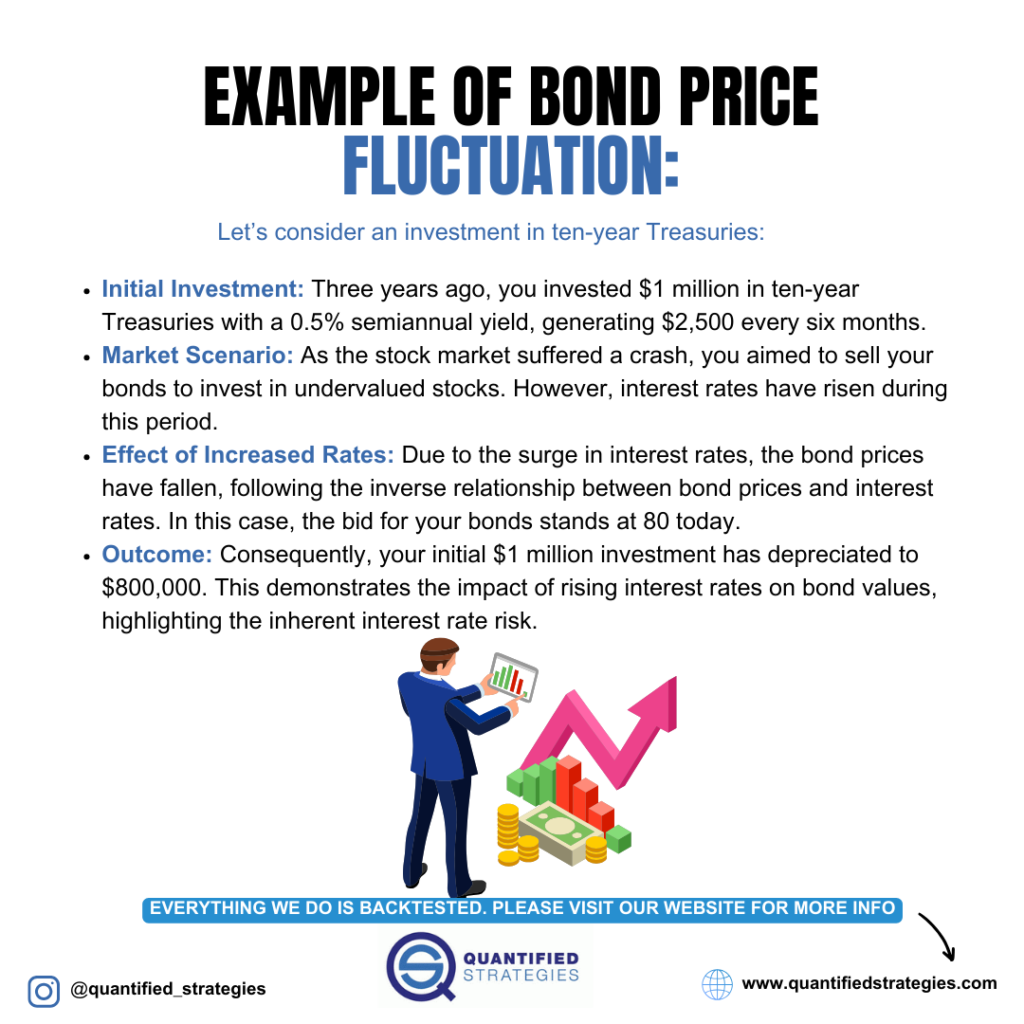
Three years back, you invested one million into ten-year Treasuries with a paltry 0.5% semiannual yield, which pays 2,500 every 6 months. Bonds typically have a face value of $1,000, which is the principal amount repaid at maturity and used to calculate coupon payments. However, a bond’s price in the secondary market is determined by supply and demand and can fluctuate above or below its face value, especially as interest rates change.
However, the stock market has crashed in the meantime, and you want to sell the bonds to invest in stocks. Stocks are cheap.
Unfortunately, interest rates have risen, and no buyers are willing to pay what you paid. As a matter of fact, not only stocks have crashed, but also bonds because interest rates have increased. Because of the higher rates, bond prices need to fall. Today, the bid is at 80 for your bonds.
Thus, your one million investment is only worth 800 000. Quite a loss! This is interest rate risk, and it’s for real. If, instead, interest rates had fallen and the bond’s price increased in the secondary market, you could have realized capital gains by selling your bonds before maturity.
We hope you get the point on why bond prices fluctuate.
Related reading: Bond Glossary
Is bond trading profitable?
That depends on the strategy, of course. But as you’ll discover in this article, the main benefit of bond trading strategies is that they are complementary and add to the overall returns.
Why bond trading strategies are good
Bonds are volatile, but the best part is that bonds usually don’t correlate too much with stocks. They are complementary.
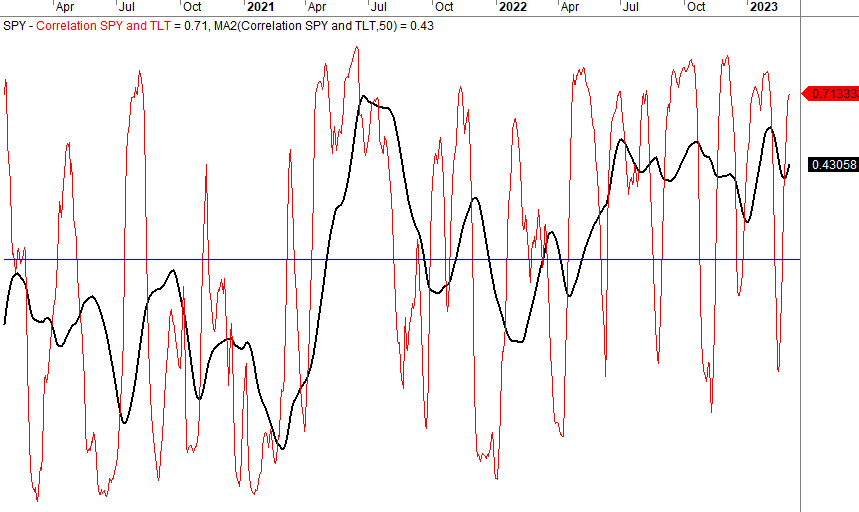
The chart below shows the 25-day rolling correlation between SPY and TLT (red line). The black line is the 200-day moving average. SPY tracks S&P 500, while TLT tracks Treasury 20-year bonds.
As you can see, the correlation goes up and down, but the black line is around zero most of the time, indicating no correlation (the blue line marks zero):
If you want a primer on correlation, please see our separate article:
Bond trading strategies backtests
We assume you are most interested in specific bond trading strategies.
Let’s look at some specific bond trading strategies. The strategies below are backtested on the ETF that tracks 20-year Treasury bonds (TLT), but they can most likely be traded by using the corresponding futures contract, given you use the same official trading hours as TLT.
Bond trading strategy backtest 1
Our first bond trading strategy was published a few years ago and called Calendar Effects In Long-Term Treasuries.
The trading rules are simple (this is a seasonal strategy):
Trading Rules
Let’s look at the trading rules:
You find the trading rules at the bottom of the article
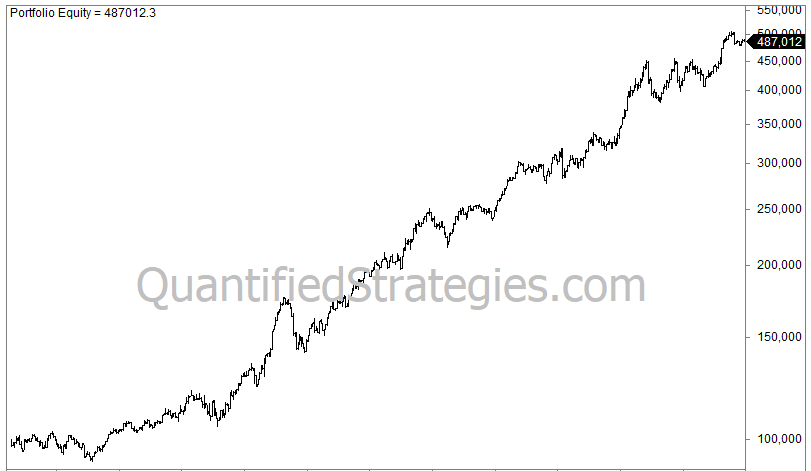
The strategy has returned the following equity curve since TLT’s inception in 2002:
The trading statistics and metrics are good:
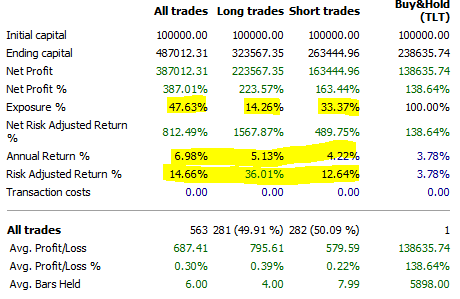
The return is more than twice buy and hold despite being invested just 61.8% of the time. If we look at the risk-adjusted return it’s even better at 14.6%.
We argue these are “spectacular” returns for such a “simple” strategy! We believe seasonal patterns are one of the lowest-hanging fruits in trading, but there is no guarantee the pattern will continue working in the future. And, this strategy can further be improved.
Bond trading strategy backtest 2
Our second bond trading strategy is strategy 11 from our trading library. It trades TLT and uses three variables to determine when to buy, along with a straightforward exit criterion.
Below is the equity curve since TLT’s inception in 2002:
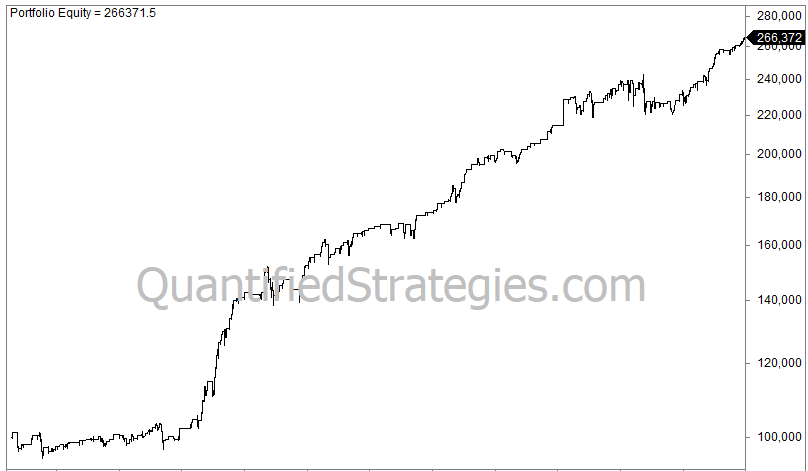
The performance metrics and statistics are good:
- No. of trades: 273
- Average gain per trade: 0.38% (0.96% for winners and -1.16% for losers)
- Win ratio: 72%
- Profit factor: 2.1
- CAGR: 4.8%
- Exposure/time in the market: 15%
- Max. drawdown: -9%
Bond trading strategy backtest 3
We have more bond strategies; the next one is also in TLT and was our monthly trading edge for our subscribers in December 2022.
Our third bond trading strategy is strategy 15 from our trading library, and trades only short. It has two variables: seasonal and intermarket (we use another market/asset as input). Below is the equity performance since 2002:
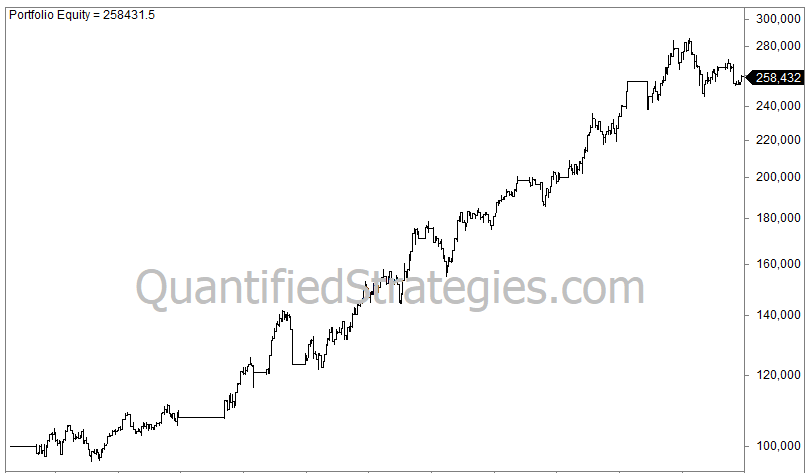
- No. of trades: 200
- Average gain per trade: 0.58%
- Win ratio: 63%
- Profit factor: 1.9
- CAGR: 5.3% (assuming no leverage)
- Exposure/time in the market: 25%
- Max. drawdown: -13%
Bond trading strategy backtest 4
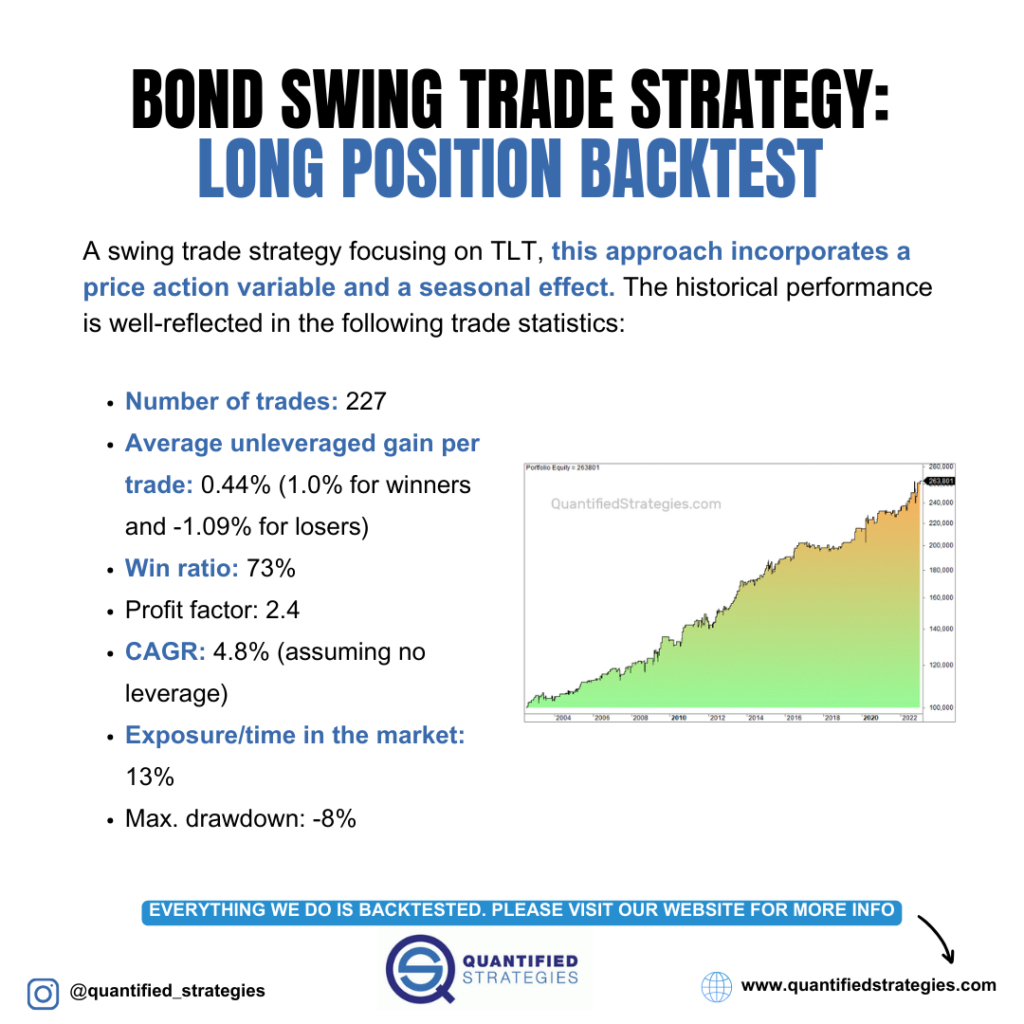
Our fourth bond trading strategy is strategy 30 from our trading library. It has one price action variable and one based on a seasonal effect.
It has the following equity curve from 2002 until today:
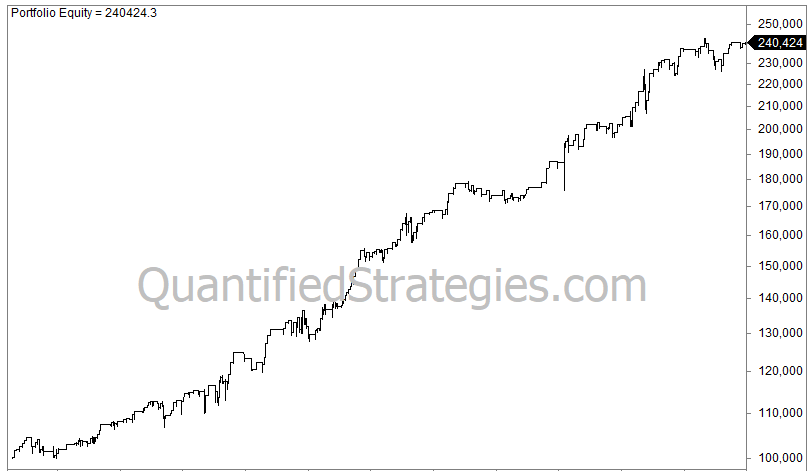
The historical performance is good, and we get the following trading statistics:
- No. of trades: 238
- Average unleveraged gain per trade: 0.44% (1.0% for winners and -1.09% for losers)
- Win ratio: 73%
- Profit factor: 2.4
- CAGR: 4.8% (assuming no leverage)
- Exposure/time in the market: 13%
- Max. drawdown: -8%
Bond trading strategy backtest 5: combining with S&P 500
One of the main reasons for including bonds is diversification. They are complementary.
To show you how we’ll combine our TLT strategies with one of our strategy bundles for the S&P 500.
Let’s start by showing the backtest results of our beginner strategy bundle in the S&P 500 from 2002 until today, which trades SPY or the futures contract (ES):
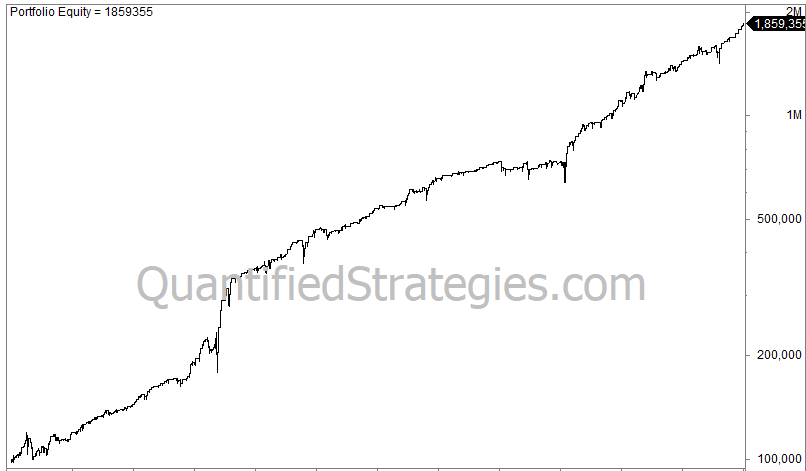
The results are very good and uncorrelated with the overall market return (buy-and-hold). The average gain per trade is 0.7%, and the annual unleveraged return is almost 13% – significantly better than buy and hold despite being invested just 25% of the time.
But what happens if we include bond strategies 3 and 4 mentioned above (strategies 15 and 30 from our trading library)? The result improves a lot:
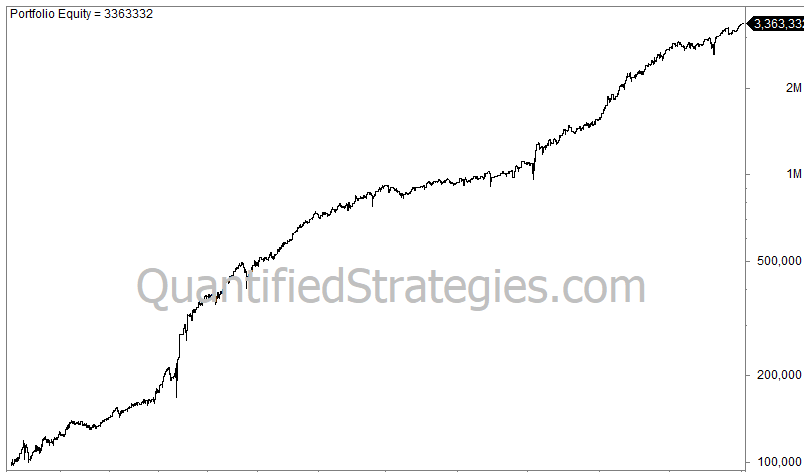
The annual returns increase from 13% to 15.8% while drawdowns decrease. This is precisely why we want to add complementary strategies, and this shows that bond strategies add valuable diversification. Drawdowns decreased even though we spent more time in the market (46%) after adding the bond-trading strategies.
Credit Risk Management
Effective credit risk management is crucial for bond investors aiming to protect their capital from the risk of default. One of the primary ways to manage this risk is by evaluating the credit ratings assigned to each bond issuer by independent rating agencies. Bonds with higher credit ratings are generally considered safer, while those with lower ratings offer higher yields but come with increased risk.
Diversifying across multiple issuers, sectors, and types of bonds can further reduce exposure to any single issuer’s financial troubles. Regularly monitoring changes in credit ratings and staying informed about the financial health of bond issuers allows investors to take proactive steps, such as rebalancing their portfolios or selling bonds that show signs of deteriorating credit quality.
Optimizing Bond Portfolios
Building an optimized bond portfolio involves balancing risk and return by selecting a diverse mix of bonds with varying credit ratings, maturities, and yields. Diversification helps reduce the impact of any single bond’s poor performance on the overall portfolio. Investors may choose a blend of government, corporate, and municipal bonds to achieve their desired risk profile and income needs.
By considering factors such as duration, yield, and the creditworthiness of issuers, investors can tailor their bond portfolios to align with their investment objectives and risk tolerance. Regular portfolio reviews and adjustments ensure that the mix remains appropriate as market conditions and interest rates change, helping to maximize returns while managing potential risks in the fixed income portion of an investment portfolio.
Bond trading strategies – conclusion
This article has shown how to improve your trading by adding complementary bond trading strategies. If you want to take your trading to a higher level, you are likely better off by adding strategies that might not be “perfect” on their own but work nicely together with other strategies.
You are not looking for the perfect strategy but strategies that complement each other.
Bond trading strategy
How do interest rates and interest rate risk impact bond trading strategies?
Interest rates have a significant impact on bond trading strategies. When interest rates rise, bond prices tend to fall, and vice versa. This inverse relationship forms the basis for many bond trading strategies. For instance, in a rising interest rate environment, traders may employ a strategy known as “riding the yield curve,” where they invest in longer-term bonds to capture higher yields before rates climb further.
Conversely, in a falling rate environment, traders might favor shorter-term bonds to minimize the risk of capital loss from decreasing yields. Additionally, interest rate expectations influence bond trading decisions. If market participants anticipate future rate cuts, they may buy bonds in anticipation of their prices rising as yields decline. Conversely, if rate hikes are expected, investors may sell bonds to avoid potential losses from falling prices.
Overall, understanding and effectively navigating the relationship between interest rates and bond prices is essential for successful bond trading strategies.
Day Trading Bonds
Day trading bonds involves the short-term buying and selling of bonds, typically within the same trading day, to profit from small price movements. This strategy is more challenging in the bond market compared to stocks, as bond prices are often less volatile and more sensitive to factors like interest rate changes, economic data releases, and central bank policies.
While day trading bonds can offer opportunities, it generally requires a good understanding of bond pricing, liquidity, and the factors influencing interest rates. Most bond day traders focus on highly liquid government bonds, such as U.S. Treasury securities, due to their volume and market responsiveness.
Can bond trading strategies be automated?
Yes, bond trading strategies can indeed be automated. With advancements in technology and the rise of algorithmic trading, many aspects of bond trading can be programmed to execute trades automatically based on predefined criteria. Automated trading systems can analyze vast amounts of data, including market trends, interest rate movements, economic indicators, and bond issuer information, to make informed real-time decisions.
These systems can also incorporate various trading strategies, such as trend following, mean reversion, or statistical arbitrage, which can be coded into algorithms. Additionally, automation can enable swift execution of trades across multiple markets and instruments, allowing for efficient portfolio management and risk mitigation.
However, it’s important to note that while automation can enhance trading efficiency, human oversight remains crucial for monitoring and adjusting automated strategies as market conditions evolve.
Are there specific bond trading strategies for beginners interested in corporate bonds?
For beginners, there are specific bond trading strategies to consider. One such strategy is dollar-cost averaging, where you invest a fixed amount regularly regardless of market conditions, reducing the impact of market fluctuations on your overall investment.
FAQ – Bond Trading Strategies (Treasury-Fixed Income)
Is bond trading fixed income?
No, bond trading is not fixed income. By that we mean that the main aim is capital gains, not income from the bonds, although you might get that as well.
What are fixed income strategies?
Fixed income strategies are strategies based on bonds or assets that pays a fixed coupon.
Is a treasury bond fixed income?
Yes, a treasury bond is fixed income.
Why does Dave Ramsey not invest in bonds?
Dave Ramsey generally avoids bonds because his investing philosophy is built around simplicity, long-term growth, and behavioral discipline, not portfolio optimization in the academic sense.
What does Warren Buffett say about Treasury bills?
Warren Buffett has actually spoken very positively about U.S. Treasury bills — but for a very specific purpose. Unlike many investors, he does not view T-bills as long-term investments. He sees them primarily as a superior form of cash.
What happens to treasury bonds if the market crashes?
When the market crashes, the effect on Treasury bonds depends on the type of bond and investor behavior, but generally, Treasuries are considered a “safe haven” and historically bonds tend to rise.