
Momentum Trading Strategy (Backtested, Trading Rules And Backtest Settings)

Can we make a successful momentum trading strategy? Momentum trading is the opposite of buying low and selling high: momentum is about buying strength.
Momentum trading is an investment strategy that differs from traditional buy-low-sell-high approaches, focusing instead on capitalizing on existing price trends. It is considered a high-risk strategy that relies on the continuation of price trends.
What is momentum?
Momentum in trading is the rate of acceleration in an asset’s price. In financial markets, it represents the “velocity” of a trend, operating on the principle that prices in motion tend to stay in motion. Momentum trading works much like a car gaining speed (acceleration) and then slowing down (deceleration); traders look to capitalize on these shifts by entering positions as momentum builds and exiting when it fades. Traders look for buy and sell signals generated by technical indicators to determine optimal entry and exit points.
Key technical indicators like the Relative Strength Index (RSI) and MACD help investors quantify this strength to identify entry and exit points. These indicators are calculated using recent closing prices and often include a signal line to help identify overbought or oversold conditions and potential trend reversals. Momentum trading is less dependent on fundamental analysis and focuses more on price trends and technical indicators.
Technical analysis tools are used to predict future price movements, and indicators like the stochastic oscillator can help predict price movements and trend reversals.
Does momentum work?
Momentum investing is an approach that seeks to buy stocks with the best historical performance over a given period and then periodically rebalance the portfolio such that at any given time, it’s invested in the stocks with the highest momentum.
Momentum trading strategies aim to capitalize on market trends and are often considered short term trading strategies.
This approach is based on the momentum hypothesis, which believes a strong correlation exists between 3-12 months ‘historical return and 3-12 months’ future return.
Momentum trading strategies are usually focused on short-term market movements, but the duration of a trade can depend on how long the trend maintains its strength.
That is, stocks that performed the best over the medium term (3-12 months) are likely to continue performing well in the near future, say the next 3-12 months.
How momentum trading works
Here’s how it works:
- A momentum investor buys stocks that have performed best over the last 6 months (can be 3, 9, or 12 months). Traders use technical analysis tools to identify potential trading opportunities and determine when to enter and exit positions.
- The investor rebalances his portfolio every month or 3 months by selling the least performing ones and buying new stocks currently performing better. Traders identify rising or falling stocks using technical analysis tools rather than company fundamentals.
Why does momentum work?
We need to look at some facts to understand why momentum investing works:
Eric Crittenden of Long Board Funds published a fascinating blog post in 2016 called 80 Percent Of Stocks Have A Lifetime Return Of Zero.
Crittenden looked at the distribution of returns for all stocks listed between 1989 and 2015. Put short, over the long term, a small minority of stocks drive all the returns for the overall market!
Approximately 20% of all stocks accounted for all the gains during the period, meaning that the remaining 80% accounted for zero returns. During the same period, S&P was up 12-fold! The majority of the stocks ended up worthless.
It’s like the Pareto principle:
Roughly 80% of consequences come from 20% of causes – the 80/20 rule
Momentum trading includes identifying strong price trends and using specific techniques to capitalize on them, often integrating risk management, technical indicators, and asset selection.
This is what the distribution looked like:
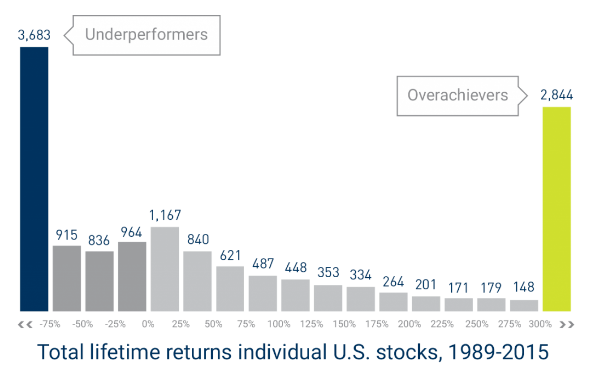
The chart is negatively skewed: many losers and a few winners that turn out to be multibaggers.
We quote from the blog post:
7.7% of all active stocks outperformed the S&P 500 Index by at least 500% during their lifetimes. Likewise, 976 stocks (6.8% of all active stocks) lagged the S&P 500 by at least 500%. The remaining 12,404 stocks performed above, at or below the same level as the S&P 500.
What are the implications of the research?
Navigating the market may be more efficient by playing defensively and avoiding underperforming investments. Successful traders often use momentum trading strategies to achieve superior returns by focusing on stocks with strong upward trends and maintaining a disciplined approach.
Can this be done?
The fact is that picking winners is very difficult, but this is where momentum investing might come to the rescue: you are buying strong stocks and avoiding weak stocks.
Richard Driehaus is considered the Father of Momentum Investing, and his investing techniques have become the basics of modern momentum trading.
(Eric Crittenden’s blog post was written before Hendrik Bessembinder published his famous paper Do Stocks Outperform Treasury Bills?)
Let’s backtest a simple monthly momentum strategy for the S&P 500:
The trading rules can’t get any simpler, and we backtest the following:
Trading Rules
You find the trading rules at the bottom of the article
This approach is a form of breakout trading, where traders act on buy and sell signals generated by price crossing key moving averages. A common rule in momentum trading is to only buy stocks if the price is above its 200-day moving average.
This is it – two simple rules. You can also enter at the opening of the following month after a signal.
Effective Risk Management for Momentum Traders
Momentum trading offers the potential for significant profits by capitalizing on strong price trends, but it also comes with heightened risks—especially in volatile markets. For momentum traders, effective risk management is not just a safety net; it’s a core component of a successful trading strategy.
To navigate the fast-paced world of momentum investing, traders must implement robust risk management techniques that help protect against adverse market movements and sudden reversals. Here are some essential strategies and tools that momentum traders should consider:
- Position Sizing: Carefully determine the size of each trade based on your overall portfolio and risk tolerance. Using position sizing software or calculators can help ensure that no single trade exposes you to excessive downside risk.
- Stop-Loss Orders: Setting stop-loss orders is crucial for limiting potential losses. These orders automatically close your position if the stock price moves against you, helping to prevent significant drawdowns. Trailing stops can also be used to lock in gains as the price advances in your favor.
- Diversification: Don’t put all your eggs in one basket. By spreading trades across different asset classes—such as stocks, exchange traded funds (ETFs), and commodities—you can reduce exposure to any single market or sector, minimizing the impact of sudden downturns.
- Technical Indicators: Momentum trading relies heavily on technical analysis tools like the Relative Strength Index (RSI) and Moving Average Convergence Divergence (MACD). These indicators not only help identify strong price momentum and potential trading opportunities, but also signal overbought or oversold conditions, alerting you to possible trend reversals.
- Trading Plan: Develop a clear trading plan that outlines your entry and exit rules, risk limits, and criteria for adjusting your strategy. Sticking to your plan helps maintain discipline, especially during periods of market volatility.
- Monitor Transaction Costs: High trading frequency can lead to increased transaction costs, which can erode profits over time. Use low-cost brokers and optimize your trading strategy to minimize unnecessary trades.
- Stay Informed: Market sentiment and news events can quickly shift price trends. Successful momentum traders continuously monitor market conditions, adapting their strategies to capitalize on new opportunities or to protect against emerging risks.
Momentum trading requires a proactive approach to risk management. By combining technical indicators, careful position sizing, stop-loss strategies, and diversification, traders can better manage the risks involved and increase their chances of achieving consistent, significant profits. Remember, even the most robust momentum trading strategy can be undermined by poor risk management—so always prioritize protecting your capital.
In summary, effective risk management is the foundation of any successful momentum investing strategy. Whether you’re trading stocks, ETFs, or other assets, staying disciplined, adaptable, and informed will help you navigate the complexities of market dynamics and capitalize on strong price movements while minimizing potential losses.
Momentum trading strategy – backtest
Let’s backtest the momentum strategy and evaluate the trading statistics and results. We used the cash index since 1960 for the backtest, so dividends are not considered, which understates returns; however, that doesn’t alter the findings. We are interested in the relative performance between the strategy and the index; therefore, it should not matter.
Let’s look at the equity curve:
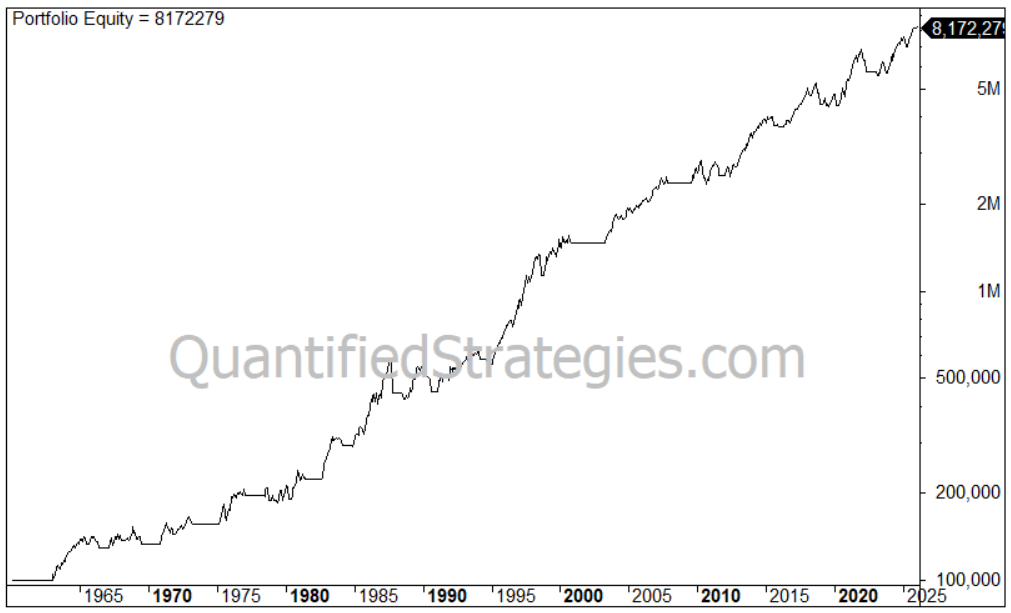
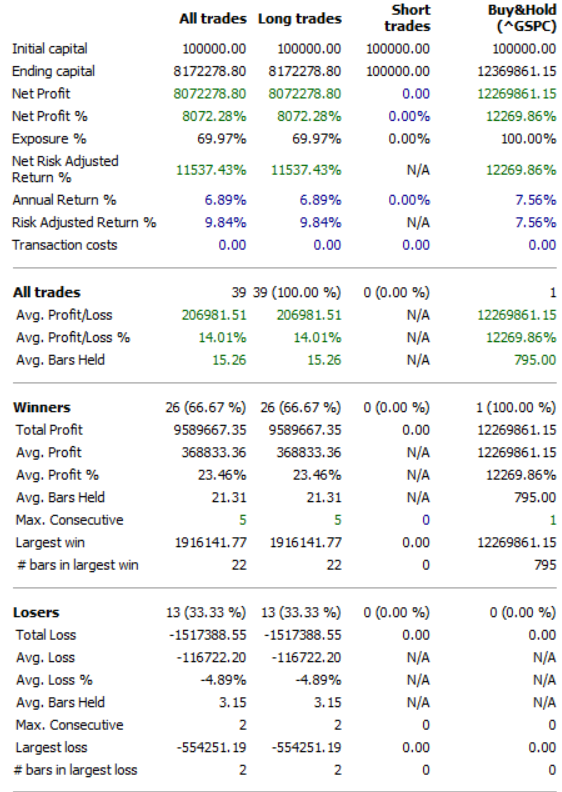
We started with 100 000 in 1960 and ended with 8.2 million today. This equals an annual return of 6.9% vs. buy and hold’s 7.5%, not including dividends. The performance of momentum trading strategies is primarily driven by changes in asset prices, which are influenced by factors such as market sentiment, news, and regulatory changes.
The trading results and statistics are slightly worse than buy and hold, but we must consider that the strategy is only invested 70% of the time and has substantially smaller drawdowns (26% vs. 55%). Trading volume is also an important consideration, as higher trading volume ensures sufficient liquidity and allows for more effective execution of trades in momentum trading.
If we factor in the less time spent in the market, we argue the risk-adjusted return is 9.8% – substantially higher than buy and hold:
One of the reasons for the small drawdowns is the return distributions:
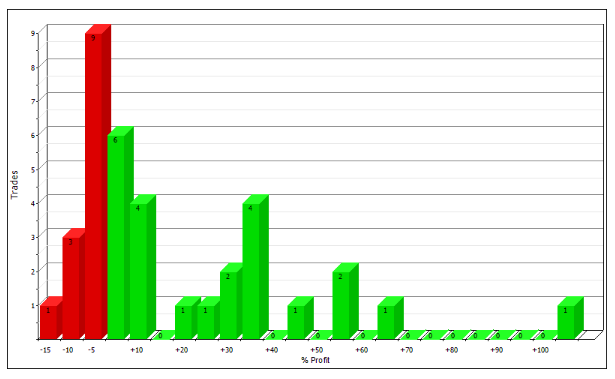
As you can see, there are a few losing trades, but that is more than offset by more big winners than losers. The average loss is less than 5%, while the average winner is almost 25%! However, it’s important to note that high transaction costs and high turnover in momentum trading can erode profits due to frequent buying and selling.
This is the complete trade list since 1960 (36 trades):
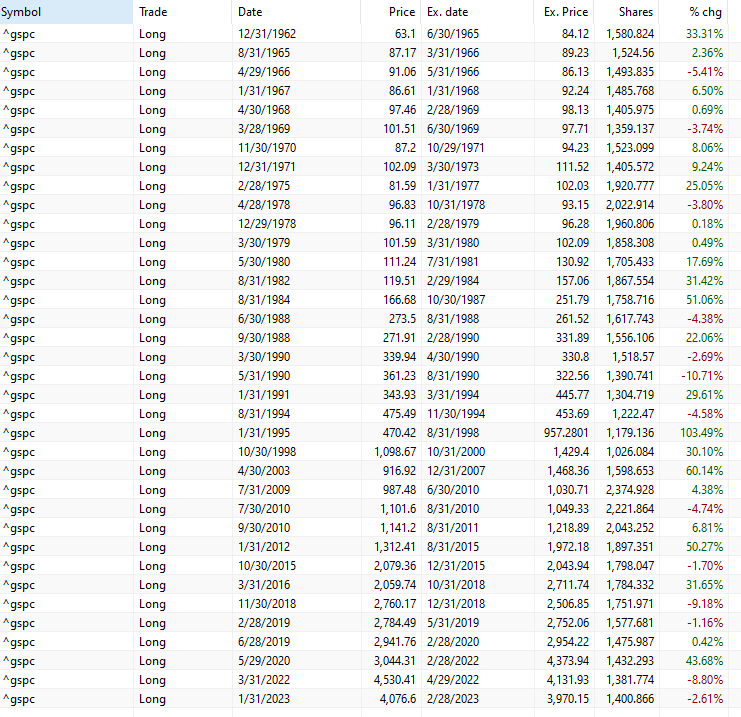
Does it matter which kind of moving average you use? We tried two different ones (simple and exponential), and the simple one performed best.
S&P Momentum Index and momentum indicators
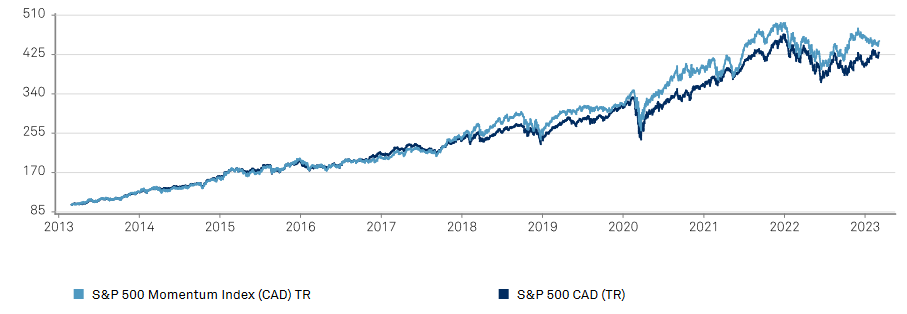
S&P has made a momentum index:
The S&P 500 Momentum Index measures the performance of stocks that exhibit relative market strength (ticker code: SP500MUP). It’s an international index that covers all markets. The index reflects the collective actions of market participants, including both institutional and retail investors, whose trading decisions drive price trends and momentum.
Since inception, the performance has been like this:
Platforms like Blueshift offer an excellent opportunity for retail investors to create, backtest, and execute their own momentum trading strategies live.
List of trading strategies
We have written over 1200 articles on this blog since we started in 2012. Many articles contain specific trading rules that can be backtested for profitability and performance metrics.
The compilation includes day trading strategies designed to capitalize on short term price movements, allowing traders to take advantage of rapid changes in asset prices caused by news, market sentiment, or regulatory factors.
The trading rules are compiled into a package you can purchase (recommended) or just a few of your choice. We have hundreds of trading ideas in the compilation.
The strategies are taken from our landing page of profitable trading systems.
The strategies also come with logic in plain English (plain English is for Python trading and backtesting). Technical analysis is an important part of a short-term trader’s arsenal, as it helps predict future price movements by analyzing charts.
To buy it, you must become a member.
These strategies must not be misunderstood for the premium strategies that we charge a fee for:
FAQ:
How does Momentum Investing work?
Momentum trading involves buying stocks with the best historical performance over a specific period and periodically rebalancing the portfolio based on the highest momentum stocks.
It aims to capitalize on the correlation between past and future stock performance. Momentum investors buy stocks that have performed well in the last 3-12 months and regularly adjust their portfolios by selling underperforming stocks and buying those with better current performance.
Why does Momentum Investing work?
Momentum investing leverages the momentum hypothesis, suggesting a strong correlation between historical returns and future returns. Stocks that have performed well in the medium term are likely to continue performing well in the near future.
What is the rationale behind a Momentum Strategy for the S&P 500?
The Momentum Strategy for the S&P 500 aims to exploit the long-term uptrend in the stock market by buying strong stocks and avoiding weak ones, thus reducing losses and improving overall returns. Momentum investing helps navigate the market efficiently by avoiding underperforming investments. By focusing on strong stocks, it provides a defensive approach to investing.