

Larry Connors’ Multiple Days Up And Multiple Days Down Trading Strategies

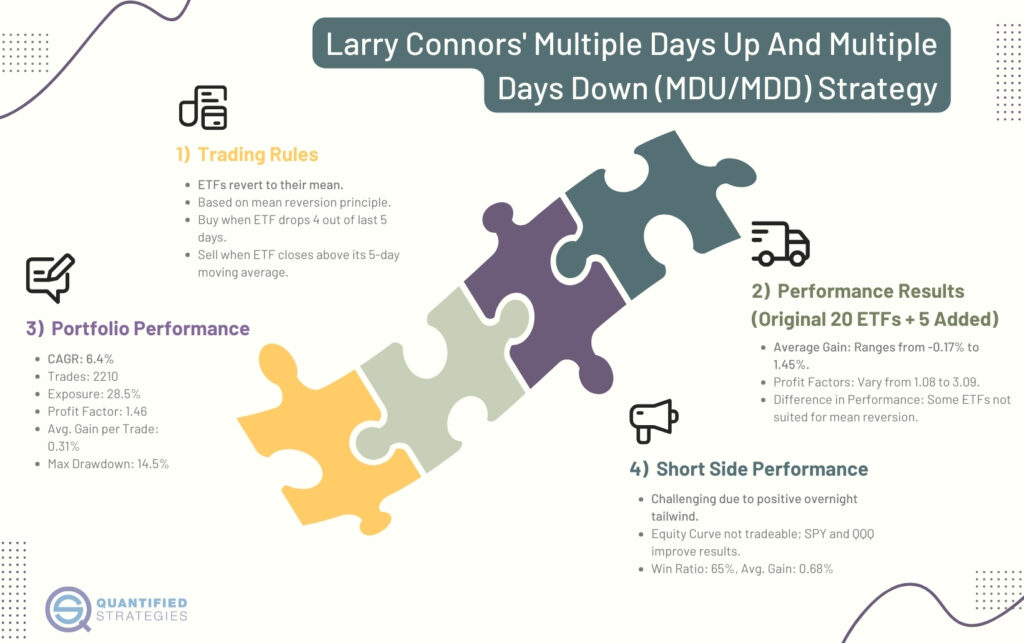
In Chapter 6 of Larry Connors’ High Probability Trading, there is a trading strategy called Multiple Days Up (MDU) and Multiple Days Down (MDD). The books by Larry Connors, including High Probability Trading, are considered key resources for traders interested in quantitative and algorithmic trading. The Multiple Days Up and Multiple Days Down strategy is one of the strategies by Larry Connors, and is based on mean reversion principles. Backtesting involves testing a trading strategy on historical data to evaluate its performance; Connors’ original tests were performed on the S&P 500 index and other ETFs.
The book was published in 2009, the trading tests were done until 31st of December 2008, and it’s time to test and check how the strategy has performed since then.
You can find the four previous strategies from Larry Connors, plus many more, on this page:
Here you can find all our Larry Connors Trading Strategies.
The trading rules of the strategy:
The main idea behind this strategy is that ETFs tend to revert to their mean. This method is one of the market strategies designed for short-term trading in liquid markets like SPY and QQQ. Because ETFs are composed of many stocks or assets, they are unlikely to reach zero value, so they generally work better for mean-reversion strategies than individual stocks, which can reach zero. Strategies that focus on mean reversion typically use price indicators and RSI to identify entry points.
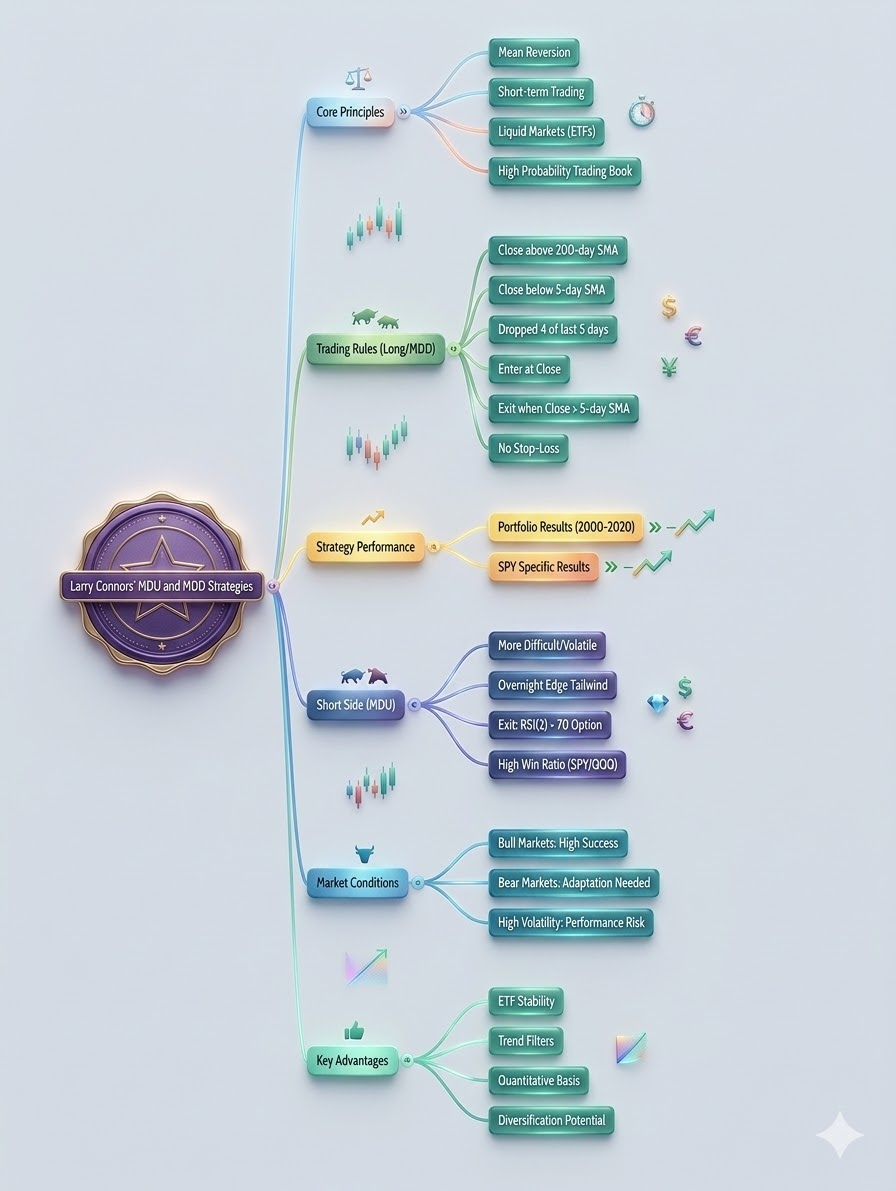
In this strategy, we look to buy when an ETF has fallen in 4 of the last 5 trading days. The trading rules are as follows:
The closing price must be below the 5-day simple moving average before entering a buy trade.
The closing price must be above the 200-day moving average.
No stop-loss order is used in this strategy, which is the same for the MDU (Multiple Days Up) and MDD (Multiple Days Down) strategies.
The trades are usually short-term, often closing within a few days to take advantage of the immediate reversion to the mean.
Trading Rules Summarized
- The close is above the 200-day moving average.
- The close must be below the 5-day moving average.
- The ETF must have dropped at least 4 days out of the last 5 trading days.
- If 1-3 above is true, then enter at the close.
- Sell on the close when the ETF closes above its 5-day moving average.
- No stop-loss.
If you’d like to know the code of Connors’ strategy, plus the code for all the other free strategies on this website, click here:

For more on why we use Amibroker, you might want to read this article: Thoughts on Amibroker
The results of the Multiple Days Up strategy:
Below are the results for the original 20 ETFs Connors used, and an additional five ETFs we added (results are from the inception of the ETF until December 2020):
| Result by Connors | Average gain since | Profit | ||||
| Average gain in % | inception to Nov.2020 | factor | Difference: | |||
| DIA | 0.17 | 0.19 | 1.36 | 0.02 | ||
| EEM | 0.85 | 0.43 | 1.66 | -0.42 | ||
| EFA | 0.73 | 0.52 | 2.24 | -0.21 | ||
| EWH | 0.62 | 0.17 | 1.1 | -0.45 | ||
| EWJ | 0.56 | 0.21 | 1.2 | -0.35 | ||
| EWT | 0.02 | 0.09 | 1.1 | 0.07 | ||
| EWZ | 1.45 | 1.13 | 3.09 | -0.32 | ||
| FXI | 0.88 | 0.22 | 1.19 | -0.66 | ||
| GLD | 0 | 0.35 | 1.67 | 0.35 | ||
| ILF | 1.04 | 0.98 | 2.71 | -0.06 | ||
| IWM | 0.44 | 0.36 | 1.64 | -0.08 | ||
| IYR | -0.17 | 0.03 | 1.08 | 0.2 | ||
| QQQ | 0.76 | 0.54 | 2.01 | -0.22 | ||
| SPY | 0.5 | 0.4 | 1.98 | -0.1 | ||
| XHB | 0.48 | 0.75 | 2.55 | 0.27 | ||
| XLB | 0.33 | 0.29 | 1.42 | -0.04 | ||
| XLE | 0.92 | 0.39 | 1.47 | -0.53 | ||
| XLF | 0.11 | 0.47 | 2.04 | 0.36 | ||
| XLI | 0.3 | 0.31 | 1.71 | 0.01 | ||
| XLV | 0.31 | 0.41 | 2.07 | 0.1 | ||
| ETFs not | ||||||
| included: | ||||||
| GDX | 0.38 | 1.31 | ||||
| GDXJ | 1.22 | 1.93 | ||||
| TLT | 0.22 | 1.47 | ||||
| XLP | 0.24 | 1.57 | ||||
| XME | 0.69 | 1.6 |
The last five ETFs were not part of Connors’ original test.
How does the strategy perform as a portfolio?
Most traders don’t trade just one instrument, so let’s test how the strategy performs as a portfolio.
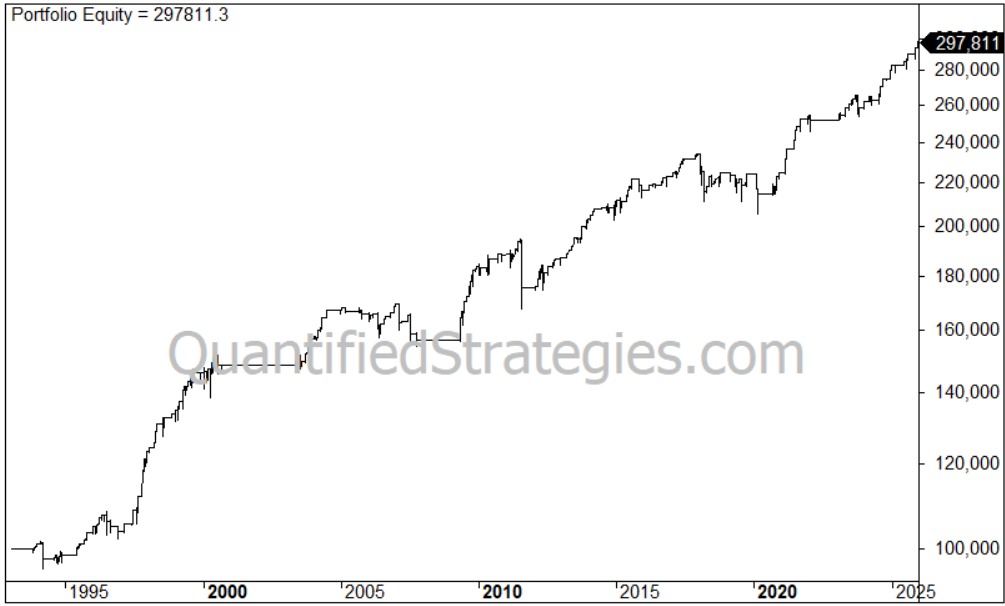
The simulation is run with a maximum of five open positions at any time, each representing 20% of the equity. This also means the capital is frequently in cash. The portfolio is simulated from 2000 through December 2020, with capital compounded (no commissions or slippage).
The equity curve looks like this:

The results can be summarized like this:
- CAGR: 6.4%
- The number of trades: 2210
- Exposure: 28.5%
- The profit factor: 1.46
- Average gain per trade: 0.31%
- Maximum drawdown: 14.5%
Compared to the other four mean reversion strategies from Connors, this one has the lowest profit factor. Several of the ETFs are most likely not suited for mean reversion, so the results can be improved.
The results in SPY:
If we change the strategy to only trade SPY, we get this compounded equity curve:
There are 264 trades, the profit factor is 2.2, the max drawdown is 13%, and the CAGR is only 3.4%. The low CAGR can partly be explained by the low time spent in the market: 9%.
How does the strategy perform on the short side
Short is always much more difficult than the long side. The reason is that stock indices have a positive tailwind overnight:
Una exit strategy efectiva es crucial para la gestión de riesgo en este tipo de operaciones. En algunas variantes, la salida se produce cuando el RSI de 2 períodos cruza por encima de 70, lo que ayuda a determinar el momento óptimo para cerrar la posición y proteger las ganancias o limitar las pérdidas.
As a portfolio of a maximum of five positions the equity curve looks like this (only shorts):
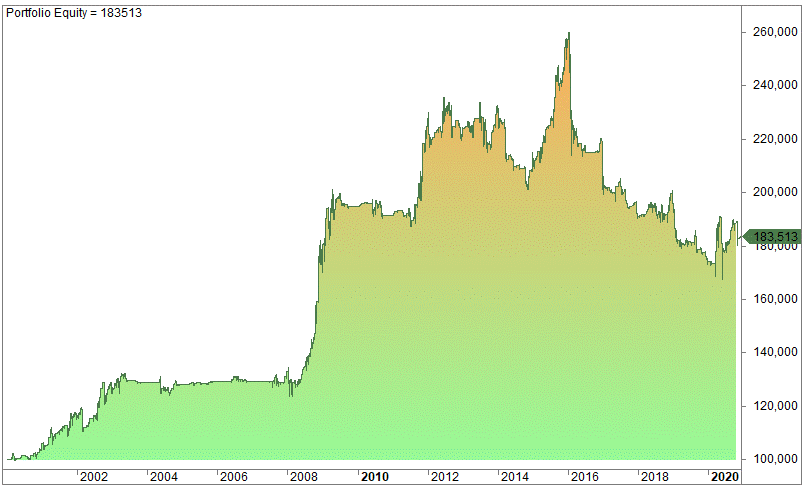
This is not tradeable, of course. If we change to only trade SPY and QQQ (having max two positions), we get this equity curve:
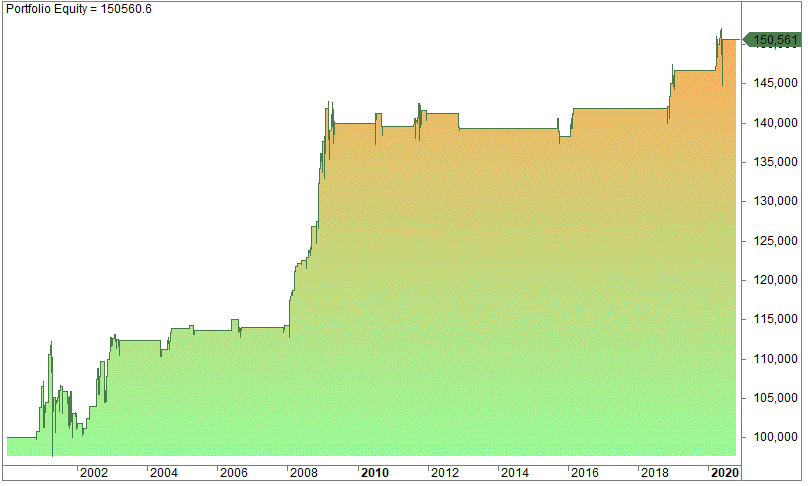
Much of the gain happened in 2008, but still the results are surprisingly good: the win ratio is 65% and the average gain is 0.68%.
Here you can find all our Larry Connors Trading Strategies.
Strategy Performance Under Different Market Conditions
Analyzing trading strategies, such as the one proposed by Larry Connors in his book on high probability trading, requires evaluating how the strategy performs in different market scenarios. The Multiple Days Up (MDU) and Multiple Days Down (MDD) strategies are based on mean reversion, using indicators like the 200-day moving average and the 5-day moving average to define entry and exit signals. This approach is especially relevant in ETF trading, since these instruments, being composed of multiple assets, tend to exhibit more stable reversion patterns than individual stocks.
In bull markets, the MDU and MDD strategies typically generate buying opportunities when an ETF has experienced consecutive declines, provided the closing price remains above the 200-day moving average. This condition acts as a filter to avoid trading in prolonged downtrends, increasing the strategy’s probability of success. Entry is made at the close, and exit occurs when the price exceeds the 5-day moving average, allowing short-term movements in favor of the reversal to be captured.
On the other hand, in bear markets, the strategy can be adapted to seek opportunities on the short side by selling ETFs that have risen for several consecutive days. However, as observed in the results and the equity curve, short selling is often more challenging due to the long-term upward trend of indices and ETFs, which can increase the drawdown and reduce the profit factor.
A key aspect of this strategy is the absence of a stop-loss order, which means that risk control depends heavily on the robustness of the signals and the diversification of the portfolio. While this can allow traders to capture complete reversal moves, it also exposes them to significant losses if the market moves against their position. Therefore, it is essential to monitor the equity curve and adjust exposure according to market conditions and the performance of each ETF.
Backtesting and research show that the MDU and MDD strategies can deliver consistent results in markets with a defined trend and moderate volatility, but their performance can be affected in high-volatility environments or during sharp trend reversals. For this reason, many traders choose to combine this strategy with other risk management rules or additional filters, such as the RSI or macroeconomic context assessment.
In conclusion, Larry Connors’ Multiple Days Up and Multiple Days Down strategies are among the best examples of a high-probability ETF trading approach based on mean reversion and the use of moving averages. However, like any quantitative strategy, it requires constant analysis and adjustments based on the market, the asset, and the trader’s risk profile.
The key is understanding the strategy’s limitations and strengths, using tools such as the equity curve, drawdown analysis, and diversification to maximize returns and minimize risks when trading ETFs and other financial instruments.
Multiple days up (MDU) and multiple days down (MDD) – conclusion:
Common for all strategies is that you can’t expect them to perform well on all asset classes. Each ETF has its own distinct features, and you must tweak (without data mining) to find what works on each. Hence, the Multiple Up Days and Multiple Down Days strategy can most likely be improved.
Moreover, optimization is likely to gain some more insights into the strategy.
FAQ:
What is Larry Connors’ Multiple Days Up (MDU) and Multiple Days Down (MDD) trading strategy?
Larry Connors’ MDU and MDD strategy is outlined in Chapter 6 of his book “High Probability Trading.” It focuses on mean reversion, buying when an ETF has dropped 4 out of the last 5 trading days and certain conditions are met, and selling when the ETF closes above its 5-day moving average.
How do the trading rules of the MDU and MDD strategy work?
The strategy involves buying when an ETF meets specific criteria, including being above the 200-day moving average, below the 5-day moving average, and having dropped at least 4 days out of the last 5 trading days. The sell signal occurs when the ETF closes above its 5-day moving average, and there’s no stop-loss.
What were the results of the MDU strategy on various ETFs?
Results for the MDU strategy on 20 ETFs, along with additional ones, were provided. The results included average gains, profit factors, and differences in performance. Some ETFs may not be suited for mean reversion, suggesting potential for improvement.