
The High Cost of Greed: 5 Famous Investors Who Ended Up in Prison

The world of high finance is often romanticized as a fast-paced arena of brilliant minds and overnight fortunes. However, the line between aggressive trading and criminal misconduct is thinner than many realize. While the markets offer immense opportunities for wealth, they also serve as a stage for some of the most sophisticated crimes in history.
Key Takeaways
- Greed often pushes investors into illegal activities
- Financial crimes eventually collapse, regardless of scale
- Insider trading leads to serious legal consequences
- Ponzi schemes rely on deception, not real profits
- Lack of oversight enables massive financial disasters
- Market success never justifies breaking the law
- Ethical trading is essential for long-term survival
From billion-dollar Ponzi schemes to the collapse of centuries-old institutions, the stories of these five individuals serve as a sobering reminder that in the financial world, shortcuts often lead to a dead end.
Bernie Madoff: The Architect of the World’s Largest Ponzi Scheme
Bernie Madoff was once a pillar of the financial community, even serving as the chairman of the NASDAQ. However, behind the facade of his successful investment firm lay a massive Ponzi scheme—a fraudulent investing scam that generates returns for earlier investors with money taken from later investors.
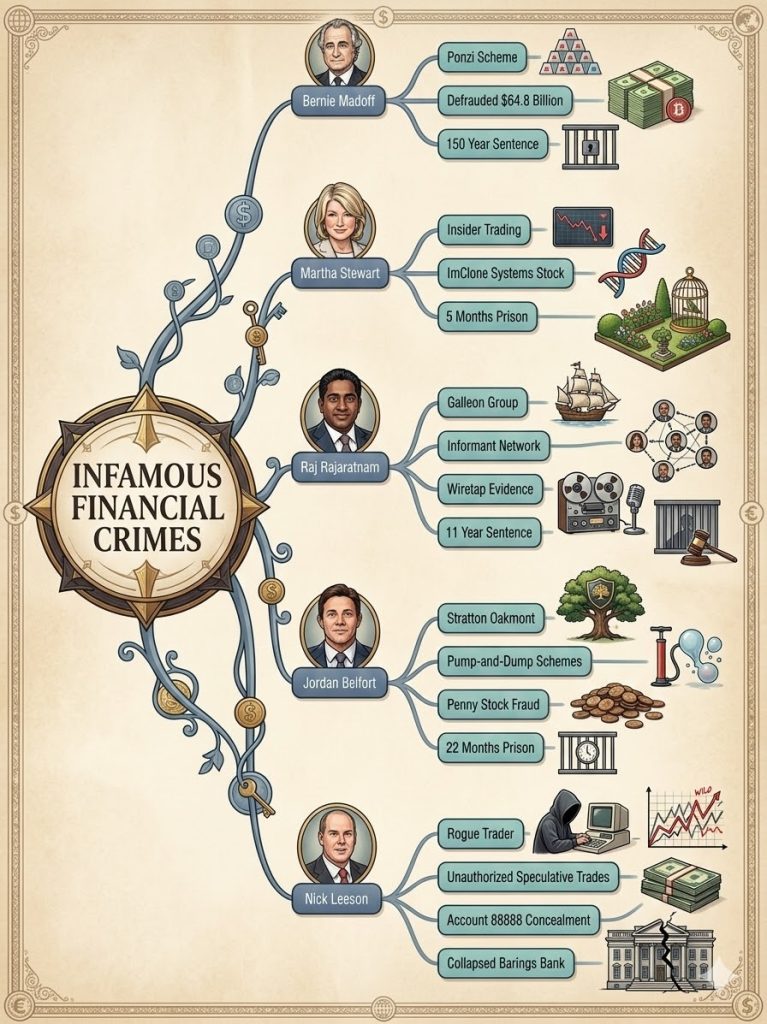
- The Crime: Madoff defrauded thousands of investors out of an estimated $64.8 billion.
- The Fallout: His scheme collapsed during the 2008 financial crisis when he could no longer meet redemption requests.
- The Sentence: In 2009, he was sentenced to 150 years in prison, the maximum allowed by law.
Martha Stewart: The Cost of Insider Trading
Unlike the other names on this list, Martha Stewart was a household brand name long before her legal troubles began. Her case remains one of the most famous examples of insider trading, which involves trading a public company’s stock based on material, non-public information.
- The Crime: In 2001, Stewart sold nearly 4,000 shares of ImClone Systems just one day before the FDA rejected the company’s new drug, an event that caused the stock price to plummet. She had received a tip from her broker about the impending news.
- The Sentence: Stewart served five months in a federal correctional facility, followed by five months of home confinement and two years of probation.
Raj Rajaratnam: A Massive Network of Informants
Raj Rajaratnam was the billionaire founder of the Galleon Group, one of the largest hedge funds in the world. His downfall was the result of a massive federal crackdown on insider trading that utilized wiretaps—a tool usually reserved for organized crime and drug trafficking.
- The Crime: Rajaratnam cultivated a vast network of corporate insiders at companies like McKinsey, Intel, and Goldman Sachs to provide him with secret earnings data and merger information.
- The Sentence: He was convicted on 14 counts of conspiracy and securities fraud and sentenced to 11 years in prison.
Jordan Belfort: The Real-Life “Wolf of Wall Street”
Long before the Hollywood biopic, Jordan Belfort ran Stratton Oakmont, a “boiler room” brokerage that specialized in pump-and-dump schemes.
- The Crime: Belfort and his associates would “pump” up the price of cheap “penny stocks” by spreading false or misleading information to unsuspecting investors. Once the price peaked, they would “dump” their own shares, causing the price to crash and leaving investors with worthless paper.
- The Sentence: Belfort served 22 months in prison after testifying against numerous partners and associates in his fraud scheme.
Nick Leeson: The Man Who Broke Barings Bank
Nick Leeson didn’t set out to run a fraud scheme; he was a “rogue trader” whose unchecked gambles led to a historic catastrophe. Barings Bank was one of the oldest and most prestigious banks in the UK, having counted Queen Elizabeth II as a client.
- The Crime: Working in Singapore, Leeson began making unauthorized speculative trades. To hide his mounting losses, he used a secret error account (account 88888). Eventually, his losses exceeded $1.3 billion, more than the bank’s entire available capital.
- The Sentence: Leeson fled but was eventually caught and sentenced to six and a half years in a Singaporean prison. His actions caused the immediate collapse and bankruptcy of Barings Bank.
The Final Lesson
These cases demonstrate that whether through calculated fraud like Madoff or reckless concealment like Leeson, the “house” eventually wins. Ethical trading and transparency aren’t just moral choices—they are the only sustainable ways to survive in the global markets.
