
Execution Timing Is Alpha: Why Short-Horizon Strategies Live or Die by the Clock

In systematic trading, the assumption that a signal computed at the market close should be executed at the next day’s open is widespread. For many strategies with holding periods measured in weeks or months, this workflow is acceptable. However, for short-term trading systems where average holding periods are less than three days, delaying execution by ~17 hours can materially erode alpha.
This article explains why execution timing is a first-order factor in short-term trading performance. We cover the sources of performance decay, the alternatives to “signal at close → execute next open,” and how to backtest each approach rigorously. We also review relevant research on intraday vs. overnight dynamics and market microstructure, including auction mechanics and spread behavior, to frame best practices for live implementation.
What Is Short-Term Alpha and Why It Decays
Alpha represents the excess return a strategy generates beyond a benchmark or expected return. Short-term alpha typically arises from microstructure inefficiencies or rapid mean-reversion effects that decay within hours. In contrast, long-term signals (e.g., value or trend) persist over days or weeks.
When execution delays occur, especially across multi-hour or overnight windows, several adverse effects accumulate:
- Informational decay: The predictive value of a signal computed at the close diminishes as market conditions evolve.
- Overnight risk and noise: Holding overnight introduces exposure to news, earnings, macro surprises, and other unknown catalysts that are not part of the original signal design.
- Auction and opening volatility: Auction imbalances and wide bid-ask spreads at the open can erode expected returns and introduce implementation slippage.
For example, mean-reversion strategies frequently rely on short memory in returns. Evidence shows that intraday mean-reversion can be materially stronger than overnight reversal effects, meaning execution delays that span from close to open can shift the strategy into a very different regime. Academic work highlights the opposing characteristics of overnight vs. intraday returns, often referred to as a tug-of-war between overnight and intraday effects.
Short-Term Alpha Decay Explained
Why delays matter
The primary reason short-term alpha degrades with execution delay is that the strategy is no longer capturing the same informational set. Let’s illustrate:
- Signal computed at 16:00 reflects information up to the close.
- Execution at 09:30 next day incorporates ~17 hours of additional price action the strategy was not designed to capture, including overnight news and market rebalancing.
- The resulting trade is no longer a direct reflection of the signal’s informational advantage.
For strategies whose expected return per trade is measured in tens of basis points (e.g., 20–30 bps), this noise can completely overwhelm the intended edge.
Traditional Workflow: Signal at Close, Execute Next Open
This is the classic workflow many systematic traders adopt.
Workflow Steps
- Compute signal using the closing price of day t.
- Submit orders overnight or just before the open.
- Trade at the open price on day t+1 (often via Market-on-Open — MOO).
Advantages
- Backtest alignment: The live process aligns with the out-of-sample historical simulation.
- Operational simplicity: No intraday data required; standardized process.
Disadvantages
- Alpha decay: Execution delay across the overnight window erases part of the signal’s predictive value.
- Overnight gap risk: News and macro events can introduce volatility that the strategy cannot profit from but must endure.
- Mixed return regimes: Opening prices reflect auction imbalances and order flow unrelated to the signal.
While this approach remains defensible for signals with multi-day persistence or where operational simplicity is prioritized, it is often suboptimal for high-frequency or short-horizon strategies.
How has this strategy performed? Below is the equity curve of the S&P 500 when we buy at the close and sell the next open:
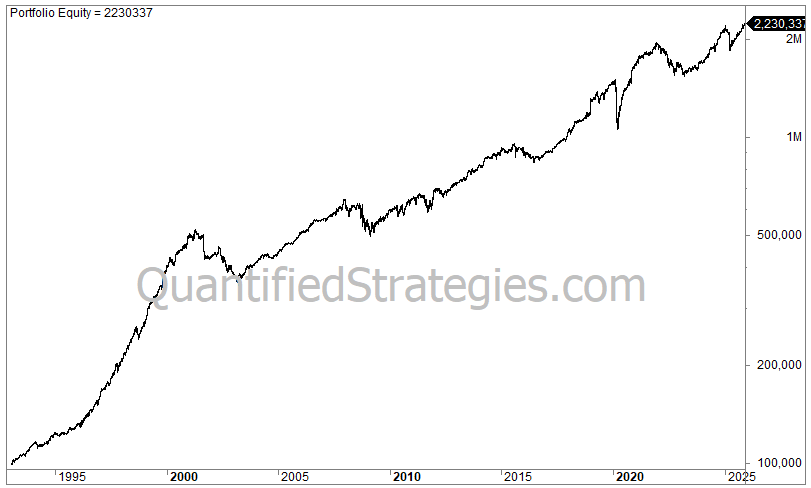
Average gain is 0.04% per day/trade.
Stocks are not the only asset that performs well during this period. Gold (GLD) performs much the same:
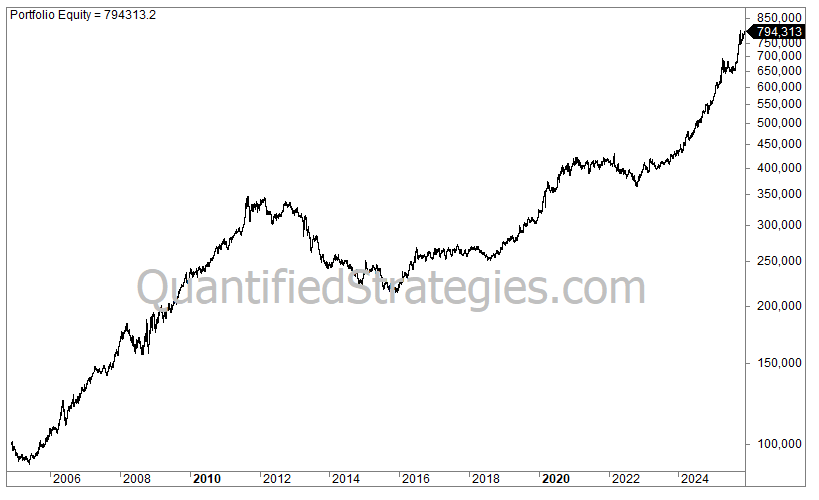
Average gain is also 0.04% – just like stocks.
Alternate Execution Schemes for Short-Term Trading
To reduce alpha decay and preserve signal value, systematic traders can adopt one of several execution schemes:
- Compute and execute at or near the market close
- Compute before close, execute with Market-on-Close (MOC) orders
- Intraday execution with tighter timing
Each alternative requires careful attention to market microstructure and backtesting design.
Computing and Executing at Market Close
What This Means
Rather than calculating a signal at the end of the day and waiting until the next open, compute the signal shortly before the close and execute immediately within that same session.
Why It Helps
- Eliminates the overnight gap delay
- Preserves more signal value by tightening the time between signal computation and execution
Microstructure Risks
However, this method exposes the strategy to microstructural distortions near the close:
- Bid-ask spreads are often wider in the final minutes.
- Market depth can thin, making market orders expensive.
- Closing auctions can behave differently across venues.
Empirical work confirms that bid-ask spreads show a U-shape intraday pattern, with wider spreads near the open and close, especially in less liquid names and during times of stress.
Implementation Guide
To control costs:
- Compute the signal several seconds before the close (e.g., 15:59:50).
- Prefer limit orders with price objectives near expected auction prices.
- Avoid unguarded market orders in the final 10 seconds.
This approach works best for very liquid instruments such as SPY or major futures contracts where depth remains robust near the close.
Market-on-Close (MOC) Execution After Signal at 15:45
A pragmatic compromise for short-term strategies is to compute signals before the close (e.g., 15:45) and execute via Market-on-Close (MOC) orders.
How It Works
- Use timestamped intraday data to compute signals early enough (e.g., 15:45).
- Submit MOC orders ahead of the auction cutoff.
- Fill at the official closing price — often the same price used in many close-to-close backtests.
Benefits
- Minimal delay: Only a 15–20 minute lag between signal and execution.
- Deeper liquidity: Closing auctions generally aggregate substantial volume and offer tighter spreads.
- Backtest alignment: The live fill price (official close) is often directly used in historical simulations.
Drawbacks
- You must obtain and process intraday data — often 1-minute or better — to compute your signals accurately at the decision time.
- The strategy defined by a 15:45 decision may differ from one defined at 16:00: some opportunities appear only at the actual close.
Research Context
Exchange operators publish guides to closing auction operations because they are a major source of liquidity and price formation. For example:
- NYSE Closing Auction Fact Sheet explains how closing crosses work, when imbalances are disclosed, and how orders are processed.
- Nasdaq Opening and Closing Crosses FAQ details the timetable and available order types for participating in closing crosses.
Using auction mechanisms effectively can significantly reduce implementation slippage relative to raw market orders near the close.
Comparing Execution Timing: Case Study Evidence
To quantify how execution timing affects a short-term trading strategy, consider the following empirical comparison on the SPY ETF:
Execution Schemes Tested
- Theoretical close-to-close: Signal at 16:00, executed at the same close price (idealized no-slippage benchmark).
- 15:45 → Market-on-Close (MOC): Computed at 15:45; orders filled at official close price.
- Classic close → next open: Delay of ~17 hours; execution at next day’s open.
Observed Results
| Scheme | Cumulative Return | Avg Return/Trade | Hit Ratio | Notes |
|---|---|---|---|---|
| Theoretical Close-to-Close | ~520% | 31 bps | 74% | Upper performance bound |
| 15:45 → MOC | ~346% | 27 bps | 71% | Most realistic short-delay |
| Close → Next Open | ~254% | 22 bps | 63% | Evident alpha decay |
The pattern is clear:
- Reducing signal–execution delay dramatically preserves alpha.
- Delays spanning overnight produce the largest deterioration in return and hit rate.
- The theoretical bound excludes microstructure costs and should not be interpreted as achievable in practice, but it is a useful benchmark.
These findings confirm that small timing differences (minutes vs. overnight) can have first-order effects on strategy performance when signals have short half-lives.
Why Overnight Returns Matter
Overnight returns behave differently from intraday returns, both statistically and economically.
Overnight vs Intraday Return Dynamics
Academic research demonstrates:
- Overnight returns capture news and macroeconomic events that occur outside trading hours.
- Intraday returns reflect microstructure, liquidity provisioning, and mean-reversion patterns tied to order flow.
The classic “tug-of-war” research shows that these return components can behave in opposition and carry different predictive structures.
This difference is crucial. A strategy designed to exploit intraday mean reversion is not designed for overnight news risk. Forcing a strategy to wait until the next open effectively transforms it into something else.
How to Backtest Execution Schemes Without Look-Ahead Bias
Good execution modeling means enforcing information availability at every decision point.
Principles of Bias-Free Backtesting
- Signal timing must reflect real data availability: If you compute at 15:45, only use data available up to that timestamp.
- Auction rules must be simulated accurately: MOC fills should use historical closing prices or accurate proxies for official close prints.
- Avoid peeking ahead: Don’t use future bars or close prices to derive features that wouldn’t have been known at the decision time.
This is where the “lag by one bar” heuristic comes from: it ensures that your signal does not inadvertently incorporate future information. However, modern technology allows more precise timestamps and removes the need for rigid constraints, as long as you properly manage information sets.
To backtest the 15:45 → MOC approach:
- Use intraday data (e.g., 1-min or tick).
- Compute signals using data up to 15:45.
- Assign fills at the official closing price.
- Apply realistic transaction cost assumptions.
For “close → next open”:
- Use daily bars.
- Compute signal at day t close.
- Assign fills at day t+1 open.
- Model realistic opening auction costs or slippage if necessary.
Additional Alternatives and Best Practices
Limit Orders in Closing Auctions
Instead of MOC, use Limit-on-Close (LOC) orders to control execution prices.
- Pros: Limits slippage; retains participation in the auction.
- Cons: Risk of non-fill; must model non-filled orders robustly in backtests.
Intraday Execution Windows
For very fast signals, consider using short intraday windows (e.g., 15:50–16:00) with participation logic rather than raw market orders.
Instrument Choice
Some instruments (high-liquidity ETFs or futures) support tighter execution spreads and deeper end-of-day liquidity than small caps.
Conclusion: Execution Timing Is Not an Implementation Detail
For short-term trading systems, execution timing is one of the most important determinants of live performance. When signals decay rapidly, forcing executions into an overnight delay can transform a profitable strategy into a mediocre one.
Key takeaways:
- Delaying execution from the close to the next open can materially erode short-term alpha.
- Alternatives include executing near the close or using Market-on-Close orders with intraday signals.
- Backtests must reflect real decision timing and auction mechanics to avoid bias.
- Microstructure effects — spreads, auction depth, and overnight risk — are fundamental to execution performance.
By understanding market microstructure and designing execution schemes that minimize unnecessary delays, systematic traders can preserve more of the signal’s value and improve real-world performance.
FAQ
Is Your Backtest Alignment Sacrificing Real-World Alpha?
While aligning execution with the next-day open keeps live trading perfectly synchronized with a historical backtest, it often ignores the rapid decay of short-term signals. For strategies with a short half-life, this “clean” alignment can be a trap that preserves the methodology while sacrificing the actual profit potential.
Is Computing Trading Signals Milliseconds Before the Close Viable?
Modern technology allows complex signals to be computed in milliseconds, making the traditional requirement to wait for the next bar largely obsolete. However, while technically viable, the article warns that the primary constraint is microstructural, as bid-ask spreads often widen and liquidity collapses in the final seconds of the trading day.
MOC Orders vs. Market Orders: Which Best Preserves Signal Integrity?
Market-on-Close (MOC) orders are generally superior because they tap into deep closing auction liquidity, avoiding the slippage common with last-second market orders. By computing signals 15 minutes before the bell and using MOC orders, traders can capture the majority of the alpha while maintaining a realistic, implementable workflow.
Why Do Hit Ratios Plummet When Executing at the Next Day’s Open?
Hit ratios drop because a significant portion of a signal’s predictive power is eroded by overnight price moves. In the SPY case study, the hit ratio fell from 74% to 63% when execution was delayed 17 hours, proving that the market often “absorbs” the mean-reversion opportunity before the next morning’s open.
When Does Execution Delay Transition from a Minor Detail to a First-Order Risk?
Execution timing becomes a first-order risk for any strategy where the average holding period is less than three days. At this frequency, the speed of alpha decay is so high that even small delays are no longer secondary implementation details but the dominant factor in whether a strategy survives live trading.
Does Execution Delay Impact Scalability Differently Across Individual Nasdaq 100 Stocks?
While the SPY case study provides a benchmark, individual stocks in the Nasdaq 100 introduce variables like liquidity heterogeneity and stock-specific microstructure effects. Future research is required to see if execution delays are more punishing for less liquid names or if cross-sectional dispersion offers more “cushion” for slower execution.
