
The Most Traded Currencies In The World (Video, Data, Statistics)

The most traded currencies in the world might be a bit more surprising than you imagined.
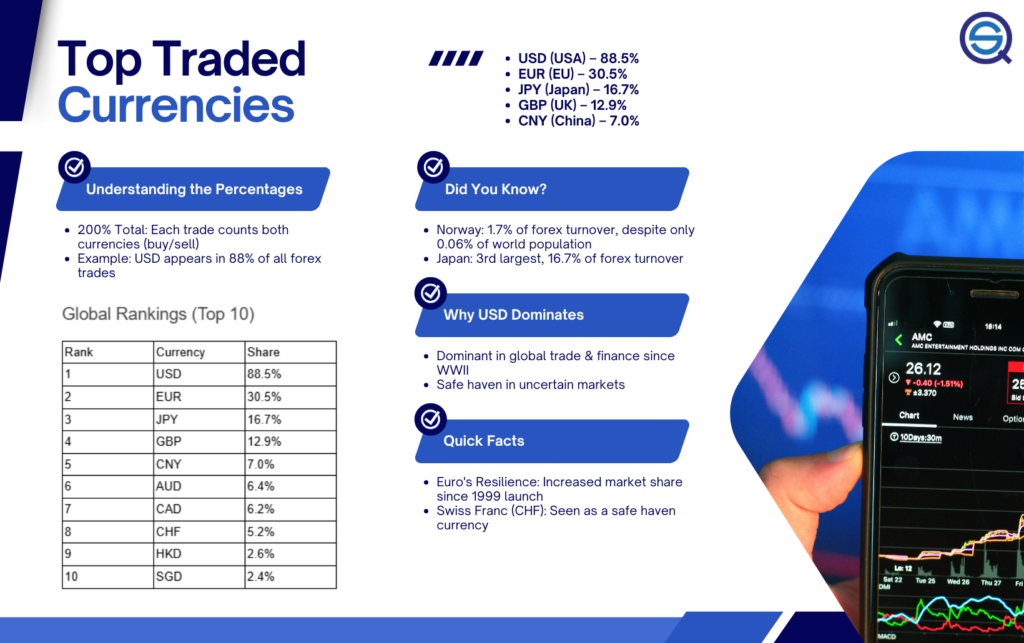
For example, did you know that tiny Norway has 1.7% of the forex turnover, despite having only 0.06% of the world’s population?
This is the result of having an open economy, decent policies, and huge resources of the most demanded commodities of the world: oil and gas.
Key Takeaways
- Global FX turnover is dominated by a few key currencies, based on data from the Bank for International Settlements (BIS)
- Currency shares sum to 200% because every trade includes two currencies (one bought, one sold)
- USD (88.5%) is the most traded currency by far, reflecting US economic dominance, deep capital markets, and safe-haven status
- EUR (30.5%) is second, benefiting from the size of the eurozone and long-term confidence (Lindy effect)
- JPY (16.7%) ranks third, driven by Japan’s role in global finance and carry trades
- GBP (12.9%) remains highly traded due to London’s role as a global FX hub
- Smaller countries can have outsized FX presence (e.g., NOK 1.7%) due to open economies and commodity exports
- Commodity-linked currencies (AUD, CAD, NOK, NZD) punch above population size
- Safe-haven currencies include USD and CHF, attracting flows during market stress
- FX activity reflects trade, capital flows, financial stability, and geopolitical trust, not population size
Related reading: Hundreds of free backtested strategies.
Likewise, Japan has 16.7% of the forex turnover and comes in third.
In this article, we look at the most recent data from BIS, the Bank For International Settlements, and we compiled the following table showing the most traded currencies in the world:
The most traded currencies in the world – table
This is the whole list from BIS:
| Rank | Currency | Country | Share |
| 1 | USD | USA | 88.50% |
| 2 | EUR | EU | 30.50% |
| 3 | JPY | Japan | 16.70% |
| 4 | GBP | Great Britain | 12.90% |
| 5 | CNY | China | 7.00% |
| 6 | AUD | Australia | 6.40% |
| 7 | CAD | Canada | 6.20% |
| 8 | CHF | Switzerland | 5.20% |
| 9 | HKD | Hong Kong | 2.60% |
| 10 | SGD | Singapore | 2.40% |
| 11 | SEK | Sweden | 2.20% |
| 12 | KRW | South-Korea | 1.90% |
| 13 | NOK | Norway | 1.70% |
| 14 | NZD | New Zealand | 1.70% |
| 15 | INR | India | 1.60% |
| 16 | MXN | Mexico | 1.50% |
| 17 | TWD | Taiwan | 1.10% |
| 18 | ZAR | South Africa | 1.00% |
| 19 | BRL | Brazil | 0.90% |
| 20 | DKK | Denmark | 0.70% |
| 21 | PLN | Poland | 0.70% |
| 22 | THB | Thailand | 0.40% |
| 23 | ILS | Israel | 0.40% |
| 24 | IDR | Indonesia | 0.40% |
| 25 | CZK | Czech | 0.40% |
| 26 | AED | UAE | 0.40% |
| 27 | TRY | Turkey | 0.40% |
| 28 | HUF | Hungary | 0.30% |
| 29 | CLP | Chile | 0.30% |
| 30 | SAR | Saudi Arabia | 0.20% |
| 31 | PHP | Philippines | 0.20% |
| 32 | MYR | Malaysia | 0.20% |
| 33 | COP | Columbia | 0.20% |
| 34 | RUB | Russia | 0.20% |
| 35 | RON | Romania | 0.10% |
| 36 | PEN | Peru | 0.10% |
| 37 | BHD | Bahrain | 0.00% |
| 38 | BGN | Bulagaria | 0.00% |
| 39 | ARS | Argentina | 0.00% |
| 40 | Others | Others | 2.30% |
Please be aware that the total sum for all currencies is 200% because each currency trade is counted twice: once for the currency being bought and once for the one being sold.
These percentages represent the overall frequency of a currency’s involvement in currency trades, whether it’s being bought or sold. For instance, the US dollar is a participant in 88% of all currency transactions, while the euro is present in 31% of trades.
The data is based on the most comprehensive source of data there is: The BIS Triennial Central Bank Survey. BIS is the Bank for International Settlements and registers all international transactions.
The survey has been done every year since 1986.
Why is the US Dollar the most traded currency in the world?
It’s no surprise that the US dollar is by far the most traded. Pax Americana, the world order after WW2, has left the US in a dominant economic, cultural, and geopolitical position.
The US is the leading innovative power in the world, and almost 70% of stock market capitalization is US stocks.
When financial markets turn sour, investors head for the safe heaven of US dollars. Where else can you go? Would you trust to invest in China, a totalitarian communist state? Obviously, most don’t.
The euro has gradually increased market share, despite it was believed doomed from the start in 1999. However, the EUR is still there, and the longer it lasts, the longer we believe it will stay (the Lindy effect).
The Swiss Franc is also regarded as a safe haven, just like the USD.
