
Best Day to Buy Bitcoin: A Backtest

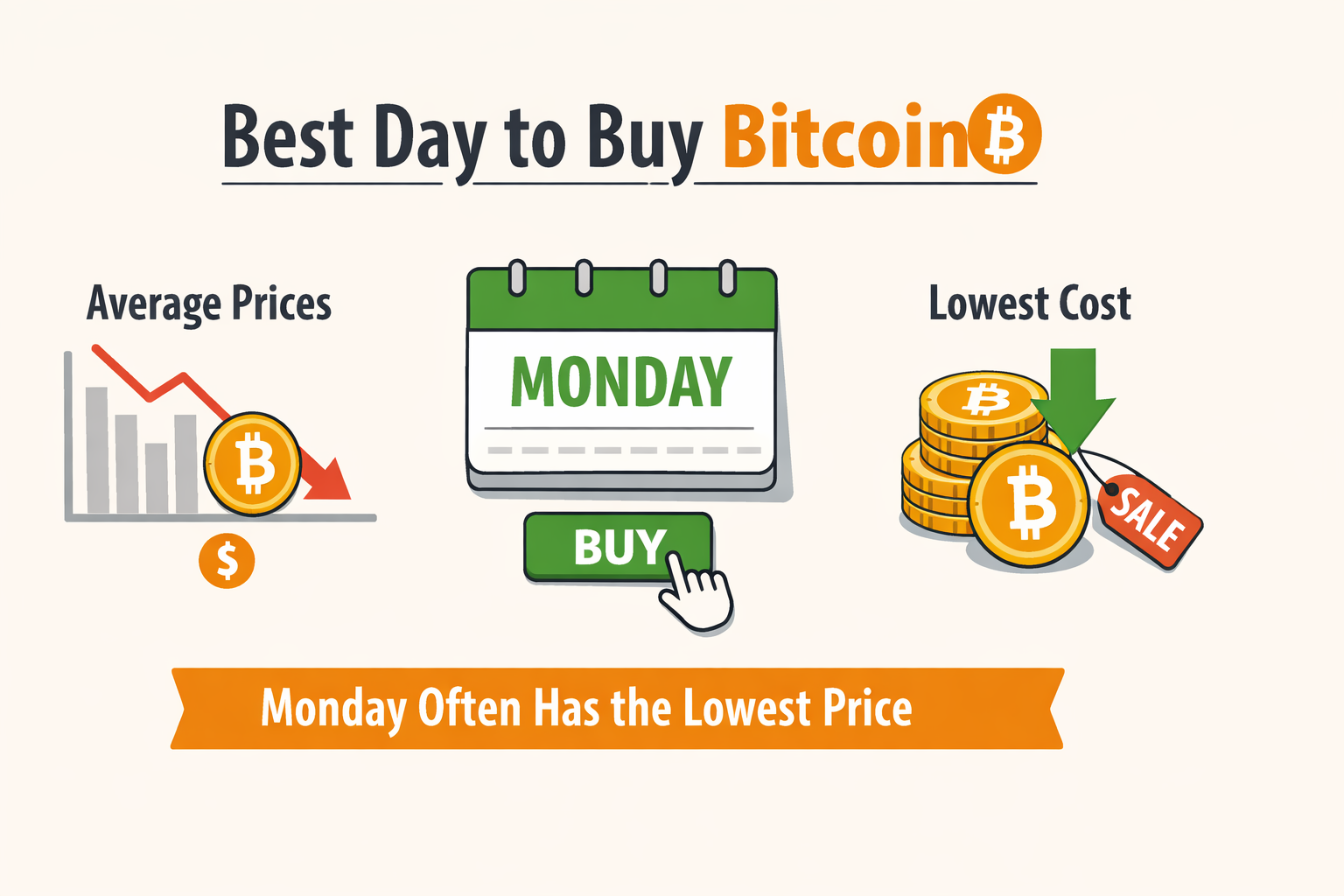
According to historical backtesting since 2014, Monday is the best day to buy Bitcoin. Buying late Sunday and holding through Monday has historically delivered the highest average daily return of 0.51%. Jump to backtest.
If you’ve ever asked yourself what is the best day of the week to buy Bitcoin, you’re not alone. Many traders and crypto investors are constantly seeking patterns and edges in the volatile world of cryptocurrencies. One frequently debated idea is that certain days of the week may offer better buying opportunities than others.
In this guide, we answer that exact question — backed by historical data — and show which day of the week has provided the strongest returns for Bitcoin over the long run. The best time to buy Bitcoin is a hotly debated topic, with many seeking the best time or even the cheapest day to enter the market.
Let’s dive into the data and uncover the hidden patterns in Bitcoin’s daily performance. Sundays and Mondays generally offer lower entry prices for Bitcoin, and prices tend to start low on Monday and increase as the week goes on.
Key Takeaways: The Best Day to Buy Bitcoin
- What is the best day of the week to buy Bitcoin?: Monday is statistically the best day to buy Bitcoin, yielding an average daily return of 0.51% based on historical data since 2014.
- Optimal Timing: Buying late Sunday evening (UTC) allows you to capture the historically strong price action that occurs when institutional markets reopen on Monday.
- The “Weekend Effect”: Prices on Sundays are often 2.3% lower than mid-week peaks due to lower trading volume and reduced liquidity.
- Weakest Performers: Thursday (+0.07%) and Sunday (+0.04%) are historically the poorest days for price growth and entry.
- Early Week Advantage: The first half of the week (Monday–Wednesday) consistently outperforms the latter half, with a combined return of 0.87% vs. 0.56%.
- Holding Strategy: Wednesday and Friday show relative strength (+0.26% and +0.25%), making them better days to hold rather than sell.
- DCA Alternative: For those who prefer not to time the market, Dollar-Cost Averaging (DCA) remains a proven strategy to lower average costs and reduce stress during volatility.
The Best Day to Buy Bitcoin: Data Speaks Clearly
To uncover the truth, we analyzed the historical performance of Bitcoin from the beginning of 2014 up to today. We measured the return from the close of one trading day to the close of the next, giving a clean and consistent view of daily returns across each weekday.
Here is the average return per day of the week:
| Day | Average Daily Return (%) |
|---|---|
| Monday | 0.51 |
| Tuesday | 0.10 |
| Wednesday | 0.26 |
| Thursday | 0.07 |
| Friday | 0.25 |
| Saturday | 0.20 |
| Sunday | 0.04 |
When these results are compared to other days over the past year, Monday’s returns have consistently outperformed, showing a statistically significant edge for investors seeking optimal timing.
As shown above, Monday stands out as the clear winner with an average daily return of 0.51%. This means that buying Bitcoin at the close on Sunday and holding it until the close on Monday has historically been the most profitable 24-hour period. Notably, Monday had twice the buying opportunities of the next best day, Thursday.
This anomaly has often been referred to as part of the “Weekend Effect” — a well-documented phenomenon in both stock and crypto markets. The theory is that traders digest news and events over the weekend, and by Monday, market reactions are triggered, pushing prices upward. Prices on Sundays are often 2.3% lower than midweek peaks due to reduced trading volume and fewer institutional traders active.
Several potential reasons support this:
- Lower liquidity on weekends: Crypto markets operate 24/7, but fewer traders participate during weekends, leading to sluggish or erratic price action.
- Institutional activity resumes on Monday: When professional investors return on Monday, their buying may drive up prices.
- Retail psychology: Many retail traders and investors tend to act after the weekend when they have more time to analyze the market.
- Cryptocurrency prices start low after the weekend: As market activity begins on Monday, prices often reach their lowest point before values tend to rise as trading activity increases.
While the exact cause is hard to pinpoint, the pattern has been consistent for over a decade.
Related reading: –Holiday trading strategy for Bitcoin

These patterns have been observed in cryptocurrency trades and trading activity, especially during weekend hits when trading volume is low.
Discover why Monday stands out as the most profitable day to buy Bitcoin—based on 11 years of historical performance.
How to Use This Data in Practice
Knowing the best day of the week to buy Bitcoin isn’t just an interesting statistic — identifying the best time or best time to buy can help maximize profit and inform trading strategies.
Here are three key takeaways:
- Timing matters: Even in a long-term investment like Bitcoin, short-term timing can influence your returns.
- Buy Sunday evening (UTC time): Since the daily return is measured from close to close, entering the market late Sunday aligns you with Monday’s historically strong gains.
- Avoid Thursday entries: Historically, Thursday has shown the weakest performance, averaging only 0.07% — barely positive.
- The best time to buy cryptocurrency is whenever you’re ready to start investing, especially if you use long-term trading strategies like dollar-cost averaging.
This kind of Bitcoin day-of-week analysis is often used by algorithmic traders to build rules-based strategies. Analyzing trades and cryptocurrency trades over different time periods can help refine your approach.
Are Some Days Better Than Others for Holding Bitcoin?
Beyond buying, some days offer better performance just for holding. While Monday leads in returns, Wednesdays and Fridays also show relatively strong average returns:
- Wednesday: +0.26%
- Friday: +0.25%
These may be ideal days to hold — or avoid selling — if you’re planning short-term exits. Users may choose to sell or sell cryptocurrencies on specific days depending on their trading strategies and individual goals, as timing can impact returns. Conversely, if you’re looking to rebalance your crypto portfolio, doing so mid-week might yield better outcomes than early or late week.
What About Saturdays and Sundays?
Despite crypto trading 24/7, weekend returns are surprisingly weak. Sunday in particular offers just +0.04%, making it the least favorable day for gains.
Interestingly, this contrasts with some other asset classes where weekend gaps or closures affect behavior. Bitcoin’s price, though fluid, may reflect lower trading volume and investor interest during off-hours, causing weaker trends. Weekend hits often see reduced trading activity, and the choice of account or trading platform can impact your ability to capitalize on these periods.
Surprising Twist: Bitcoin Performs Better Early in the Week
What may surprise many is that early-week returns consistently outperform the rest of the week. In fact, if you simply divide the week in two:
- Monday–Wednesday: +0.87% combined
- Thursday–Sunday: +0.56% combined
This pattern isn’t just noise — it highlights a potential psychological or behavioral pattern across market participants.
If you’re dollar-cost averaging into Bitcoin, consider skewing your purchases earlier in the week.
Additionally, cryptocurrency values tend to rise in the first weeks of the month before they collapse and continue to trend downward through the end of the month. Understanding how values tend to fluctuate during these periods is important for timing your entries. Monitoring cryptocurrency values and being aware of these trends can help investors make better decisions.
Can This Pattern Change Over Time?
Yes. Just like any market anomaly, the best day of the week to buy Bitcoin may evolve as more traders recognize and act on the pattern. Crypto markets are young and heavily influenced by narratives, sentiment, and macroeconomic factors.
What’s worked historically doesn’t guarantee future performance — significant market events can happen at any time, potentially altering established patterns — but it’s still a statistically sound edge worth knowing.
A good rule of thumb: track your own entries and see how they align with these findings over time.
Could This Be a Sign of Market Manipulation?
Some skeptics might ask: if Monday performs so well, is this manipulated? It’s a fair question.
But it’s more likely the result of a combination of:
- Liquidity cycles
- Institutional flow patterns
- Retail buying behavior
There’s no clear evidence of artificial pumping. Instead, it’s a repeatable, data-driven result that holds across a large sample size.
DCA Bitcoin Strategy: An Alternative to Timing the Market
Dollar cost averaging (DCA) is a widely used investment strategy in the crypto market, especially among those looking to build their bitcoin holdings over time without the stress of trying to predict short-term price movements. With DCA, you invest a fixed amount of money into bitcoin or another cryptocurrency at regular intervals—regardless of where the bitcoin price or overall cryptocurrency prices are at that moment.
This approach is particularly appealing in a market known for its volatility. Many investors are tempted to buy crypto at what they hope is the best possible price, often trying to pinpoint the best day of the week to buy cryptocurrency. However, as the data shows, even though Monday morning tends to offer lower prices after a quiet weekend, consistently timing the market is challenging—especially during a bear market when prices tend to swing unpredictably, or in a bull market when values can rise rapidly.
DCA bitcoin helps smooth out these ups and downs. By spreading your purchases across different days and market conditions, you naturally buy more bitcoin when prices are low and less when prices are high. This can lower your average cost per bitcoin over time, reducing the risk of making a large investment at the wrong moment. It also removes much of the emotional decision-making that can come with trying to trade cryptocurrencies based on short-term analysis or market activity.
For example, imagine an investor who decides to invest $100 in bitcoin every week for a year, regardless of the current bitcoin price. Over the course of 52 weeks, this investor would have put in $5,200. Thanks to dollar cost averaging, the average price paid per bitcoin would likely be lower than if the investor had tried to buy only on days they thought were the cheapest—especially if they missed the best day or bought during a price spike.
While the analysis in this post shows that Monday is historically the best day of the week to buy bitcoin, DCA bitcoin offers a practical alternative for those who prefer a steady, long-term approach. It’s especially useful for investors with lower risk tolerance or those who don’t have the time to monitor the crypto market closely. By sticking to a regular investment schedule, you can take advantage of both bull and bear market conditions, avoid the pitfalls of emotional trading, and build your crypto portfolio with less stress.
In summary, dollar cost averaging is a proven strategy for accumulating bitcoin and other cryptocurrencies over time. Whether you’re new to the crypto world or a seasoned trader, DCA bitcoin can help you navigate the ups and downs of cryptocurrency prices, making it easier to stay invested and focused on your long-term goals—no matter what day of the week it is.
Real-World Application: Is It Worth Adjusting Your Buying Habits?
If you invest in Bitcoin regularly or trade it actively, adjusting your timing could provide an incremental edge. Even a half percent gain per week adds up over months and years. Users should ensure their account is set up for recurring buys to maximize profit from these patterns.
Here’s what savvy investors might do:
- Buy weekly on Sunday night
- Set recurring purchases during late Sunday hours
- Refrain from selling on Mondays and Wednesdays
For those running crypto strategies using bots or algorithmic rules, this weekday pattern can be integrated into entry filters.
How Does This Compare to Stocks or Other Assets?
Interestingly, similar day-of-week anomalies exist in stock markets, too. For example:
- U.S. equities tend to underperform on Mondays (opposite of Bitcoin!)
- Gold often shows Friday strength due to pre-weekend hedging
- Forex often sees Monday lulls and Friday volatility
This contrast suggests that Bitcoin operates under its own behavioral cycle, likely due to its unique mix of retail-driven volume, 24/7 markets, and global accessibility. However, it’s important to note that these patterns can vary depending on the time period analyzed, so investors should consider the relevant time period when comparing assets.
Long-Term Implication: Is It Just Noise or Signal?
If the difference was 0.05%, we could dismiss it. But with Monday showing 5–10x the return of other days, it becomes a meaningful signal.
Combined with technical analysis or sentiment indicators, weekday seasonality could enhance entries and exits. Aligning your strategy with these patterns can help maximize profit over the long term.

Best day to buy Bitcoin? Data shows Monday outperforms other weekdays for Bitcoin returns.
Summary: What You Should Know
So, what is the best day of the week to buy Bitcoin?
Monday – with an average gain of +0.51% – is statistically the most profitable day.
Thursday and Sunday – offer the weakest performance.
Early-week buying can give your portfolio a subtle but repeatable advantage.
Recap: Best Days to Buy and Hold Bitcoin
| Day | Strategy Insight |
|---|---|
| Monday | Best day to buy or hold |
| Wednesday | Positive hold day – consider delaying sells |
| Friday | Moderate strength – good for holding |
| Sunday | Worst time to buy – wait for Monday |
| Thursday | Weak returns – consider avoiding buys |
Final Thoughts
While no timing strategy is perfect, aligning your entries with high-probability patterns can enhance long-term results. This weekday-based approach is simple, evidence-based, and easy to implement.
Frequently Asked Questions: Best Day to Buy Bitcoin & Crypto
What is the best day of the week to buy Bitcoin?
Based on historical data from 2014 to 2026, Monday is statistically the best day to buy Bitcoin. Prices often hit a local low following the weekend, with an average daily return of 0.51% as institutional activity resumes.
What is the best day to buy cryptocurrency?
Similar to Bitcoin, the broader cryptocurrency market often sees its lowest prices on Monday morning and Sunday evening. Because many altcoins follow Bitcoin’s price action, the “Monday Effect”—where prices start low and rise throughout the week—is a common trend across the crypto sector.
Why is Bitcoin cheaper on weekends?
Bitcoin prices often dip on weekends due to lower trading volume and reduced liquidity. With major stock markets closed and many institutional traders inactive, the market becomes more sensitive to smaller trades, often leading to price “lulls” or dips on Sunday.+1
Is there a best time of day to buy Bitcoin?
Data suggests that the early morning hours, specifically between 12 AM and 6 AM UTC, can offer lower prices. This period coincides with a lull in activity between the close of the U.S. markets and the full opening of Asian and European markets.
What is the best day of the month to buy crypto?
Historically, the end of the month (typically the last 10 days) has shown a tendency for price corrections. Many investors find better entry points during this time compared to the first week of the month, when prices often see a “beginning-of-month” pump from automated buys and fresh capital.
Should I try to time the market or use DCA?
While identifying the best day provides a statistical edge, Dollar-Cost Averaging (DCA)—investing a fixed amount every week regardless of price—is generally recommended for most investors. It removes emotional stress and reduces the risk of missing out on unexpected bull runs.
