

Italian Stock Market Trading Strategy (Setup, Trading Rules, Backtest, Performance Analysis)

Italy is one of the most beautiful countries in the world, and it certainly has one of the best foods. However, they have struggled to grow their economy and, accordingly, their stock market.
The Italian stock market is currently trading in the same spot it was in 1998. This is more than 25 years of no value creation. But perhaps there are any trading strategies to trade a sideways market? We believe seasonal trading strategies may do the trick.
In this article, we will look at how the Italian stock market is composed and backtest some seasonal trading strategies, from daily to monthly strategies.
Key Takeaways
- Italian stock market flat for over 25 years
- Buy-and-hold returns in Italy remain very weak
- Sideways markets can benefit from seasonal strategies
- Tuesdays and Wednesdays show strongest daily performance
- Mondays consistently deliver poor returns
- End-of-month strategy outperforms buy and hold
- March and June are best-performing months
Related reading: – Looking for a library of trading systems? (We have hundreds)

How is the Italian stock market composed?
The stock market index for the Italian stock market is called IT 40. It represents the performance of the 40 largest and most actively traded companies listed on the Borsa Italiana, the Italian stock exchange located in Milan.
Its components include Monclear, Pirelli, Tenaris, Ferrari, and Campari. However, it hasn’t performed very well in the past:
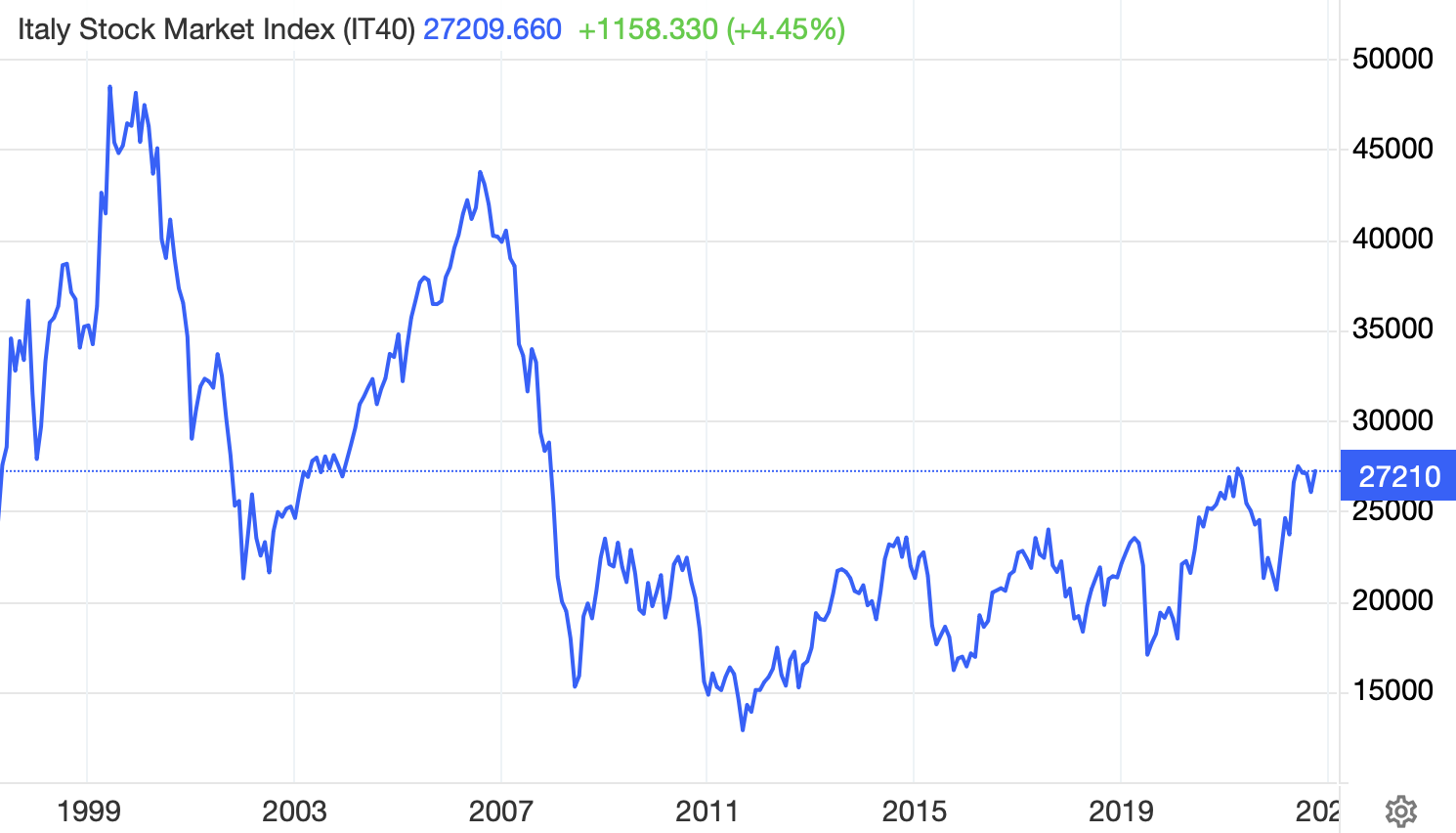
Given that the buy-and-hold returns have been so poor, we decided to backtest some seasonal trading strategies to see whether we can achieve a higher performance, starting by determining the best day for Italian stocks.
What is the best day of the week for Italian stocks?
We conducted a backtest to analyze the performance of the Italian stock market by each day of the week. By this, we mean we backtest how the Italian stock market performs on Monday, how it does on Tuesday, etc.
We used the ETF EWI (iShares MSCI Italy), with the data adjusted for dividends. Here is the equity curve:
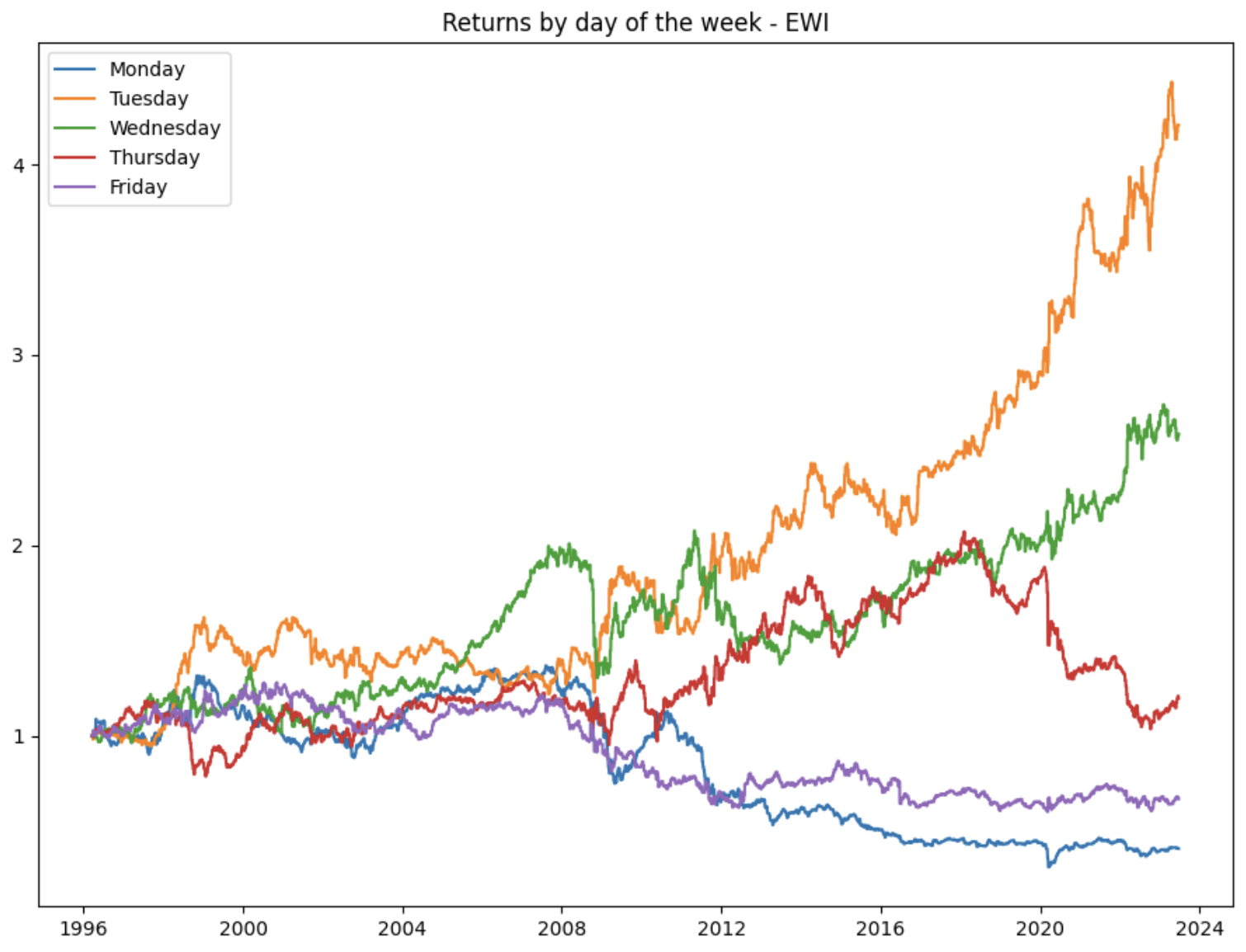
The results are pretty distinct. Italian stocks perform best on Tuesdays and Wednesdays. Thursdays are slightly positive, Fridays are flat, and Mondays are a disaster. If we were to create a trading strategy considering these results, we would definitely avoid Fridays and Mondays!
Does the end of the month trading strategy work in Italian stocks?
The end-of-the-month trading strategy is pretty simple and explained in that link. Let’s use the same trading rules on EWI and Italian stocks:
Trading Rules
You find the trading rules at the bottom of the article
Here is the equity curve:
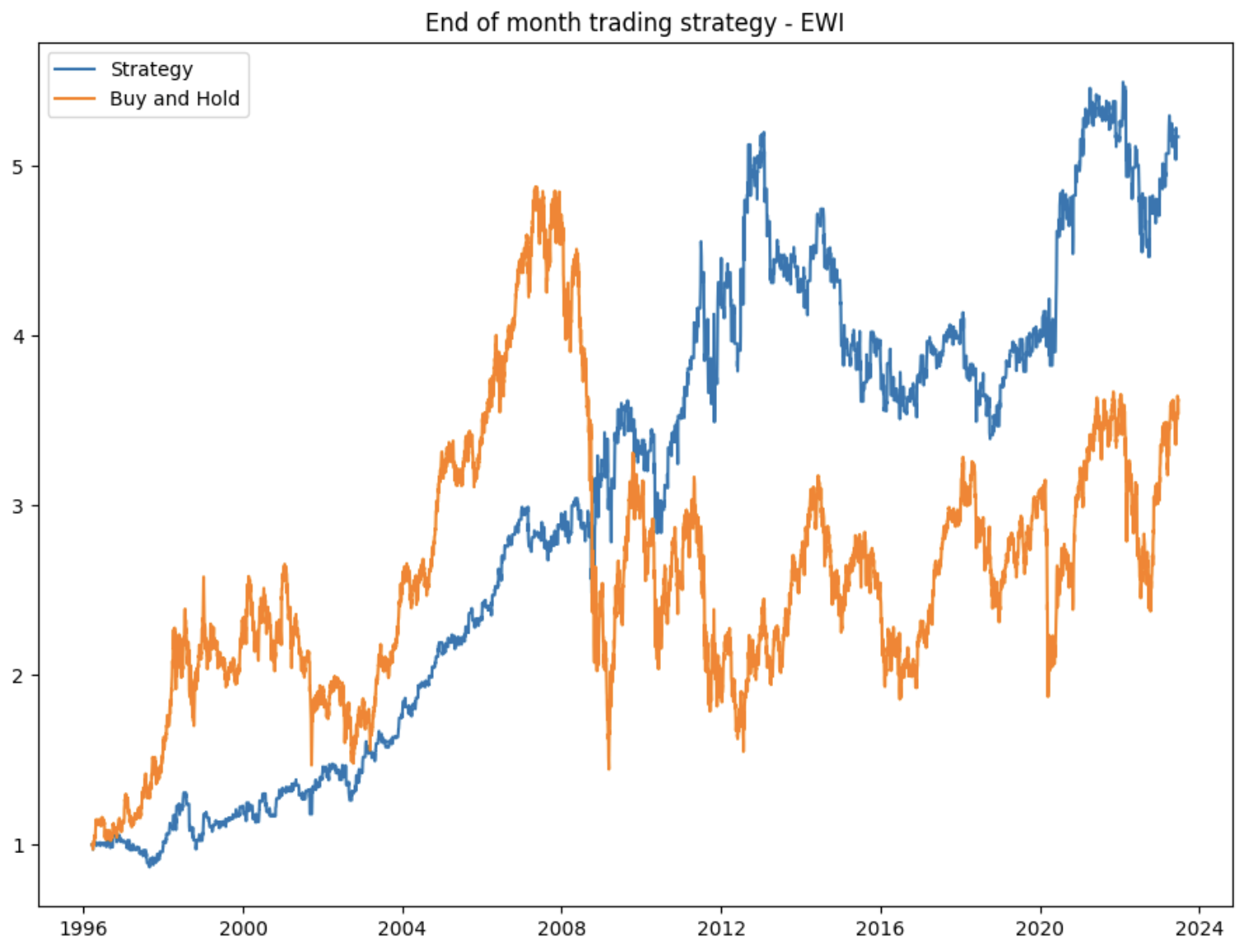
Again, this seasonal trading strategy has performed reasonably well. It does much better than buy and hold while only being investing ⅓ of the time. The CAGR of the strategy is 6.17% vs 4.71% for buy and hold.
What are the best-performing months?
Lastly, we wanted to see the months with higher returns in Italian stocks. Here are the average returns per month of EWI since inception:
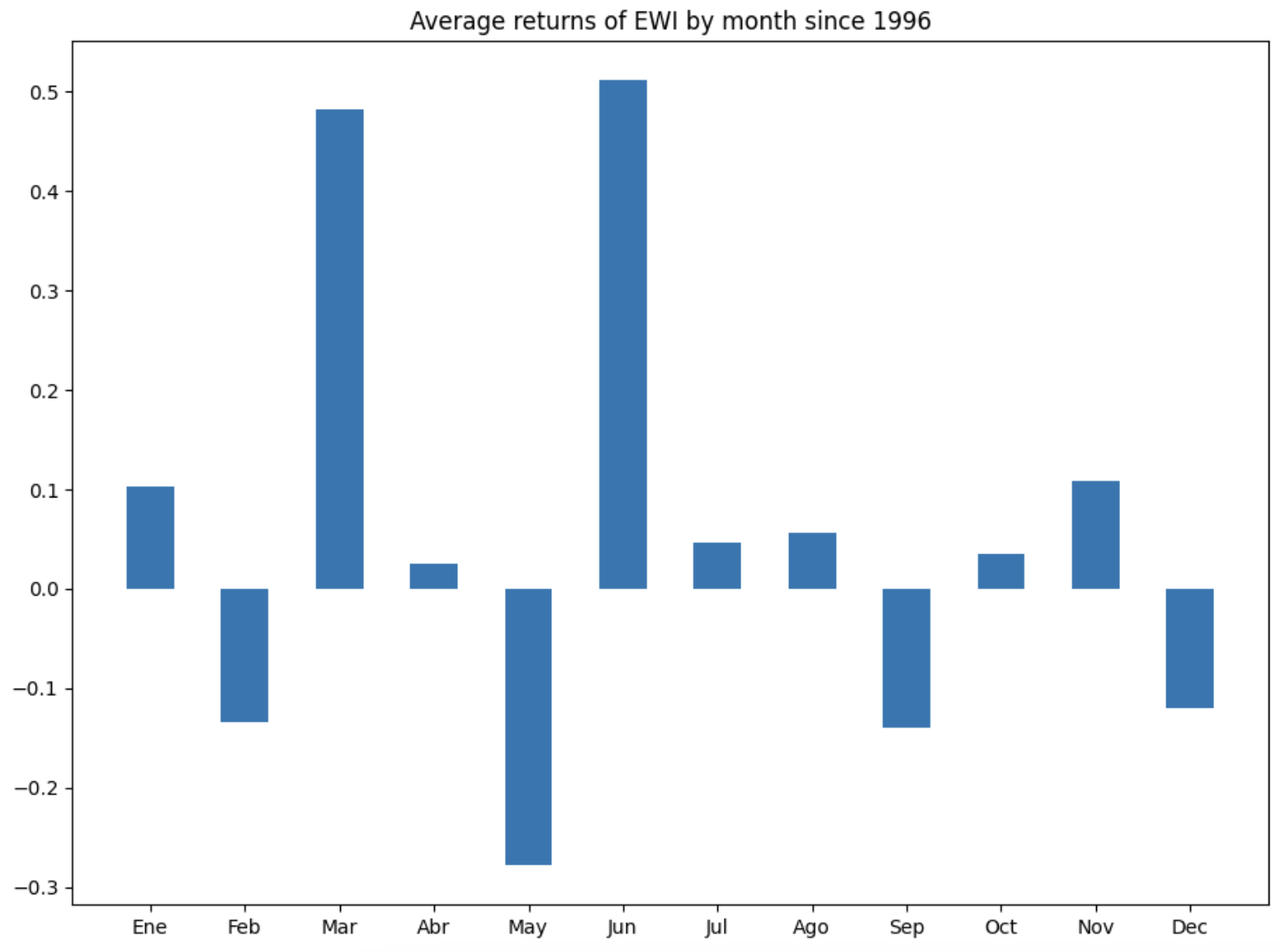
Evidently, March and June are the best months by far. The rest of the year, the ETF is more or less muted, with May being its worst month.
Seasonal trading strategies for the Italian stock market – conclusion
To sum up, it seems like the Italian stock market can be very seasonal. Tuesdays and Wednesdays are the best days by far, and well-known seasonal strategies like the end-of-the-month effect might also work.
FAQ:
Why has the Italian stock market struggled to grow its economy?
The Italian stock market, represented by the IT 40 index, has faced challenges, with its current trading level similar to that of 1998. Factors affecting its performance include economic struggles, but various trading strategies, especially seasonal ones, are explored in the article to enhance its outlook.
What companies are part of the Italian stock market index (IT 40), and how have they performed historically?
The IT 40 index comprises the 40 largest and most actively traded companies on the Borsa Italiana, including Monclear, Pirelli, Tenaris, Ferrari, and Campari. Despite the underwhelming buy-and-hold returns, the article investigates seasonal trading strategies to potentially improve performance.
What is the significance of seasonal trading strategies for the Italian stock market?
Seasonal trading strategies are explored as a potential solution to the challenges faced by the Italian stock market. The article delves into the performance of Italian stocks on different days of the week, the end-of-the-month trading strategy, and the best-performing months, revealing insights that traders can consider.