
MACD And RSI Trading Strategy For Commodities

A recent quantitative study examined the feasibility of generating abnormal returns (alpha) in the highly specialized commodity futures market by utilizing common technical indicators: the Moving Average Convergence Divergence (MACD) and the Relative Strength Index (RSI).
This research investigated whether momentum strategies could consistently outperform the S&P GSCI (Standards & Poor’s Goldman Sachs Commodity Index), which served as the study’s benchmark index. The findings challenge the notion of strict market efficiency by demonstrating empirically validated excess returns through specific indicator usage.

Trading Rules: Which Commodities, Time Frame, and Indicator Parameters (Settings)
The backtest covered a ten-year period, specifically accumulated daily data from 2010 to 2019. The investment strategy was strictly long-only (aiming to profit only from rising prices). Portfolio composition was reviewed and revised on a quarterly basis throughout the entire decade, seeking to adjust the investment portfolio to current market conditions.
Commodities and Selection Pool
To ensure diversification, the analysis focused on futures contracts within two major commodity sectors: Metal and Energy.
The nine commodities included in the selection pool were:
| Sector | Commodities Included |
| Metal | Copper, Gold, Palladium, Platinum, and Silver |
| Energy | Crude Oil WTI, Brent Crude Oil, Coal, and Natural Gas |
In each quarterly revision, the four top-performing commodities, as identified by the momentum indicator values, were selected for inclusion in the long-only portfolio.
Momentum Indicator Trading Rules and Lookback Periods
The study used standard momentum-indicator parameters to generate signals from underlying daily price data.
1. MACD (Moving Average Convergence Divergence):
◦ Trading Rule: A long (buy) signal was generated when MACD values were above zero (0).
◦ Lookback Period: The calculation used commonly applied time spans: a shorter Exponential Moving Average (EMA) of 12 days (k=12) and a longer EMA of 26 days (d=26).
2. RSI (Relative Strength Index):
◦ Trading Rule: A long (buy) signal was used when RSI values were below or close to 30, adhering to a contrarian approach of buying oversold assets with the expectation of a price rebound.
◦ Lookback Period: The RSI calculation utilized the standard period of 14 days.
Key Findings: The Joint Momentum Strategy Performance
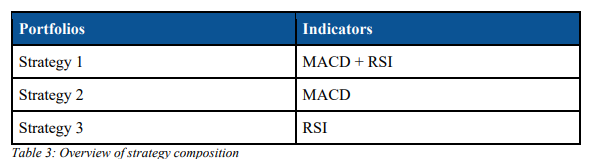
The research explored three strategies: joint use of both indicators (Strategy 1), single use of MACD (Strategy 2), and single use of RSI (Strategy 3). Strategy 1 was designed to select commodities based on the combined performance signals of both MACD and RSI as mentioned above.
The joint use portfolio significantly outperformed the S&P GSCI benchmark during the 2010-2019 period:
| Metric | Strategy 1: Joint MACD & RSI Portfolio | S&P GSCI Benchmark Index |
| Total Accumulated Return (2010-2019) | 84.14% | -10.24% |
| Difference to Benchmark | 94.38% | N/A |
| Compounded Annual Growth Rate (CAGR) | 7.33% | -2.73% |
| Statistical Significance | Statistically Significant | N/A |
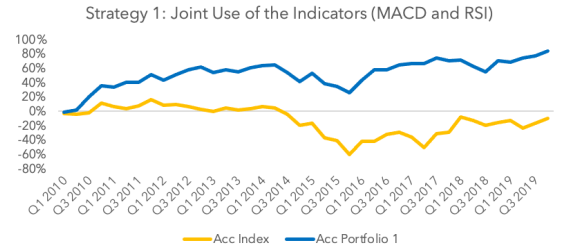
The substantial outperformance generated by the joint strategy proved to be statistically significant, leading to the rejection of the null hypothesis that the strategy would not achieve higher returns than the benchmark index.
While the joint use strategy was successful, the backtest results also showed that relying solely on the MACD indicator (Strategy 2) led to a negative accumulated return of 10.19%, which was not statistically significant. In contrast, the single use of the RSI indicator (Strategy 3) yielded the best outcome, generating an accumulated return of 94.28% over the decade and demonstrating statistical significance.