
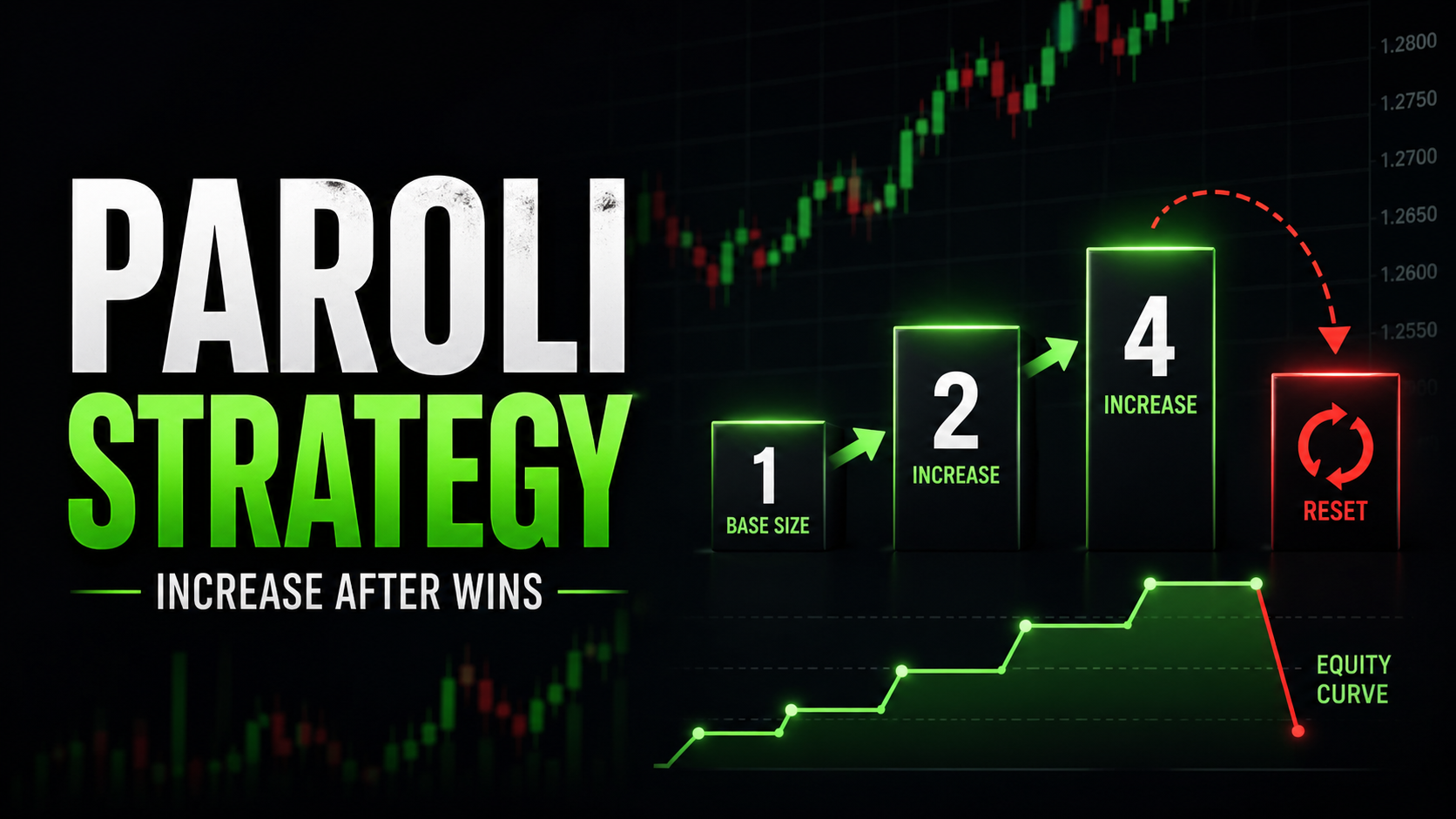
Paroli Strategy in Trading: Does Positive Progression Position Sizing Work?

Paroli strategy in trading means increasing position size after wins and cutting it back after losses. That makes it a positive progression system, usually treated as a capped anti-Martingale. The short answer is simple: Paroli can change the shape of returns, but it cannot create an edge on its own. In gambling, positive progression does not remove the house edge. In trading, it only makes sense if the underlying strategy already has positive expectancy and the market is actually rewarding trend or momentum.
Paroli strategy in trading also gets misunderstood because people treat it like a full strategy instead of what it really is, a money management overlay. In practice, traders usually translate it into either increasing risk on the next trade after a win, or pyramiding into an open winner with unrealized profits. Both versions can work in certain conditions. Both versions can also go wrong fast if costs, gaps, leverage, or a sudden reversal are ignored.
What Is the Paroli Strategy and Does It Work in Trading?
Paroli strategy in trading is a reverse Martingale idea: press size when the market is paying you, not when it is hurting you. That is less dangerous than Martingale because you are not averaging down into damage. But it still does not guarantee profit. Trading sources describing anti-Martingale systems say they can help in momentum-driven markets, while gambling math says progression systems only alter payoff distribution, not expected value. Put together, that means Paroli only has a chance if the trade selection process already has an edge.
What Is the Paroli Strategy? (Positive Progression System Explained)
The Paroli strategy is a positive progression system where you increase the next bet or trade after a win and reset after a loss. The common version is capped: double after each win until you hit three consecutive wins or one loss, then go back to the starting unit. In plain English, it is an attempt to harvest streaks without taking the runaway downside that comes from doubling into losses.
Positive progression system is the broader category. The core idea is not that the next outcome becomes more likely after a win. It does not. The math point is narrower than that. Positive progression changes the distribution of outcomes, making it more likely that you lose a little and less likely, but still possible, that you win a lot, while leaving total expected winnings unchanged. That distinction matters a lot, because most of the marketing around these systems quietly skips it.
Paroli vs Martingale: Key Differences in Risk and Returns
Paroli vs Martingale comes down to one question: when do you increase size? Martingale increases after losses and hopes a later win recovers the whole chain. Paroli increases after wins and resets after a loss. So Paroli is generally the less explosive of the two on the downside, while Martingale is the one that can burn through capital quickly if a losing streak keeps going.
Paroli vs Martingale also differs in what kind of market behavior each one implicitly bets on. Martingale leans on reversion after pain. Anti-Martingale leans on continuation after success. Trading references describe anti-Martingale as more suitable for momentum-driven environments and Martingale as the riskier choice because it scales into weakness. That does not make Paroli safe. It just means the system is at least pointing exposure in a less self-destructive direction.
Paroli vs Martingale in expected returns is where the fantasy usually dies. Neither approach changes the odds or the expected value of the underlying game or trade stream. They only reshape the path. That is why both systems can produce a lot of small wins or nice-looking streaks while still being mathematically unimpressive over the long run.
How the Paroli System Works (With Simple Examples)
How the Paroli system works is simple on paper. Start with one unit. If you win, the next bet becomes two units. If you win again, the next becomes four. If you lose at any point, reset to one. In the common capped version, if you win three times in a row, you bank the sequence and reset instead of pressing again. That creates a ladder like 1, 2, 4, then back to 1.
How the Paroli system works with a toy even-money example is easier to see. A three-win sequence turns 1 unit into a 7-unit sequence profit before reset. But the chance of stringing together three independent 50/50 wins is only about one in eight, which is why the system spends a lot of time resetting after short runs. The appeal is emotional as much as mathematical: small defined losses, occasional larger pops.
How the Paroli system works in trading should not be copied dollar for dollar from the casino version. A trader should think in risk units, not raw share count. So the right translation is not “double shares after every green trade” but “step up planned risk after a qualified win, while keeping each position tied to stop distance and total account risk.” That is the only way the sizing rule stays connected to actual market risk.
Does the Paroli Strategy Work in Gambling?
Does the Paroli strategy work in gambling? Over the long run, no, not in the sense people usually mean. It can change the session experience. It cannot beat the edge built into the game. Gambling math sources are very blunt about this: no matter what betting system is used, long-run loss rates converge to the house edge. Positive progression is still just packaging.
Does the Paroli strategy work in gambling in simulation? Anti-Martingale results from large simulations say no. In single-zero roulette even-money bets, the expected value in the anti-Martingale simulation stayed around -0.027, which is basically the roulette house edge. In double-zero roulette even-money bets, the expected value stayed around -0.0526, again matching the underlying game rather than magically improving it.
Does the Paroli strategy work in gambling for shorter sessions? Sometimes it can feel like it does, because positive progression is built to create occasional larger session wins. But that is the same as saying it changes variance and skew, not expectation. You can absolutely get a satisfying run. You just cannot turn a negative expectation game into a positive one by staking it differently.
Can the Paroli Strategy Be Used in Trading?
Can the Paroli strategy be used in trading? Yes, but only as a position sizing overlay. Trading references openly describe anti-Martingale systems as being used in markets like forex, and they frame the logic as adding during winning streaks while reducing size after losses. So the concept is legitimate. The important qualifier is that it sits on top of the entries, exits, and risk controls. It is not the source of those.
Can the Paroli strategy be used in trading in a way that actually makes sense? Usually, yes, when it is attached to trend-following or momentum logic. The academic literature on time-series momentum finds return persistence across equity index, currency, commodity, and bond futures over one to 12 months, and anti-Martingale descriptions explicitly say the approach is more useful in momentum-driven markets. That is the cleanest bridge between gambling-style Paroli logic and a real trading application.
Can the Paroli strategy be used in trading everywhere? No. If your entries are random, if your market is choppy, or if transaction costs eat most of the edge, Paroli just magnifies noise after the lucky wins and cuts size after the unlucky losses. It feels active. It is not automatically intelligent.
Paroli Position Sizing in Trading Explained
Paroli position sizing in trading usually means adjusting the risk budget after outcomes, not blindly doubling notional exposure. Proper position sizing starts with account risk, trade risk, and stop-loss distance. One standard framework is: decide how much of account equity you are willing to risk on one trade, calculate the dollar risk from entry to stop, then divide account risk by trade risk to get size. Paroli changes the first part of that process, the account risk budget, after wins.
Paroli position sizing in trading explained another way is this: imagine your base risk is 0.5% of equity. After one full winner, the next qualified signal risks 1.0%. After a second full winner, the next risks 2.0%. Then you cap it and reset after any loss or after a completed three-win ladder. That is much closer to how professionals would adapt Paroli, because the progression is expressed in risk units tied to stops, not in random lot sizes.
Paroli position sizing in trading explained in an open position often looks like pyramiding. You begin small, then add as the trade works and unrealized profits absorb some of the added exposure. That is not identical to classic Paroli, but it is the nearest market analogue and it only makes sense when the trend is real, the instrument is liquid, and leverage is controlled.
Example of a Paroli-Based Trading Strategy
A Paroli-based trading strategy can be built around a trend-following system, because trend-followers typically absorb many small losses while waiting for a smaller number of long-lasting moves that pay for them. That return pattern naturally fits a sizing rule that stays small when the strategy is cold and presses harder when it starts catching sustained trends.
A Paroli-based trading strategy example might look like this. Use one entry method only, say a breakout or trend filter system. Risk 0.5% of equity on the first trade. If the trade hits its planned target or closes as a rule-based winner, increase the next valid trade to 0.75% or 1.0%. If the next trade also wins, increase once more, maybe to 1.5% or 2.0%, then stop increasing. After any stop-out, any gap beyond tolerance, or any completed progression, go back to 0.5%. That keeps the system capped, risk-based, and testable.
A Paroli-based trading strategy should also define what counts as a win. That sounds minor, but it matters. If you count any tiny positive close as a win, you will often press size after noise. If you only count a trade that met a full exit rule, or one that moved far enough to lock in profit and reduce initial risk, the progression becomes more selective and less sloppy. That kind of discipline lines up better with pyramiding guidance and with the basic anti-Martingale idea of adding only when the market is already proving something.
Backtesting the Paroli Strategy in Trading
Backtesting the Paroli strategy in trading is where most of the hype should get filtered out. The better published research I found tends to test position sizing more broadly rather than pure Paroli overlays. In one trend-following managed futures study, target volatility improved risk-adjusted performance relative to fixed fraction, while correlation-based and omega-based methods did not reliably help. That is useful because it shows sizing rules can matter a lot, but only in context and not all in the same direction.
Backtesting the Paroli strategy in trading also has to include ugly details, not just pretty equity curves. A recent portfolio backtesting preprint found that once transaction costs are modeled, different engines can produce materially different performance numbers for the same logical strategy. That does not mean backtests are useless. It means a Paroli backtest that ignores costs, slippage, and implementation assumptions is not telling you much.
Backtesting the Paroli strategy in trading should therefore answer a few boring questions before it answers the exciting ones. What is the base risk? What triggers the step-up? What is the cap? Does the progression apply to the next trade, to an add-on inside an open trade, or both? And after costs, does the risk-adjusted result actually improve, or does the system just look more dramatic? Research on position sizing says the impact can be severe, and sometimes smaller fractions produce the better risk-adjusted profile.
Paroli vs Fixed Position Sizing: Which Is Better?
Paroli vs fixed position sizing is really a comparison between adaptability and stability. Fixed position sizing, or fixed-risk sizing, is cleaner. You decide the amount of account risk, tie size to stop distance, and repeat the process the same way every trade. That makes drawdowns easier to understand and makes performance attribution less messy.
Paroli vs fixed position sizing, in practice, usually favors fixed sizing as the default. Research on timing strategies found that position sizing has a severe impact on results, that a universal optimal size does not exist, and that smaller trading fractions often delivered the best risk-adjusted returns in most scenarios. That is a pretty strong warning against assuming that pressing size after wins is automatically an improvement.
Paroli vs fixed position sizing becomes more interesting when the underlying system is trend-following and the trader cares more about convex upside than smoothness. In that narrower case, Paroli can make sense because it lets you stay conservative when the system is cold and expand only after the strategy has already earned room to breathe. Still, that is a conditional advantage. It is not a general one.
Advantages of the Paroli Strategy in Trading
The advantages of the Paroli strategy in trading are mostly about risk direction. It adds after wins instead of averaging down after losses, which is a healthier instinct than Martingale-style recovery trading. Trading references also note that anti-Martingale behavior lines up with the old rule of letting winners run and cutting losers early.
The advantages of the Paroli strategy in trading also show up in trend systems. If momentum or trend persistence is real, and academic evidence says it often is across major futures markets, a capped positive progression can concentrate exposure in the part of the trade stream where the system is actually behaving best. That can produce a more convex payout shape than flat sizing.
The advantages of the Paroli strategy in trading include psychology too, though I would not oversell that point. Some traders find it easier to follow a rule that rewards proof and punishes failure. You lose a trade, you shrink. You win a trade, you are allowed to press, but only a little and only inside limits. That can be cleaner than the constant temptation to “make it back” after a drawdown.
Risks and Limitations of the Paroli Strategy
The risks and limitations of the Paroli strategy start with the main one: it does not create expectancy. If the entry and exit logic are weak, Paroli just rearranges the damage. Some sources state this directly, saying anti-Martingale does not change the underlying expected value and should be understood as bet management, not edge creation.
The risks and limitations of the Paroli strategy also include reversal risk. Anti-Martingale frameworks can grow position size quickly during a good streak, and then one sharp reversal can wipe out a meaningful chunk of those gains. That is especially true if the trader skips the cap, adds leverage, or keeps pressing size just because the last few trades were green.
The risks and limitations of the Paroli strategy get worse around gaps and costs. Proper position sizing can still fail to contain losses if the market gaps past the stop, and backtests become less trustworthy when cost assumptions are unrealistic. If a Paroli overlay increases turnover or shifts more capital into fast-moving conditions, those frictions start to matter even more.
The risks and limitations of the Paroli strategy include a mental trap too. Anti-Martingale literature explicitly warns about the hot hand fallacy. A streak does not guarantee continuation. Sometimes a streak means the strategy is in phase with the market. Sometimes it just means variance is being kind for a while. In real time, you usually do not know which one it is.
When Does the Paroli Strategy Work Best?
The Paroli strategy works best when the underlying market actually trends and the strategy is designed to capture continuation. Academic work on time-series momentum documents persistence across major futures markets over one to 12 months, and pyramiding guidance says adding to positions works best when you enter early in strong moves. That is the environment a Paroli-style overlay is trying to exploit.
The Paroli strategy works best when costs are low, liquidity is good, and risk definitions are clean. Liquid futures, large-cap stocks, and major forex pairs are better candidates than noisy, wide-spread instruments where each size increase pays extra friction or gap risk for the privilege. The cleaner the execution, the more honestly you can judge whether the sizing rule is helping.
The Paroli strategy works best when it is capped and rule-based. The standard capped version exists for a reason. Once positive progression is allowed to sprawl without a hard stop, it stops being a disciplined overlay and turns into discretionary overconfidence with nice branding.
When Should You Avoid the Paroli Strategy?
You should avoid the Paroli strategy when your underlying setup is mean-reverting, choppy, or mostly random. Anti-Martingale descriptions explicitly say the approach is more suited to momentum-driven markets, which implies the opposite too: if your strategy makes money from snapback and short-term reversion, pressing size after wins can actually be mistimed.
You should avoid the Paroli strategy when transaction costs, slippage, or overnight gaps dominate the trade outcome. In those cases, a sizing overlay that increases exposure after wins may simply push more capital into the very moments where market frictions hurt most. Even the best-looking backtest can get distorted once realistic execution is added.
You should avoid the Paroli strategy if you cannot stick to a cap. That sounds obvious, but it is the whole thing. A capped three-step progression is one risk profile. An uncapped “I’ll just press one more time” progression is a different animal, and usually a worse one.
Practical Rules for Using the Paroli Strategy
Practical rules for using the Paroli strategy matter more than the label itself, because a good rule set is what separates a risk overlay from a streak-chasing habit. The practical rules below are the version that best fits the research.
- Practical rules for using the Paroli strategy start with a small base risk. A common retail rule of thumb is to keep risk per trade low, often around 2% of capital or less, then size the position from stop distance rather than gut feel.
- Practical rules for using the Paroli strategy should express progression in risk units, not shares or contracts. Double the planned risk only if stops, liquidity, and account rules allow it. Otherwise the progression becomes fake precision.
- Practical rules for using the Paroli strategy need a hard cap. Two or three consecutive step-ups is enough. That is consistent with the common Paroli structure and helps bank gains before a reversal takes them back.
- Practical rules for using the Paroli strategy should be limited to markets and setups with actual continuation behavior. Trend-following and momentum-based systems are the natural fit. Choppy reversion systems are not.
- Practical rules for using the Paroli strategy must include realistic testing. Model commissions, spreads, slippage, and gaps, because once costs are introduced, backtest results can diverge meaningfully across implementations.
- Practical rules for using the Paroli strategy should reset immediately after a material loss or after a completed progression. The point is disciplined pressing, not emotional escalation.
Is the Paroli Strategy Worth Using in Trading?
The Paroli strategy is worth using in trading only if you treat it as a careful position sizing tool, not a shortcut to profitability. That means a real edge underneath, a market that sometimes trends, base risk defined from stop distance, a strict cap on progression, and honest backtesting. Under those conditions, it can be useful. Outside them, it is mostly a more respectable-looking way to chase streaks.
The Paroli strategy is worth using in trading less often than internet discussions suggest. Research on position sizing says the sizing choice can seriously change the return path, but it also says there is no universal optimal position size and that smaller fractions often win on a risk-adjusted basis. So the better conclusion is not “Paroli works” or “Paroli fails.” It is “Paroli is a niche overlay that can help some trend systems if used with restraint.”
Paroli Strategy FAQ
Paroli strategy FAQ starts with the most common confusion: people mix up a money management rule with an actual edge. The answers below keep those separate.
What is a positive progression system?
Positive progression system means you increase size after wins rather than after losses. Paroli is the classic example. The math effect is mainly on the distribution of outcomes, not on the underlying expected value.
Is Paroli profitable in trading?
Paroli can be profitable in trading if the entry and exit logic already has positive expectancy and the market regime supports continuation. It is not profitable by definition. It is an overlay, not a source of edge.
Why does Paroli fail?
Paroli fails when there is no real edge, when the market is too choppy, when one reversal erases a streak of stepped-up winners, or when costs and gaps are ignored. It also fails when traders abandon the cap and keep pressing because recent wins make them feel cleverer than they are.
Can you use Paroli with stocks or forex?
Yes. You can use Paroli with stocks or forex, but you should translate it into stop-based risk units and account for spreads, slippage, leverage, and gap risk. In other words, use modern position sizing first, then layer the progression on top.
What is the difference between Paroli and Martingale?
Paroli increases after wins and resets after losses. Martingale increases after losses and hopes a later win repairs the chain. That makes Paroli the less dangerous of the two on the downside, though neither one changes the expected value of the underlying game or strategy.
Is position sizing more important than strategy?
Position sizing is not more important than strategy in the sense that it cannot rescue a bad edge. But it can absolutely decide survival, drawdowns, and the shape of returns. Research on trading systems shows money management has a severe impact on outcomes, so ignoring sizing is a good way to misunderstand what a strategy really does.
Does Paroli work better than fixed position sizing?
Usually not as a default. Fixed position sizing is simpler, easier to test, and often better behaved. Paroli becomes interesting only when the strategy has streaky winners, the market trends, and the progression is capped and risk-controlled.
