

Rule-Based Trading

Rule-based trading is a method of making trading decisions with predefined rules instead of making every call in the moment. A solid ruleset usually covers what market you trade, what has to happen before you enter, how you get out, how much size you take, and how risk is capped.
In professional investing, the terms rules-based, systematic, and quantitative are often used very closely, and the big advantage is that a repeatable process can be tested, monitored, and reviewed before it is trusted with real money.
What Is Rule-Based Trading?
Rule-based trading is trading built around written conditions. Instead of asking, “What do I feel like doing here,” the trader follows a plan that says when a trade is allowed, when it is not, and what happens after entry.
Platform documentation for strategy testing frames this the same way: a strategy is a set of rules that systematically enters and exits the market, and rules-based approaches are valued because they are transparent and repeatable.
Rule-Based Trading Strategies
Rule-based trading strategies are usually organized around one repeatable market behavior. Common buckets include trend following, momentum, mean reversion, seasonality, volatility, and execution-focused rules.
On the institutional side, the U.S. Securities and Exchange Commission notes that algorithms are often built around repeatable execution goals like VWAP, TWAP, implementation shortfall, or participation rates, while published research and exchange education show the same rule-based logic extending to trend, momentum, seasonal, and volatility approaches.

Benefits
Benefits of rule-based trading start with consistency. If the rules are clear, you can check whether you actually followed them, backtest them on history, paper trade them, and later automate parts of the workflow.
Research discussed by the CFA Institute and AQR also points to the practical edge of repeatable and transparent processes, especially when you want cleaner reviews and less random decision drift.
Rule-Based Trading vs Discretionary Trading
Rule-based trading vs discretionary trading is really a question of process versus judgment. A discretionary trader can weigh context and make exceptions. A rule-based trader tries to define that context ahead of time.
AQR’s review makes an important point though: systematic and discretionary approaches are not opposites, and neither automatically beats the other. They can even complement each other. The real distinction is how much of the decision is made before the trade versus during the trade.
How it Works
Rule-based trading works by moving decisions upstream. You decide the market, setup, entry conditions, exit conditions, trade size, and cost assumptions before the trade happens.
Once those settings are in place, the system or the trader checks whether the conditions are met and then applies the next step. Strategy platforms make this pretty explicit by separating rules from properties like order size, commission, slippage, margin, and fill settings.
Trading Rules Explained
Trading rules are the written conditions that control the whole trade lifecycle. Good rules do not stop at entry. They also define exits, sizing, trading costs, slippage assumptions, and how much leverage or pyramiding is allowed.
The CFA Institute notes that signals and entry and exit rules tell you what and when to trade, but sizing rules still need to define how much, and platform documentation shows the same thing in practice through settings for order size, commission, slippage, margin, and stop-loss behavior.
Rule-Based Trading Systems
Rule-based trading systems are bigger than a strategy idea on a chart. A full system includes data, code or manual checklists, order routing, broker settings, fail-safes, logs, and risk controls.
That is why FINRA and the U.S. Securities and Exchange Commission focus so much on testing, supervision, software validation, pre-trade controls, and regular review. In real trading, the system around the rule matters almost as much as the rule itself.
How to Create a Trading Strategy
Trading strategy creation starts with a simple thesis, not a pile of indicators. The basic process used in quantitative investing is pretty grounded: define the idea, gather and clean the data, backtest it, evaluate it honestly, and then add risk and trading cost assumptions before doing any live deployment.
For most traders, that means starting narrow. One market, one timeframe, one setup family, one risk model. Then paper trade it before money is involved.
Backtesting Trading Strategies
Backtesting trading strategies means simulating how a strategy would have behaved on historical data. That is useful, but it is not proof. The CFA Institute calls backtesting a critical process, while also warning about overfitting, survivorship bias, look-ahead bias, and the way transaction costs can turn a good-looking model into an unusable one.
The National Futures Association also reminds traders that hypothetical results are built with hindsight and do not fully capture the pressure of real financial risk.
Risk Management
Risk management is the part beginners skip and professionals usually start with. In a rules-based process, risk rules should define maximum loss per trade, exposure limits, margin usage, what happens during volatile periods, and when trading stops for the day or session.
FINRA guidance on portfolio margin stresses written methodologies, intraday monitoring, and stress testing, while U.S. Securities and Exchange Commission rules for market access require documented pre-trade controls and ongoing review of their effectiveness.
Mean Reversion Trading Strategies
Mean reversion trading strategies assume price or spread behavior can move too far away from a baseline and later pull back toward it. That is the basic idea. The important nuance is horizon.
The CFA Institute defines a mean-reverting time series as one that tends to fall when it is above its long-run mean and rise when it is below it, while AQR’s research argues that markets can show momentum over multi-month horizons and more mean reversion over longer, multi-year horizons. So a trader should not treat mean reversion as a universal law on every timescale.
Trend Following Strategies
Trend following strategies are rule-based approaches that try to stay aligned with persistent price direction rather than predict a turning point.
They are one of the oldest systematic styles in the research literature. AQR’s long-run study on time-series momentum argues that trend following has shown persistent profitability across many decades and many economic environments, which is why it remains a core template in rule-based trading conversations.
Momentum Trading Strategies
Momentum trading strategies focus on relative strength or persistence. In plain terms, assets that have recently outperformed may keep outperforming for a period, while laggards may keep lagging.
Academic and practitioner research summarized by AQR describes momentum as a well-established empirical effect, but that does not make it easy to trade. Momentum can reverse hard, turnover can be high, and costs matter a lot if the rules are too reactive.
Seasonal Trading Strategies
Seasonal trading strategies look for recurring patterns tied to calendars, production cycles, demand cycles, or contract structure.
This is easiest to see in commodity markets. explains that natural gas demand has a strong heating and cooling cycle, and its grains education shows how planting, harvest, and old crop versus new crop dynamics create recurring pricing patterns in futures months. Seasonal rules can be useful, but they still need testing because not every seasonal pattern survives costs or regime changes.
Volatility Trading Strategies
Volatility trading strategies are less about getting price direction right and more about dealing with expected or realized volatility.
That usually pushes traders toward options or volatility-linked products. describes the VIX as a market estimate of expected stock market volatility derived from S&P 500 options, and makes the same point for implied volatility measures in futures markets. So volatility strategies are often their own category, not just a side note inside a price-direction strategy.
Swing Trading
Swing trading is a trading style that tries to capture a portion of a broader move over several days or weeks rather than every intraday fluctuation. That makes it a natural fit for rule-based traders who do not want constant screen time. defines swing trading as focusing on a portion of a larger move, with smaller but more frequent gains and fast loss-cutting.
In practice, many swing traders use rule-based tactics because holding periods are long enough for deliberate process but short enough to need structure.
Algorithmic Trading vs Rule-Based Trading
Algorithmic trading vs rule-based trading is mostly a difference between implementation and logic. Rule-based trading is the decision framework. Algorithmic trading is usually the coded version that executes or assists those rules.
The U.S. Securities and Exchange Commission shows this clearly by discussing execution algorithms like VWAP, TWAP, and POV, which are algorithms even when they are mainly solving the execution problem rather than choosing the market view. So every algorithm has rules, but not every rule-based trader has to automate.
Automated Trading
Automated trading is when software handles the calculations and sends or triggers orders once the rule conditions are met. That can reduce hesitation and speed up execution, but it adds technology risk.
TradeStation describes a strategy as automated when the platform makes the calculations required to generate entry and exit orders, while TradingView’s strategy alerts show how a server-side copy of a strategy can keep running independently in real time. Regulators then layer on the obvious requirement: automation needs supervision, testing, and controls.
Common Mistakes
Common mistakes in rule-based trading are usually boring mistakes, not mysterious ones. Traders overfit to past data, ignore survivorship and look-ahead bias, underestimate slippage and commissions, use too much leverage, or keep rewriting the rules after every losing streak.
The research here is very consistent. Good backtests can still break live because simulated fills, data timing, and real execution are not the same thing.
Best Rule-Based Trading Tools
Best rule-based trading tools usually cover four jobs: building rules, testing them, practicing them, and sending orders. is strong for chart-based scripting, backtesting, alerts, and paper trading. is built around trading robots and strategy testing.
TradeStation stands out if you want English-like EasyLanguage plus backtesting and automation. It is better for research-heavy and code-first workflows. and are useful when you want direct programmatic execution through an API.
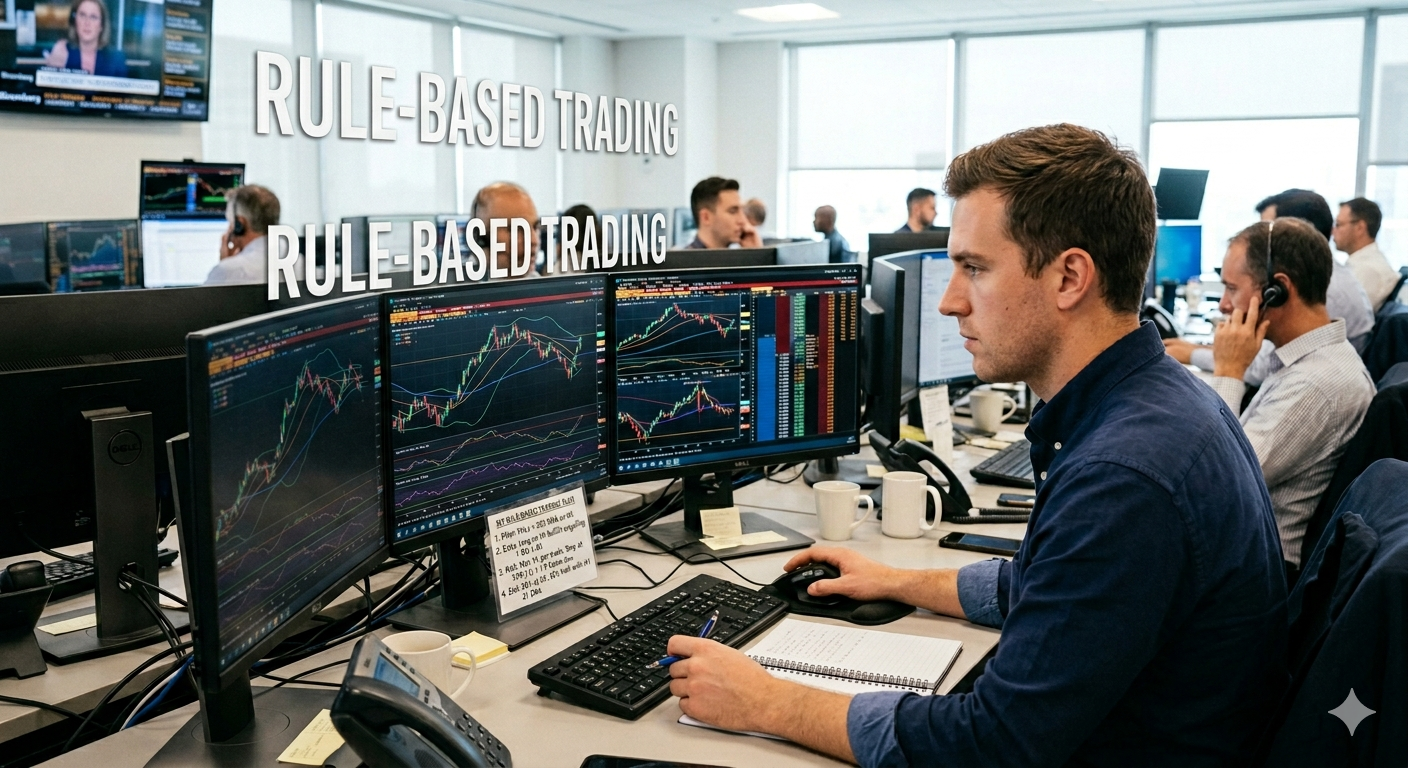
Trading Examples
Trading examples in a rule-based framework do not need to be complicated. A basic swing example might define one liquid market, one trend filter, one entry trigger, one stop-loss rule, one position-size rule, and one time-based exit.
A mean reversion example might do the same thing around a statistically stretched move. The point is not the indicator. The point is that the trade can be written down in advance and reviewed later against the same criteria.
Professional Trading
Professional trading is usually a lot more process-heavy than retail traders expect. Firms that use algorithmic or systematic methods are pushed toward documented controls, software testing, validation, supervision, written risk methods, and recurring reviews.
FINRA groups good practice around risk assessment, code development, system testing, trading systems, and compliance, while the U.S. Securities and Exchange Commission requires ongoing review of market-access controls. The lesson is simple. A professional rule-based process is built to survive mistakes, not just to spot entries.
Best Practices
Best practices in rule-based trading are plain, but they matter. Keep the rule set simple enough to explain out loud. Test with realistic costs. Separate idea generation from validation. Use out-of-sample checks, paper trading, and small live size before scaling anything.
Log rule changes so you know whether better results came from a better edge or just a curve-fit. And always compare live behavior to backtest expectations because those two will drift.
Rule-Based Trading for Beginners
Rule-based trading for beginners works best when the scope is small. Start with one market, one setup type, and one fixed risk rule. Paper trade first. Avoid heavy leverage early.
Do not jump straight into fast intraday trading just because the rules look simple on a chart is one example of a risk-free simulator, and both FINRA and platform risk disclosures make the same basic point: active short-term trading can be risky, especially for people with limited experience or limited capital.
FAQ
FAQ on rule-based trading usually starts with the obvious question: does it guarantee profits? No. Backtests are hypothetical, market conditions change, and live results often differ from simulations.
Can rule-based trading be manual? Yes. A trader can follow written rules by hand, or code them. Rule-based does not automatically mean fully automated.
Do you need coding skills? Not always. Some platforms are code-first, but others are designed so traders can build or modify strategies with less programming experience.
How often should you change the rules? Less often than most beginners think. Rules should change after evidence, not emotion. If every drawdown creates a new version of the system, you stop testing a strategy and start chasing noise.
Is rule-based trading better than discretionary trading? Not automatically. They are different approaches. Research suggests both can work, and each has trade-offs.
