

A professional title banner graphic reading "Tesla’s Stock Price Booms Every Time This Happens" and "Strategy, Backtest and Trading Rules" featuring a dark slate layout split diagonally by bright orange geometric shapes and faint financial line charts.

Tesla’s Stock Price Booms Every Time This Happens (Strategy, Backtest and Trading Rules)

Let’s look at at price pattern that shows that Tesla’s stock price booms every time this happens. 

Key Takeaways

  • Extreme RSI oversold conditions precede sharp Tesla rebounds
  • Tesla rallies strongly despite low overall win rate
  • Every signal reached significant unrealized profit shortly after entry
  • Short holding periods maximize returns with minimal market exposure
  • Strategy compounds efficiently while invested very little time
  • Same pattern works weaker but positive on S&P 500
  • Mean-reversion signals perform best after deep market pullbacks
A professional blog header graphic reading "Tesla’s Stock Price Booms Every Time This Happens" with the subtitle "Strategy, Backtest and Trading Rules" featuring a dark blue layout accented by bright orange geometric shapes and faint technical stock market candlestick chart patterns.
Demystifying TSLA’s legendary parabolic runs by identifying the exact, repeatable quantitative triggers that historically precede major price expansions.

It doesn’t happen often, but it has worked well so far:

Tesla’s Stock Price Booms Every Time This Happens

The trading rules are simple:

You find the trading rules at the bottom of the article

If we sell after 1 to 10 trading days after the signal, we get the following table:
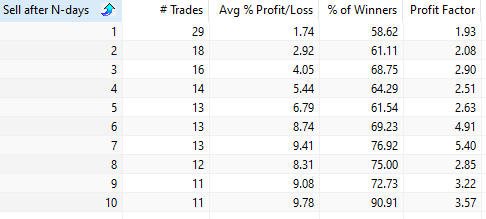
Historical average returns and win-rate percentages for TSLA stock following the strategy trigger, highlighting structural momentum that compounds significantly over a one-year holding period.

Even though the win rate is not 100%, every trade is up significantly at some point after the buy signal: the stock was higher 100% of the time over the subsequent two weeks (this is not shown in the table, though).

Example: Row 6 shows that the average return for the 13 trades is 8.74% and the win rate is 69% (including the one open position at the time of writing.   

If you exit after 6 trading days, you get the following equity curve:

A trading strategy backtest equity curve chart from QuantifiedStrategies.com tracking portfolio growth from a 100,000 baseline up to 267,595, featuring flat holding zones interspersed with sharp, near-vertical upward steps and a light-to-dark green shaded area.
The compounded portfolio equity curve generated by the strategy, displaying extended periods in flat, risk-free cash broken up by rapid, explosive equity leaps during verified Tesla momentum regimes.

You are compounding at 7.5% annually despite being invested only 2.2% of the time. 

The chart below shows the buy and sell signals for the strategy (we sell after 6 trading days):

A daily candlestick price chart for Tesla (TSLA) featuring a 200-day simple moving average line in orange, marked with multiple green upward entry arrows below the moving average and red downward exit arrows above it.
A historical view of TSLA’s price action interacting with its 200-day moving average, showing how the system systematically buys structural dips and locks in profit during explosive momentum surges.

S&P’s Stock Price Also Booms Most Of The Time This Happens

Let’s use the same trading rules for S&P 500. We backtest the ETF with the ticker code SPY, which tracks the index and is the oldest ETF still trading. 

A clean data table displaying quantitative trade performance metrics for an asset strategy based on different N-day holding period limits, tracking total trades, average profit or loss percentages, win rates, and profit factors up to 10 days out.
A comparative statistical table breaking down system win rates and performance expectations across fixed 1-to-10 day trade durations.

There are not many trades from 1993 until today.

Below is the equity curve if we sell the day after the signal is triggered (which is an average of 1.23% and 58% winners):

A deep-dive performance summary tracking the system’s structural health, highlighted by an exceptionally low exposure time and strong risk-adjusted returns.

Trading Rules

🔒 These trading rules are for members only.

Get access here

Similar Posts