
Crypto Trend Trading Strategy for Bitcoin And Altcoins

In recent years, the cryptocurrency market has rapidly transformed from a niche innovation into a significant segment of the global financial system. By March 2025, its total market capitalization soared past $3 trillion, with over 100 cryptocurrencies individually exceeding $1 billion in value. This growth has captured significant attention from both retail traders and large institutional investors.
However, the crypto space is famously volatile. While many investors have pursued speculative gains or long-term fundamental convictions, the inherent volatility and structural risks highlight the critical need for robust, adaptive, and risk-aware investment frameworks that go beyond a static buy-and-hold approach.
This post explores a tactical trend-following methodology, successfully applied in traditional asset classes for decades, and its powerful application to Bitcoin and the broader altcoin market.
The article is based on a research paper by Zarattini, Pagani, and Barbon and is called Catching Crypto Trends; A Tactical Approach for Bitcoin and Altcoins. We emphasize that we at QuantifiedStrategies.com have NOT backtested or verified the results.
Why Smart Trend Trading Strategies
Cryptocurrencies offer fertile ground for systematic trading methods due to their high liquidity, substantial volatility, lack of conventional valuation anchors, and a participant base often prone to emotion-driven decisions. Specifically, trend-following strategies are uniquely positioned to capitalize on sustained price trends or parabolic moves.
The existence of momentum, where asset prices continue moving in their recent direction, has been extensively documented across traditional markets for decades.
Recent academic work has begun to show similar momentum effects within cryptocurrencies. However, much of this existing crypto research often focuses exclusively on Bitcoin, potentially introducing selection bias, or omits crucial practical details about transaction costs, order execution, and portfolio rebalancing, which can significantly impact net profitability.
The research by Zarattini, Pagani, and Barbon aims to address these gaps by empirically testing a diversified trend-following approach across multiple cryptocurrencies and time horizons, explicitly accounting for practical implementation details.
Donchian Channels: Trading Rules
The tactical approach proposed in the paper is rooted in a classic breakout methodology, utilizing Donchian Channels. Originally developed by Richard Donchian in the 1950s, these channels define upper (highest high), lower (lowest low), and middle boundaries over a specified look-back period. A breakout above the upper boundary signals bullish sentiment, while a breach below the lower boundary indicates bearish momentum.
Donchian Channels gained significant recognition through the famous Turtle Traders experiment in the 1980s, demonstrating the profitability of systematic, rules-based trading.
The strategy establishes a long position when the closing price hits the upper Donchian Channel boundary. Each position is then maintained until the price closes below a dynamically updated trailing stop, which is never allowed to move downward, ensuring disciplined exits to protect against reversals.
To manage the high variability of crypto returns, the strategy incorporates a volatility-based position sizing method. Each trend position is sized so that the target annualized volatility is 25%, with allocation capped at 200% to prevent excessive leverage. This means exposure dynamically adjusts, decreasing during periods of high volatility and increasing during calmer market regimes, aiming for a more stable portfolio-level risk profile. While effective at stabilizing volatility, it’s noted that this approach might reduce participation in very strong, volatile trending moves.

The strategy employs an ensemble approach. Recognizing that the effectiveness of trend-following can vary with the look-back window length, the model aggregates signals from multiple Donchian Channel models calibrated with different periods (e.g., 5, 10, 20, 30, 60, 90, 150, 250, and 360 days). This diversification across trend horizons enhances the strategy’s robustness.
Bitcoin & Altcoins: Impressive Performance of Trend-Following
The historical backtests, spanning from January 2015 to March 2025, revealed compelling results for this tactical trend-following approach.
- Performance on Bitcoin:
- ◦ Shorter look-back period models (5 to 30 days) exhibited the strongest risk-adjusted returns.
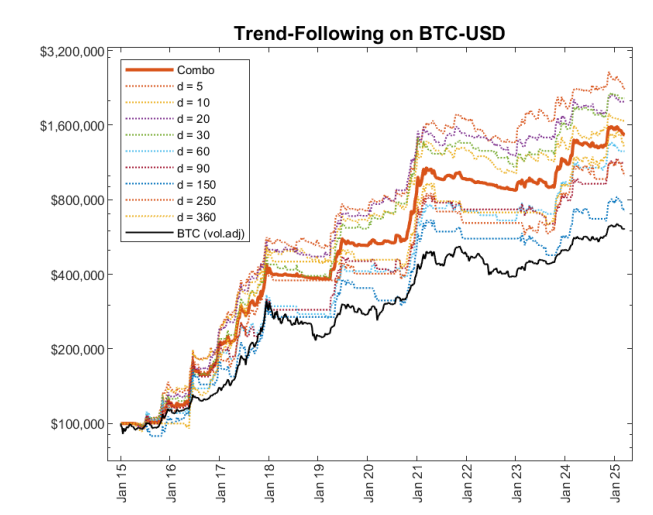
- ◦ The ensemble “Combo” model achieved a Compound Annual Growth Rate (CAGR) of 30%, a Sharpe ratio of 1.58, a Sortino ratio of 2.03, and a significant annualized alpha of 14% versus Bitcoin itself.
- ◦ Notably, it reduced the maximum drawdown to just 19%, compared to over 80% for a passive long position in Bitcoin.
- Performance on a Diversified Altcoin Portfolio:
- ◦ Extending the analysis to a broader universe, the same framework was applied to rotational portfolios of the top 20 most liquid digital assets, rebalanced monthly.
- ◦ This diversified strategy produced a net-of-fees Sharpe ratio of 1.57, a maximum drawdown of only 11%, and a statistically significant annualized alpha of 10.8% relative to Bitcoin.
- ◦ The CAGR remained strong, close to 18% for portfolios up to 20 assets.
The results for Bitcoin can be summarized graphically:
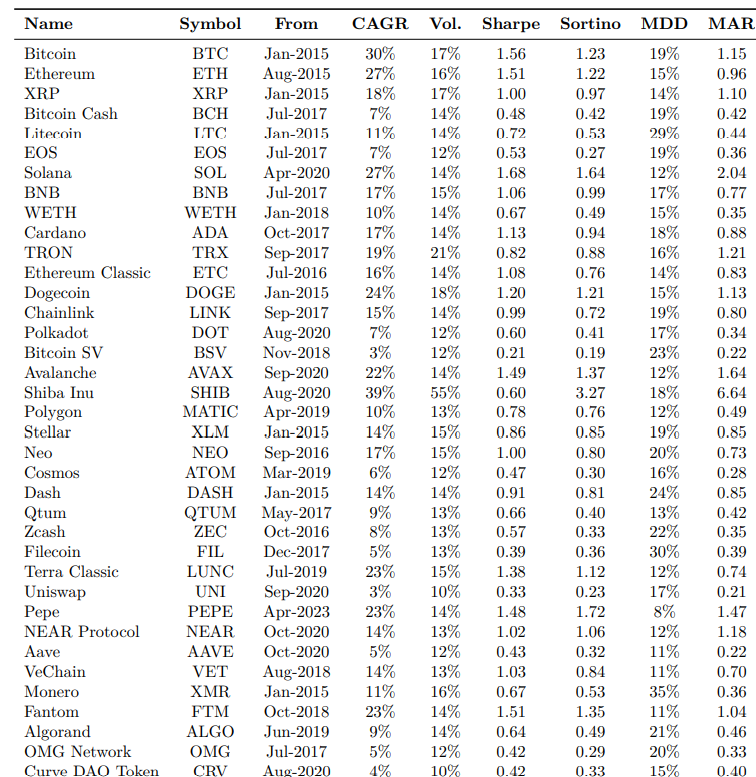
All the coins summarized:
Risk Management and Transaction Cost Mitigation
The study carefully examined the impact of transaction costs, which can significantly erode the profitability of high-turnover strategies. While typical Bitcoin trading costs on major exchanges are often below 5 basis points (bps), the research conservatively assessed sensitivity at 10, 25, and 50 bps. As expected, profitability decreased with higher transaction costs, particularly for short-horizon models with more frequent trading.
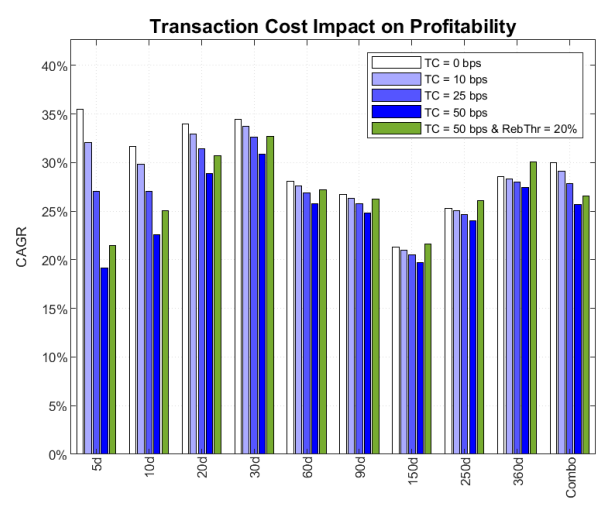
To counteract this, the authors proposed a straightforward yet effective portfolio technique to mitigate these expenses: a 20% rebalance threshold. This rule means the portfolio is only rebalanced if the difference between the current and target allocation (due to volatility changes) exceeds 20%.
This threshold applies only to volatility-induced rebalancing; any signal-based adjustments (like a new entry or stop-loss trigger) result in an immediate position update. This enhancement materially recovered performance, helping to restore a significant portion of the strategy’s gross returns. All reported diversified portfolio results are net of 10 bps transaction costs and incorporate this 20% rebalance threshold.
Diversify Your Crypto Portfolio: Trend Trading Strategy
For a truly robust and resilient implementation, the strategy incorporates a dynamically selected, diversified set of tradable tokens. Each month, eligible assets are identified based on criteria such as being listed for at least 365 days, not being a wrapped token, stablecoin, or NFT collectible, and having a median daily trading volume of at least $2 million over the preceding 30 days. The top assets by volume are then selected.
Historical simulations indicated that performance improved with broader diversification up to approximately 20 assets, after which the marginal benefits of including additional cryptocurrencies diminished. The Sharpe ratio remained notably stable around 1.5 across various portfolio sizes.
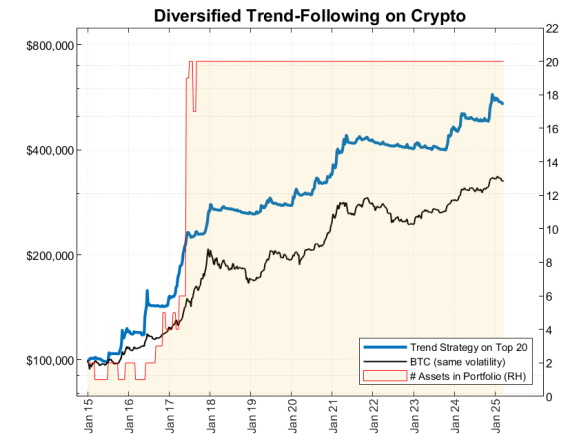
The findings suggest an optimal balance between capturing broad market trends and maintaining capital efficiency lies in a portfolio of approximately 10 to 20 cryptocurrencies. Attempting to diversify further with 50 or more assets would likely introduce challenges like diminishing liquidity, wider bid-ask spreads, and higher transaction costs, potentially offsetting the benefits.
Interestingly, the study found no meaningful “size effect” on the profitability of trend-following strategies when focusing on the top 100 most traded cryptocurrencies; risk-adjusted returns remained stable across liquidity deciles. This suggests that the strategy performs well across a range of sufficiently liquid digital assets.
Crypto Trends vs. Traditional Assets: Uncorrelated Strategies for Your Portfolio
A key finding for portfolio managers is the comparison between the diversified crypto trend-following program and traditional trend strategies.
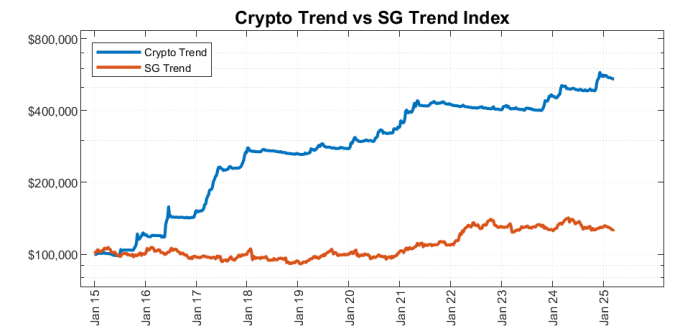
When compared to the SG Trend Index, a benchmark for institutional managed futures programs in traditional asset classes, the 6-month rolling correlation varied substantially, often oscillating between slightly negative values and peaks of over 30%. The average rolling correlation over the sample period was approximately 7.4%, indicating a generally low linear relationship.

This low correlation highlights that crypto trend-following offers meaningful diversification benefits when included in a broader trend-following allocation.
The structural and behavioral characteristics of digital assets seem to contribute to this distinct return profile. Furthermore, the crypto trend program delivered substantially stronger performance than the SG Trend Index, particularly during major momentum phases in the digital asset space. This underscores its potential to capitalize on structural price dislocations and persistent directional moves unique to crypto markets.
Centralized vs. Decentralized Exchange Risks
Implementing crypto trading strategies involves additional risks compared to traditional finance, largely stemming from the fundamental choice between centralized exchanges (CEXs) and decentralized exchanges (DEXs).
- Centralized Exchanges (e.g., Binance, Kraken):
- ◦ Pros: Direct purchase with fiat currencies, algorithmic trading via APIs.
- ◦ Risks: Counterparty risk (assets deposited under the exchange’s custody), vulnerability to hacking attacks, and potential mismanagement or misappropriation of user funds, as seen with Mt. Gox and FTX.
- Decentralized Exchanges (e.g., Uniswap, Hyperliquid):
- ◦ Pros: Avoids counterparty risk because assets remain under the user’s control in non-custodial wallets. Users interact directly with smart contracts and liquidity pools for token swaps.
- ◦ Risks: Full responsibility for asset security falls on the user; loss or compromise of private keys results in permanent loss of tokens with no recovery mechanism. DEXs rely on stablecoins for cash-equivalent exposure, which, despite improvements in transparency, still carry a risk of de-pegging from fiat currencies during market stress. Additionally, all on-chain activity is transparent and publicly accessible, meaning third parties can analyze wallet behavior and potentially reverse engineer trading strategies.
Crypto Trend Trading Strategies – Conclusion
The research presented in “Catching Crypto Trends” clearly demonstrates that a tactical trend-following approach, meticulously designed with Donchian Channels, an ensemble model, and careful risk management, consistently delivers strong risk-adjusted performance across both Bitcoin and a wide selection of altcoins. Investors can achieve high Sharpe ratios, significantly reduced drawdowns, create diversification from traditional assets, and substantial alpha compared to passive crypto exposure.
This strategy is particularly appealing to investors looking to enhance diversification within a traditional trend-following portfolio, or those aiming to capture the immense upside potential of crypto markets while actively avoiding the severe drawdowns that have characterized passive exposure to digital assets.