

Gold Momentum Strategy (Backtest)

In this article, we present you a Gold Momentum Trading Strategy, originally based on research by Cyril Dujava of Quantpedia, suggests that gold performs significantly better when its momentum aligns with that of other asset classes – specifically US Treasuries.
Gold is widely recognized as a safe haven asset and a key indicator of economic conditions in global markets, especially during periods of inflation and heightened geopolitical tensions, which can have a significant impact on gold prices.
This article is based on an article by Allocate Smartly called Gold Cross-Asset Momentum.
A sound gold trading strategy helps you plan and manage your risk, capital, and portfolio.
How the Gold Momentum Strategy Works: Trading Rules
The core of this Gold Momentum Trading Strategy is a well-established relationship between gold prices and Treasury yields. Instead of looking at gold in isolation, this strategy uses a simple two-step verification process at the close of each month:
- Measure 12-month Total Return: Calculate the 12-month total return for both gold (represented by GLD) and 10-year US Treasuries (IEF).
- The Signal: If the 12-month return for both gold and treasuries is positive, you go long on gold.
- The Exit: If either return is negative, the strategy dictates moving to cash until the next month-end evaluation.
A sound gold trading strategy takes into account everything from the current trend to the trading platform being used, as the platform is where you implement, backtest, and execute your trades.
Analyzing past price movements is crucial for identifying trends, support and resistance levels, and potential reversals in gold trading. This historical price action informs the momentum signals used in this strategy.
Position sizing is important; professional traders often limit risk to a small percentage of their total capital for each trade to manage losses effectively.
Traders can use tight stop-loss orders just below the most recent low for long trades or above the most recent high for short trades to protect against sharp reversals.
Why Simplicity Prevents Overfitting
While many trading models are complex, the beauty of this Gold Momentum Strategy lies in its simplicity. Complexity often increases the risk of overfitting, where a strategy is too closely tailored to past data and fails in real-time.
While traditional gold momentum (buying gold simply because its own returns are positive) provides a benefit over buy-and-hold, adding the treasury requirement makes the returns even stronger. By requiring positive momentum in both assets, the strategy reduced exposure by 19%, effectively cutting out a significant number of low-performing months over the last 50 years.
Related reading: –Why Every Trader Should Diversify Into Gold Strategies
Risk Management in Gold Momentum Trading
Effective risk management is the cornerstone of any successful gold trading strategy. Given the inherent volatility of the gold market, traders must adopt a disciplined approach to minimize losses and maximize potential gains. One of the most practical ways to reduce risk is by setting stop-loss orders, which automatically close a position if the gold price moves against you beyond a predetermined level. This helps protect your portfolio from significant drawdowns during sudden market fluctuations.
Position sizing is another critical component – limiting the size of each trade ensures that no single position can disproportionately impact your overall portfolio value. By carefully managing exposure, traders can maintain a balanced approach even during periods of heightened volatility.
Technical indicators such as the Relative Strength Index (RSI) and Moving Average Convergence Divergence (MACD) are invaluable tools for assessing overbought or oversold conditions in the gold market. These indicators help traders identify optimal entry and exit points, allowing them to capitalize on prevailing market trends while avoiding trades during less favorable market conditions. Moving averages, like the 50-day and 200-day, can also provide clear signals for trend direction and potential reversals.
Staying attuned to macroeconomic factors, central bank policies, interest rate changes, and the strength of the US dollar is essential, as these elements can have a significant impact on gold prices. Geopolitical risks and global market events often drive investors toward gold as a safe haven asset, but it’s important to continually assess whether current market conditions support a bullish or bearish outlook.
Before committing real capital, traders can use demo accounts to test and refine their gold trading strategy. This practice environment allows for experimentation with different risk management techniques and technical indicators without financial risk, building confidence and improving decision-making.
Trailing stops are another effective tool, enabling traders to lock in profits as the gold price moves in their favor while still providing downside protection if the market reverses. Regularly reviewing backtested results can offer insights into how a strategy might perform under various market cycles, but it’s crucial to remember that past performance does not guarantee future results—market conditions can and do change.
A disciplined approach to gold trading includes ongoing research, monitoring market news, and adjusting strategies as new data and trends emerge. Regular portfolio rebalancing and careful position sizing help maintain a healthy risk-reward balance, supporting long-term investment goals.
Ultimately, every trader should consider their own risk appetite, investment objectives, and financial situation before engaging in gold trading. Seeking professional investment advice can further help tailor a gold trading strategy to individual needs. By combining technical analysis, fundamental research, and robust risk management techniques, traders can navigate the complexities of the gold market with greater confidence and consistency.
Performance Insights: 50 Years of Data
Backtested results from 1970 show that this Gold Momentum Strategy has been consistent for over five decades. However, there are nuances to its performance:
- Cash Returns: Since roughly 2002, the advantage of the strategy versus a simple buy-and-hold approach has appeared to wane slightly. This is largely due to weaker returns on cash during that period, meaning investors weren’t rewarded as much when the strategy moved out of gold.
- Annualized Return: Annualized return is a key metric for evaluating the effectiveness of momentum strategies, as it measures the compounded growth rate of the portfolio over time.
- Effectiveness: Despite the lower cash returns, the strategy remains similarly effective when looking strictly at the periods when the investor is actually in the market. Tracking price movements and price action is crucial for identifying trading opportunities and maximizing returns.
- Volatility: Gold naturally “runs hot and cold”. This strategy can go through long periods, up to two decades, where it might drastically underperform the broader market. Gold prices can also fall during certain market conditions, such as rising interest rates or geopolitical crises, leading to downturns that traders must be aware of.
- Comparison to Stocks: Compared to stocks, gold often serves as a safe haven during periods of economic uncertainty, providing diversification benefits and offsetting losses when market confidence in stocks declines.
- Short-Term Price Movements: Short-term price movements during high-volatility, news-driven market events can be captured using 5-minute charts, allowing traders to exploit rapid changes.
- Breakout and Range Trading: Breakout strategies provide opportunities when the market transitions between bearish, bullish, and range-bound phases, while range trading strategies profit from price oscillations between support and resistance levels.
- Volume and Momentum: High trading volume typically validates strong momentum, while moves on low volume are considered less reliable.
- Bollinger Band Squeezes: Bollinger Band Squeezes indicate periods of low volatility, which often precede momentum explosions.
- Golden Cross and Death Cross: A Golden Cross signals bullish momentum, while a Death Cross signals bearish momentum.
- Herding Behavior: The strategy exploits the herding behavior of market participants, where FOMO (fear of missing out) drives more investors into an existing trend.
Here is the equity curve from Allocate Smartly:
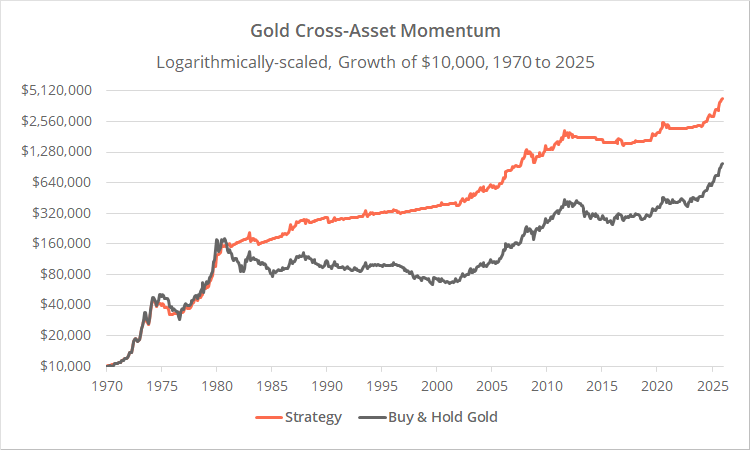
Gold Momentum Trading Strategy
These are the performance metrics:
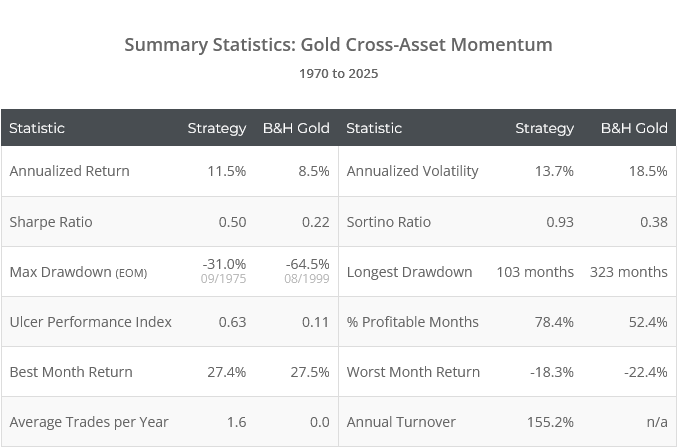
Gold momentum trading strategy returns
We backtested the strategy ourselves and got the following results for GLD (the gold ETF) from its inception until today:
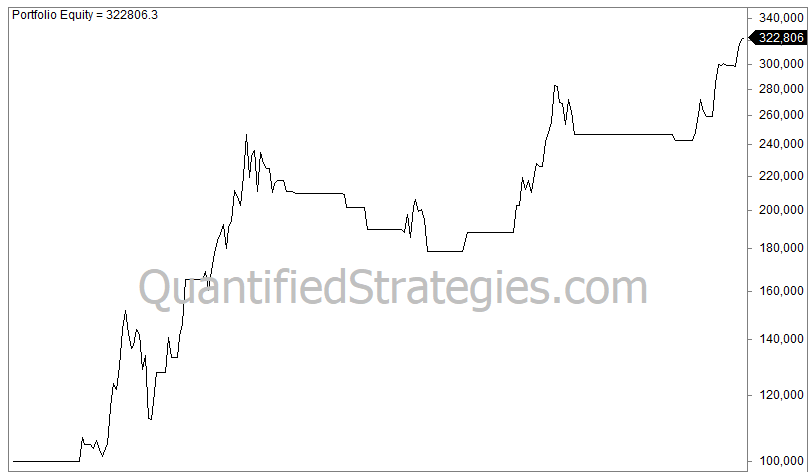
Gold Momentum Strategy
The return is almost 6% per year, while buy-and-hold returned 10.5%.
If we use the same trading rules on weekly bars, the results improve slightly:
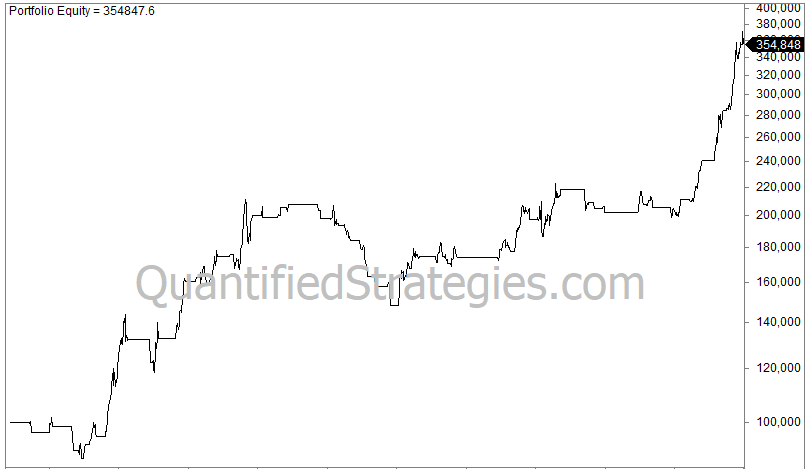
Gold Momentum Strategy (weekly bars)
The annual returns increase to 6.2%.
Gold Momentum Strategy: Final Thoughts
Because gold is highly volatile, this approach is generally not considered a standalone portfolio solution and should usually be limited to a small percentage of total assets.
Alternatively, it can be used as an overlay for other gold-related strategies. In an overlay application, an investor only follows a gold signal from another strategy if the Gold Momentum Strategy also confirms that both gold and treasury momentum are positive.
Gold Trading: Frequently Asked Questions
What is the most profitable gold trading strategy?
While no strategy guarantees 100% success, Trend Following combined with Price Action is widely considered the most consistent. Because gold is a “trending” asset, traders often identify the primary direction on a Daily chart and look for “Breakout” entries during high-volatility sessions like the London/New York overlap.
Do gold trading strategies work?
Yes, but they require strict discipline. Gold (XAU/USD) is significantly more volatile than most currency pairs. A strategy only “works” if it accounts for Fundamental Analysis (Interest rates and USD strength) alongside Technical Analysis. Without a solid risk management plan, even a winning strategy can fail during a sudden market spike.
What is the 5-3-1 rule in trading?
The 5-3-1 rule is a framework designed to help traders focus and avoid “analysis paralysis”:
- 5: Focus on five currency pairs or assets (like Gold) to learn their personality.
- 3: Choose three specific strategies that you have mastered.
- 1: Stick to one specific time of day to trade (e.g., the New York Open).
What is the 5 minute gold trading strategy?
This is a high-speed Scalping Strategy used to capture small price movements. It typically involves using the 20 and 50 Exponential Moving Averages (EMA) on a 5-minute chart. Traders look for a “cross” of these averages confirmed by an RSI reading above 50 for buys or below 50 for sells, aiming for a quick profit of 10–20 pips.
What are the biggest gold trading mistakes?
The most common pitfalls include ignoring the US Dollar Index (DXY), as gold usually moves inversely to the dollar. Other major mistakes include over-leveraging (using too much margin for gold’s high volatility) and trading during “choppy” consolidation periods where there is no clear trend.
What is a gold future trading strategy?
Gold futures involve contracts to buy or sell at a set price on a future date. A common strategy is Volume Profile trading, where traders identify “Value Areas” (price levels where the most trading volume occurred). Entering trades at these high-volume nodes allows retail traders to follow the “Big Money” or institutional flow.
