
The Real Reason You Keep Switching Trading Strategies (And How to Stop)

You have probably experienced the following:
You crush it for a week with Strategy A – three green days in a row, confidence through the roof. Then a couple of losers hit, and suddenly you’re on Reddit hunting for Strategy B.
Two weeks later, you’re convinced Strategy C is “the one.”
Does this sound familiar?
If you’re like most retail traders, you’ve probably cycled through half a dozen systems in the last year alone. You tell yourself the old one “stopped working.” The market changed. The indicators are broken.
But deep down, you know the pattern: you abandon ship the moment things get uncomfortable, and you get uncertain.
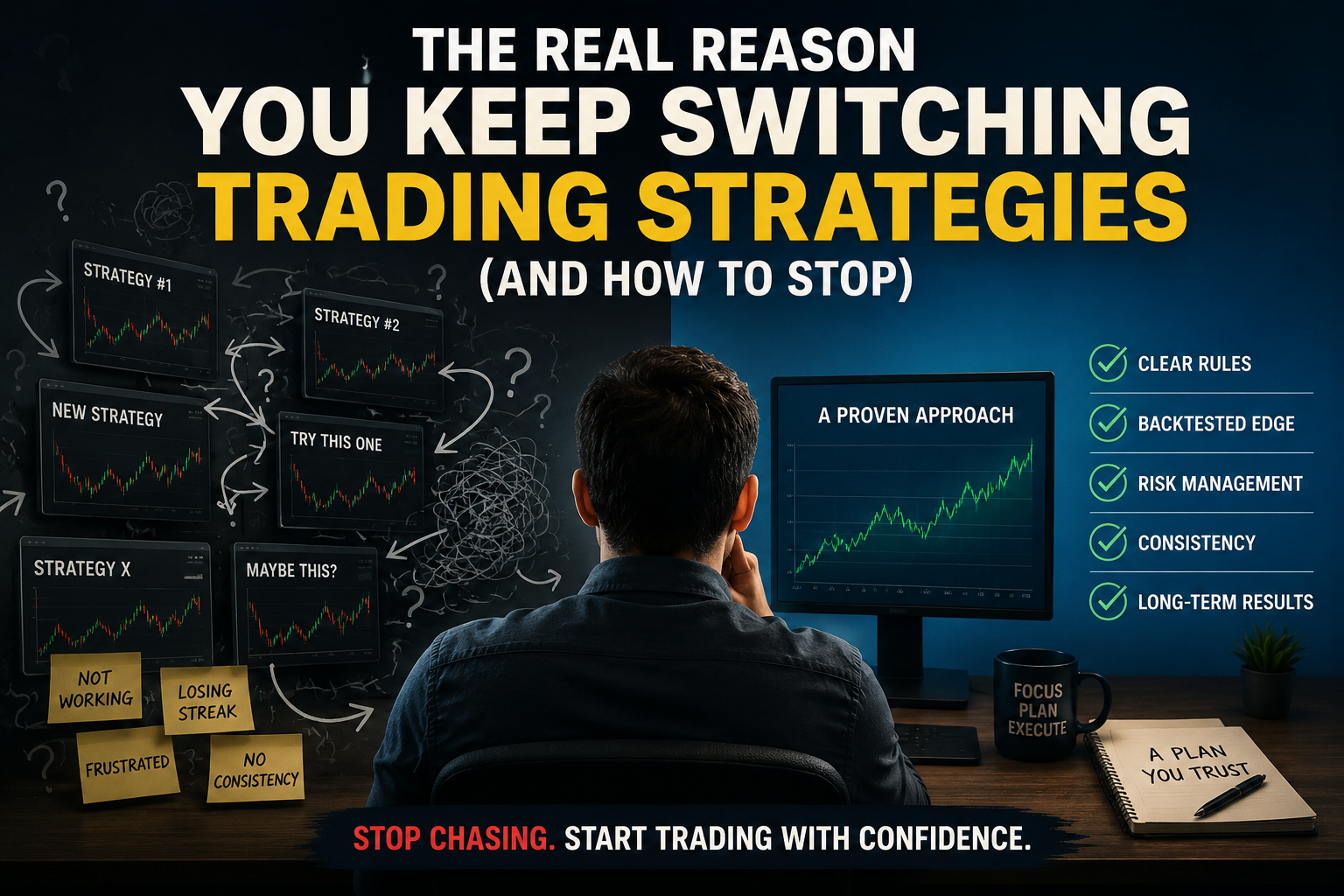
But here’s the uncomfortable truth: The real reason you keep switching isn’t that the strategies are bad. It’s that you’ve never given any single one enough time or “emotional” space for its statistical edge to actually show up.
Now, to help you get started, we have made an inexpensive course that includes two strategies:
If you follow this course, it should increase the probability of making money from the start.
The Brutal Stats That Explain Why Most Traders Stay Stuck
Let’s get the numbers out of the way so we’re not sugarcoating anything:
- Research shows roughly 80–95% of day traders lose money overall. Personally, Hakan and I believe the numbers are closer to 99% (!)
- 97% of traders who stick it out for more than 300 days still lose money.
- 40% quit within their first month. Within three years, only 13% are still trading. After five years? Just 7% (Source: tradeciety.com)
- In 2024, 72% of day traders ended the year in the red (source: blueguardian.com)
- In swing trading, the numbers are better, but not by a wide margin
- In investing, the great majority underperforms the indices by many percentage points (Source: JP Morgan)
The tiny group that actually makes it (the 1–2% who are consistently profitable) isn’t using some secret holy grail indicator. They simply stopped doing what you’re doing right now.
The Real Psychological Trap: Shiny Object Syndrome + Recency Bias on Steroids
You don’t switch because you’re undisciplined in the generic sense. You switch because your brain is wired to chase dopamine and avoid pain in the moment.
- Novelty bias: A new strategy feels exciting. The backtests look perfect. The YouTube guru’s screenshots are flawless. Your current system feels boring and “broken” after a normal drawdown.
- Recency bias: Three losing trades in a row feel like proof the strategy is dead, even though every winning system has losing streaks built into its math.
- Lack of trust in probabilities: Most hoppers have never truly calculated their strategy’s expectancy (average win × win rate – average loss × loss rate). Without that number burned into your brain, every red day feels personal instead of statistical.
- Optimism/pessimism bias: Just like recency bias, you switch from optimism to pessimism.
Mark Douglas nailed this years ago in Trading in the Zone (a book we strongly recommend): consistency doesn’t come from finding the perfect strategy. It comes from executing a single, sound strategy with strict discipline while treating trading as a probability game, not a series of emotional events.
You’re not strategy-hopping because you lack knowledge. You’re doing it because you lack the emotional tolerance to sit through the variance.
The Hidden Cost Nobody Talks About
Every time you switch, you reset the clock:
- You lose all the data you’ve collected on how your specific personality interacts with that system.
- You pay higher transaction costs and spread slippage while learning the new rules.
- You reinforce the belief that “the next one will finally work” (but which is just another form of gambling).
The result?
You become a collector of half-tested edges instead of a master of one.
How to Finally Stop: The 180-Day Commitment Framework
Here’s the exact process that turns chronic hoppers into consistent traders. It’s simple, but it’s not easy because it forces you to feel the discomfort you’ve been avoiding.
- Step 1: Pick ONE strategy and write it in 3 sentences or less. Entry rules. Exit rules. Risk rules. Nothing else. No “sometimes I add this indicator if the moon is full.” Print it and tape it to your monitor.
- Step 2: The trading rules must be precise enough to backtest. How else do you know if you can make money? Backtesting is far from bulletproof, but in our opinion, the best starting point.
- Step 3: Commit publicly and set the non-negotiable test period. Minimum 180 trading days or 200 trades- whichever comes last. No exceptions, even if you’re down 20%. Tell a trading friend or post it in a private group. External accountability is rocket fuel.
- Step 4: Reduce size. You need to detach from money. To make sure you take all trades, reduce size.
- Step 5: Build your expectancy and track it religiously.
- Step 6: Disable noise and distractions. Only selectively read social media. Replace the dopamine with something else.
- Step 6: Make sure you have a trading journal where all trades are registered. Rate your emotional state on every trade (1–10). You’ll start seeing the pattern: the urge to switch almost always hits at 3/10 or lower.
Before you take another live trade, you must know:
- Historical win rate in different market regimes
- Average win vs. average loss
- Maximum expected drawdown
If you don’t have this data, you’re not trading; you’re gambling with extra steps.
To strengthen the commitment, we recommend that you write an agreement with yourself and put it on the wall (!).
If you want to refine the strategy, only tweak one variable at a time.
When It Is Okay to Pivot (The Rare Exception)
Only after you’ve completed the full test period and the market regime has objectively changed (e.g., you were trading a mean-reversion strategy during a strong trending year). Even then, the new strategy still gets the full 180-day treatment.
The Edge Isn’t in the Strategy – It’s in You
The next strategy you try won’t be magically better than the last one. But if you finally stick with it long enough for the math to work, you will become the trader who actually has an edge. That said, you must trade several strategies to get diversification.
Most people will read this article, nod along, and still switch strategies next week. The 1% who print out the commitment contract and actually follow through? Those are the ones who no longer count toward the 99% statistic.
Your move: Pick your one strategy today. Journal your first 10 trades with full emotional transparency. Then come back in three months and tell us how it feels to finally stop running.
The market doesn’t reward the smartest strategy. It rewards the most consistent executor.
Now go and execute!