

A Trend Following Strategy for the S&P 500 (Backtest)

A trend following strategy for the S&P 500 is one of those ideas that seems almost too simple to work: be invested when the market is rising, and step aside when it starts falling. Despite this simplicity, the approach has proven remarkably durable across decades of bull markets, crashes, and sideways periods.
What Is Trend Following?
At its core, trend following is not about prediction, it’s about reaction. Instead of trying to forecast where the market will go next, you simply observe what it is already doing and align yourself with that direction. If the market is trending higher, you stay long. If the trend breaks, you exit.
This philosophy gained widespread attention during the famous Turtle Experiment in the 1980s, where Richard Dennis demonstrated that even novice traders could apply systematic trend-following rules successfully. The takeaway was clear: success didn’t require complex forecasts, but discipline and consistency.
Why Trend Following Works in the S&P 500
The S&P 500 is particularly well-suited for trend following because of its long-term upward bias combined with periodic, often severe drawdowns. A trend-following strategy aims to capture the bulk of sustained moves while avoiding the worst declines.
Importantly, trend followers don’t try to pick tops or bottoms. Instead, they focus on capturing the “meat” of the trend. This means accepting that you’ll never buy at the exact low or sell at the exact high, and being completely fine with that trade-off.
The Drawbacks of Trend Following
Trend following is not easy to execute in practice. One of the biggest challenges is the low win rate. Many trades will be small losses due to “whipsaws,” where the market briefly breaks a level before reversing.
This leads to strings of losing trades, which can be psychologically difficult. For example, after five consecutive losses, many traders hesitate to take the next signal, often right before a big trend emerges. The edge in trend following comes from sticking to the rules, especially during these difficult periods.
Why Trend Following Is Appealing
One of the biggest advantages of trend following is its simplicity and objectivity. There’s no need to constantly interpret macroeconomic data, central bank decisions, or valuation metrics. The market itself dictates your actions.
Personally, this is what makes the strategy so attractive. It removes opinion and replaces it with process. You follow predefined rules, trust the system, and let the probabilities play out over time.
Additionally, trend following works very well as a complement to mean reversion strategies. These two approaches behave very differently, which makes them powerful when combined. A diversified trading approach, across strategies, time frames, and asset classes, is often more robust than relying on a single edge.
Does a Trend Following Strategy for the S&P 500 Work?
A simple backtest gives useful insight. Since 1960, a basic trend-following strategy on the S&P 500 delivered around 6% annual returns on the cash index. While this is lower than the approximately 7.5% return from buy-and-hold, the strategy was only invested about 65% of the time.
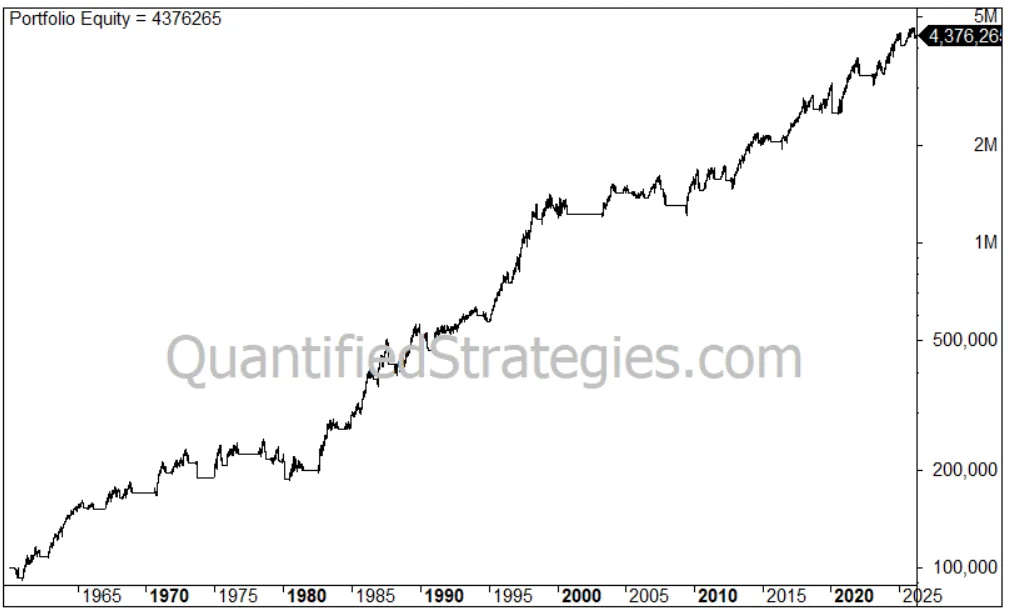
Because of this reduced exposure, the risk-adjusted return is actually stronger – closer to 9%. Even more importantly, the maximum drawdown was significantly lower: about 25% compared to roughly 55% for buy-and-hold.
Simple Trading Rules
The strategy itself can be implemented with very straightforward rules:
- Buy when the closing price breaks above the 100-day high
- Sell when the closing price breaks below the 100-day low
These rules are easy to understand, but as always, the real challenge lies in consistently following them through both winning and losing periods.