
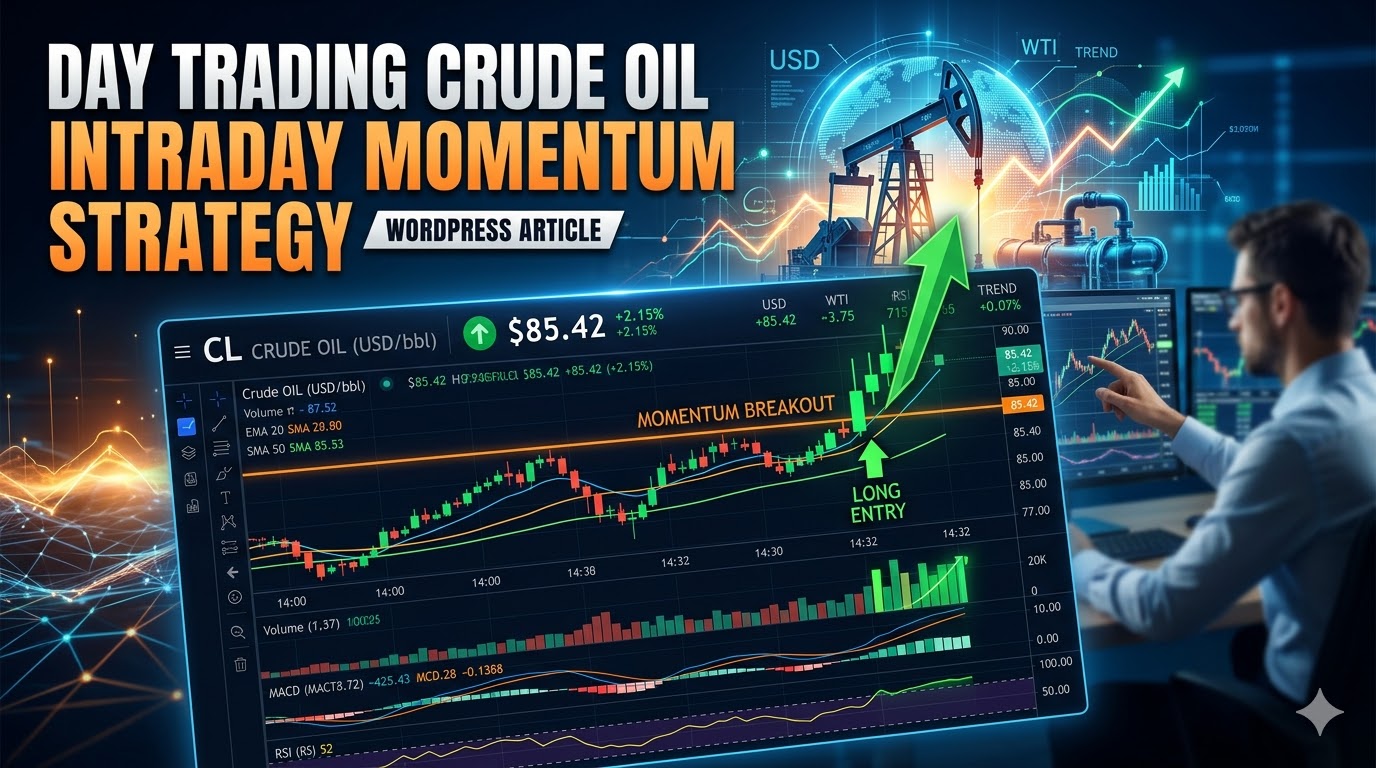
Day Trading Crude Oil: Intraday Momentum Strategy

For decades, traders have used momentum strategies, the idea that past winners keep winning, to find success in equity, currency, and commodity markets. While most research focuses on long-term trends over months or years, a groundbreaking study by Wen et al. (2019) called Intraday Momentum and Return Predictability: Evidence from the Crude Oil Market reveals a powerful phenomenon happening within a single trading day:
Crude oil is one of the world’s most traded commodities and is primarily priced against two benchmarks: Brent Crude and West Texas Intermediate (WTI). Brent Crude serves as a global benchmark, while WTI is a key benchmark for US oil prices and is widely traded globally. These benchmarks reflect the dynamics of the global oil market, providing traders with real-time opportunities across international exchanges. Intraday momentum trading strategy in the crude oil market.
The First 30 Minutes Predict the Last 30
By analyzing high-frequency data from the United States Oil Fund (USO) between 2006 and 2018, researchers discovered that the first half-hour of trading (9:30–10:00 a.m. EST) significantly predicts the last half-hour of the day (3:30–4:00 p.m. EST).
Essentially, if the oil market performs well in its opening minutes, it is statistically likely to finish the day on a high note.
For short-term traders, this means that if the first half-hour is positive, the strategy involves opening a long position to capitalize on potential intraday gains. This approach is particularly suited for those prioritizing flexibility, liquidity, and quick trade execution. This finding is robust for both in-sample and out-of-sample data, providing a reliable signal for high-frequency traders.
Why Crude Oil Futures are Different from the Stock Market
While intraday momentum exists in stocks, the oil market behaves uniquely. In the U.S. equity market, both the first and the second-to-last half-hour returns help predict the end-of-day result. However, the sources show that in the crude oil market, the second-to-last half-hour has no predictive power.
This suggests that oil traders need a specialized approach that differs from traditional stock trading strategies.
When Does Intraday Momentum Work Best?
The strength of this predictability isn’t constant; it fluctuates based on market conditions. The study found that momentum is significantly stronger during:
- Market Crises: Predictability was nearly six times stronger during oil market and global financial crises compared to stable periods.
- High Volatility and Volume: On days with large price swings or heavy trading activity, the “opening signal” becomes much clearer.
- Overnight News Jumps: The momentum is most powerful on days following significant overnight news, especially positive news.
- The “Market Timing” Strategy: Outperforming Buy-and-Hold
During periods of high volatility and volume, increased activity from market participants can amplify price movements. Crude oil prices are influenced by a combination of geopolitical events, natural disasters, changes in supply and demand, and investor speculation, all of which can contribute to the heightened momentum observed during these periods.
Trading Rules
To test the economic value of this discovery, the researchers developed a market timing strategy. The trading rules are simple:
- Observe the return in the first half-hour (1).
- Take a position: If 1 is positive, go long; if 1 is negative, go short.
- Exit: Close the position at the very end of the trading day.
This strategy generated an annualized average return of 1.85%, significantly outperforming the “always-long” strategy (0.76%) and the traditional “buy-and-hold” strategy, which actually saw a loss of 17.89% over the same period. Furthermore, the timing strategy offered a higher Sharpe ratio, indicating better risk-adjusted returns.
The Science Behind the Trend: Why Does This Happen?
Researchers point to two primary economic drivers for this intraday pattern:
- Infrequent Portfolio Rebalancing: Some investors, hampered by “slow-moving capital,” delay their trading orders until near the market close, following the same direction as the morning’s moves.
- Late-Informed Investors: Not everyone processes news at the same speed. “Late-informed” investors may take hours to digest overnight information, eventually entering the market during the highly liquid final half-hour, which reinforces the initial price direction.

Intraday Momentum Trading Strategy In Crude Oil
Risk Management and Position Sizing
The crude oil market is renowned for its volatility, with crude oil prices often swinging dramatically in response to global events, supply and demand shifts, and unexpected data releases. For traders, this means that managing risk is not just important – it’s essential for long-term success.
One of the cornerstones of risk management in trading crude oil futures is position sizing. Determining how much capital to allocate to each trade can make the difference between weathering a volatile market and suffering outsized losses.
Many traders use stop-loss orders to automatically exit a trade if the market price moves against them, limiting potential losses. Similarly, limit orders can be set to lock in profits when crude oil prices reach a predetermined level. By combining these tools with thoughtful position sizing, traders can protect their accounts from the unpredictable swings that characterize oil markets.
Technical and fundamental analysis play a vital role in informing these risk management decisions. Technical indicators such as the Relative Strength Index (RSI) help traders spot overbought or oversold conditions, signaling when a reversal in price action might be on the horizon. Meanwhile, fundamental analysis—tracking supply and demand trends, monitoring geopolitical events, and staying alert to economic data releases—provides crucial context for understanding why crude oil prices are moving and what might come next.
For those new to trading crude oil futures or looking to manage risk more tightly, micro crude oil futures contracts offer a practical solution. At one-tenth the size of standard contracts, micro crude oil futures allow traders to participate in the market with smaller trade sizes and lower margin requirements, making it easier to control risk and fine-tune position sizing.
Successful crude oil trading also means staying informed about the factors that drive oil prices. Geopolitical tensions, changes in production levels, and shifts in global supply and demand can all trigger significant price movements. By keeping a close eye on market news and analysis, traders can anticipate potential risks and adjust their strategies accordingly.
Related reading: –WTI Crude Oil Trading
Conclusion for Traders
The crude oil market offers a predictable window of opportunity for those who know where to look. By paying close attention to the first 30 minutes of the trading day, investors can gain a statistically backed advantage in predicting the final 30 minutes, especially during times of high volatility and crisis.
Technical analysis is essential for identifying market direction and timing entries and exits in crude oil day trading strategies. However, you need to backtest the ideas prior to trading live. Traders can also benefit from educational resources to deepen their understanding of intraday momentum strategies and crude oil market dynamics.
Analogy for Understanding: Think of the trading day like a long-distance race. In the oil market, the “first lap” (the first 30 minutes) often acts like a pacesetter. If the lead runner starts with an aggressive, confident burst, the momentum tends to carry through to a strong finish in the final lap, as the rest of the field (the late-informed traders) eventually follows that same path.
