

How to Rotate Between Assets: 3 Backtested Strategies

Many readers have indicated they like to rotate between assets. Thus, we compile an article called how to rotate between assets: 3 backtested strategies.
Markets rarely move in the same direction at the same time. While one asset class is performing well, another may be struggling.
Asset rotation strategies attempt to take advantage of these differences by systematically shifting capital toward the strongest assets.
In this article, we look at three backtested asset rotation strategies, explain how they work, and examine their historical performance.
The first strategy is one from Meb Faber:
Meb Faber’s Momentum and Trend-Following Strategy For Gold, Stocks, And Bonds
Most investors are attracted to complexity.
Here’s an example of how you can utilize the momentum factor in practice:
- A momentum investor buys stocks that have performed best over the last 6 months (can be 3, 9, or 12 months)
- The investor rebalances his portfolio every month or every 3 months by selling the least performing ones and buying new stocks that are currently performing best.
Pretty simple. Rinse and repeat 4 times per year.
Meb Faber suggested using a variation of the above for the most obvious three asset classes. You find the trading rules at the end of the article.
Meb Faber’s Momentum and Trend-Following Strategy – Backtest
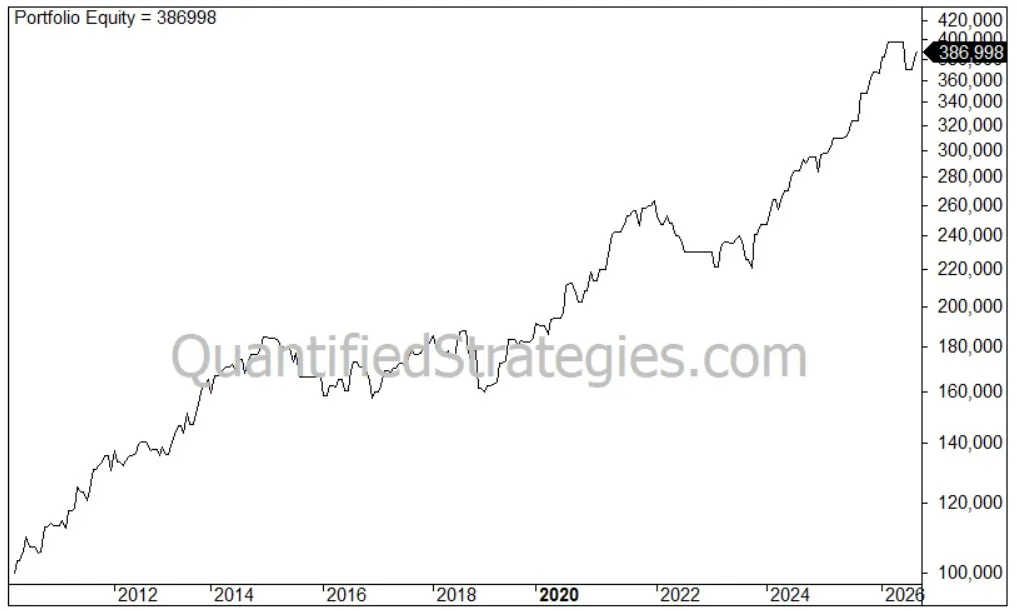
We backtested it from 2010 until today (it has performed well before that):
Performance
- No. of trades: 382
- Average gain per trade: 0.7%
- Win ratio: 55%
- Profit factor: 1.6
- Annual returns (CAGR): 8.7%
- Exposure/time in the market: 92%
- Risk-adjusted return: 9.3% (CAGR divided by time spent in the market (0.92))
- Max drawdown: -15%
Let’s go to the second one:
Multi-Asset Sector Rotation Strategy
Instead of trying to predict which asset class will perform best, the strategy follows price trends across several markets. When an asset is rising and showing strength, the strategy can be invested.
When the trend weakens, it can reduce exposure or move to another asset.
The main idea is simple: participate in strong trends, avoid prolonged weakness, and diversify across different return drivers.
A strategy that only trades stocks depends heavily on the stock market environment. But a multi-asset approach can include stocks, bonds, gold, commodities, and other assets. This gives the strategy more opportunities and may reduce the reliance on a single market.
Trend following is not perfect. It can suffer from false signals, whipsaws, and prolonged underperformance. But its biggest advantage is that it does not require forecasts. It reacts to what the market is actually doing.
However, trend-following can be difficult to sustain due to the low win rate.
Multi-Asset Trend-Following Strategy
The backtested strategy returned the following results (after slippage and commissions of 0.03% per trade):

Strategy type: Trend-Following.
Market: SPY (S&P 500), TLT (Treasury bonds), GLD (gold), EEM (Emerging stock markets), EFA (International stocks developed markets ex. USA, and DBC (Commodities).
Performance
- No. of trades: 122
- Average gain per trade: 5.8%
- Win ratio: 57%
- Profit factor: 3
- Annual returns (CAGR): 9.1%
- Exposure/time in the market: 74%
- Risk-adjusted return: 12.3% (CAGR divided by time spent in the market (0.74))
- Max drawdown: 17%
The risk-adjusted return is decent. You are on average 26% in cash, earning nothing, perhaps capital that can be employed elsewhere.
Now, we are ready for the third and last of the 3 backtested sector strategies:
Momentum Strategy for Stocks, Bonds, and Gold
Instead of trying to predict the next market move, this strategy follows what the market is already telling us.
The Momentum Strategy for Stocks, Bonds, and Gold ranks these three asset classes based on recent performance and allocates to the strongest trends.
Stocks offer growth potential, bonds can provide stability, and gold may help during inflationary or crisis periods.
By using momentum to shift exposure between them, the strategy aims to participate in strong markets while becoming more defensive when conditions weaken.
Does it work?
Momentum Strategy for Stocks, Bonds, and Gold
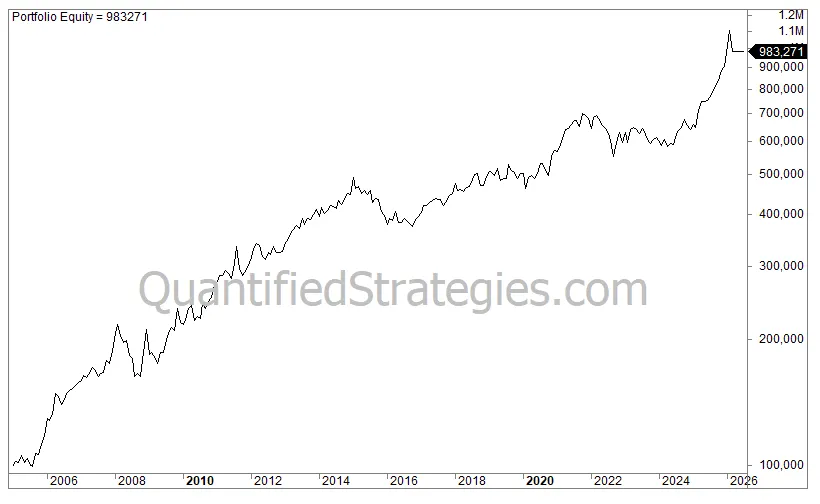
We backtested it (trading rules at the bottom):
Strategy type: Momentum/rotation strategy
Market: SPY (S&P 500), bonds (TLT), gold (GLD)
Performance
- No. of trades: 98
- Average gain per trade: 2.6%
- Win ratio: 60%
- Profit factor: 2.7
- Annual returns (CAGR): 11.3%
- Exposure/time in the market: 100%
- Risk-adjusted return: 11.3% (CAGR divided by time spent in the market (1))
- Max drawdown: 25%
Trading Rules
The trading rules for the strategies read like this:
You find the trading rules at the bottom of the article
We did an optimization:

The first column shows the number of months in the lookback period, while the second column shows the annual returns. As you can see, it has performed well over all periods.