

How We Built a Bitcoin Trend-Following Strategy Using ChatGPT

beast. It doesn’t behave like stocks, bonds, or even gold. It trends when it wants to — and when it does, it often does so aggressively. That’s exactly why trend-following strategies can work well with crypto. But to avoid the whipsaws and noise, you need the right kind of filter.
In this post, we’ll walk you through how I used ChatGPT to help design a simple but surprisingly effective Bitcoin trend-following strategy. We started with the classic Donchian Channel breakout and added a simple twist that made a big difference in performance.
Key Takeaways
- Bitcoin trend-following strategies capture strong price trends
- Donchian Channel breakout identifies Bitcoin trend entries
- ADX filter detects low-volatility breakout conditions
- Bitcoin consolidations often precede explosive moves
- Systematic rules reduce emotional crypto trading
- Backtesting validates crypto trading strategy performance
- Trend strategies outperform buy-and-hold in tests
- Volatility-based filters improve breakout reliability
Related reading: – Bitcoin and crypto trading strategies
The Core Idea: Trend Following for Bitcoin
Trend-following is a time-tested strategy. It doesn’t predict – it reacts. You buy strength, hold it, and exit when the trend weakens.
We made the following prompt in ChatGPT:
I would like to create a trend following strategy for Bitcoin. Can you please help me get some ideas?
As you can see, it was a pretty simple prompt.
ChatGPT provided 5 different trading ideas:
- A moving average crossover system.
- Donchian Channel breakout
- Trend with pullback confirmation
- Volatility-weighted trend following
- Time-series momentum
We didn’t backtest all strategies, but we opted to examine the Donchian Channel breakout system in more detail because it has historically been successful for the Turtle traders. It’s also one of the oldest trading ideas.
Originally used by Richard Donchian and later made famous by the Turtle Traders, this strategy simply says:
➡️ Buy when price breaks above the highest high of the last N days — that’s your breakout.
➡️ Exit when price drops below the lowest low of the last M days.
This method is popular because it’s:
- Simple
- Systematic
- And often effective on assets that trend strongly — like Bitcoin
Our Twist: A 15-Day Breakout With an ADX Filter
Rather than using the standard 20-day breakout, we made two key adjustments:
1. A Shorter Lookback: 15-Day High
This makes the strategy more responsive, entering trends slightly earlier, which can be beneficial in crypto. We backtested the lookback period from 5 to 100 days, and all are profitable. However, 15 seems to offer the best risk and reward.
2. ADX Filter: Only Trade When ADX(14) < 25
This is the unusual part.
Most people use ADX to confirm strength: they only want to trade when the ADX is high. But we did the opposite. We only allowed trades when ADX was below 25.
Why? A low ADX typically indicates that the market is quiet or consolidating. And Bitcoin often breaks out explosively from low-volatility conditions.
By using this filter, we was able to:
- Avoid entering during noisy chop
- Position trades just before volatility expansion
- Reduce false signals
The Final Strategy Rules
Here are the exact rules we used:
Long Entry:
- Bitcoin closes above the 15-day high
- ADX(14) is below 25
- Enter at the close
Exit:
- Price closes below the 15-day low
- Exit at the close
You can enter and exit at next open, as well.
No short trades. Bitcoin has historically been biased to the upside, and trend-following tends to work best on the long side.
Why It Works for Bitcoin
Bitcoin doesn’t trend like traditional assets. It often spends long periods in consolidation, then suddenly breaks out with force. Using a Donchian breakout alone can lead to false breakouts during periods of market noise.
But by adding the ADX filter, this system waits until price action is calm, when the crowd has stopped caring, and then jumps in as momentum builds.
This aligns perfectly with how Bitcoin tends to behave:
- Low-volatility coil → violent move → trend
- Rinse and repeat
Backtest Results (Summary)
I ran the strategy on daily BTC/USD data going back to 201
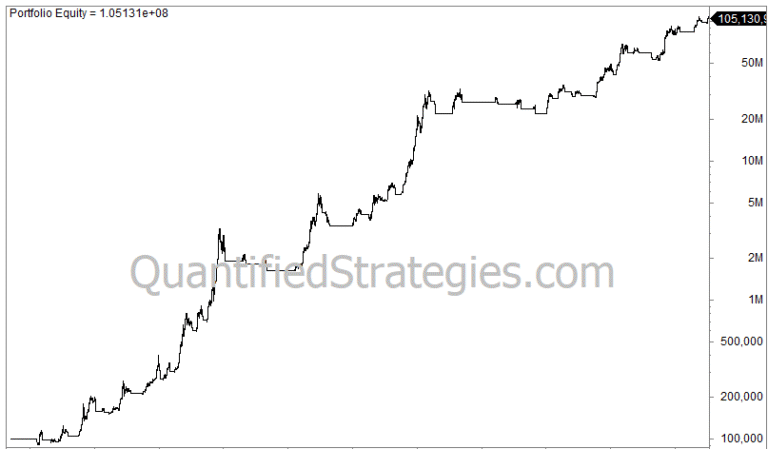
Here’s a quick summary:
- ✅ Strong CAGR of 90% (better than buy and hold’s 66%)
- ✅ Smooth equity curve
- ✅ Fewer trades, but higher win rate (35 trades and 63% win rate
- ✅ The strategy is invested around 50% of the time
- ✅ Significantly better risk-adjusted return than the basic Donchian breakout
Of course, past performance doesn’t guarantee future results. But the core idea makes logical sense, and the numbers back it up.
What’s Next?
There are a few ways I could take this strategy further:
- Add volatility-based position sizing (e.g., ATR-based risk)
- Use a trailing stop instead of a fixed exit
- Apply the system to other trending cryptos like Ethereum or Solana
Final Thoughts
This was a fun experiment. We utilized ChatGPT to generate ideas and inform the system’s structure. Starting with a classic trend-following model and making one small but meaningful change made a significant difference.
If you’re building crypto strategies, we encourage you to experiment with simple ideas, and don’t be afraid to break the rules a little, like using ADX against the trend instead of with it.
Sometimes, that’s where the edge is hiding.
Want to Test It Yourself?
Here’s the full strategy again:
Entry:
- Close > 15-day high
- ADX(14) < 25
- Enter at the next open (or at close)
Exit:
- Close < 15-day low
- Or fixed holding period