

Pullback Strategy For The S&P 500

Today, we look at a pullback strategy for the S&P 500.
Pullbacks are among the most common price patterns in the stock market. Instead of chasing a stock after it has already moved sharply, a pullback strategy waits for the price to retreat, consolidate, or pause before entering.
The basic idea is simple: trade in the direction of the main trend, but look for a better entry after a temporary decline. This can help reduce risk, improve timing, and avoid buying when enthusiasm is already stretched.
Today’s strategy is a bit different because it’s not the typical mean reversion play. We buy into N-day strength on a weak day.
Because of this, this strategy is ideal for diversification.
In this article, I’ll explain what a pullback is, why it can work, and how traders can approach it with clear rules rather than guesswork.
Pullback Strategy
We quantified some trading rules (see rules at the bottom), and we got the following equity curve:
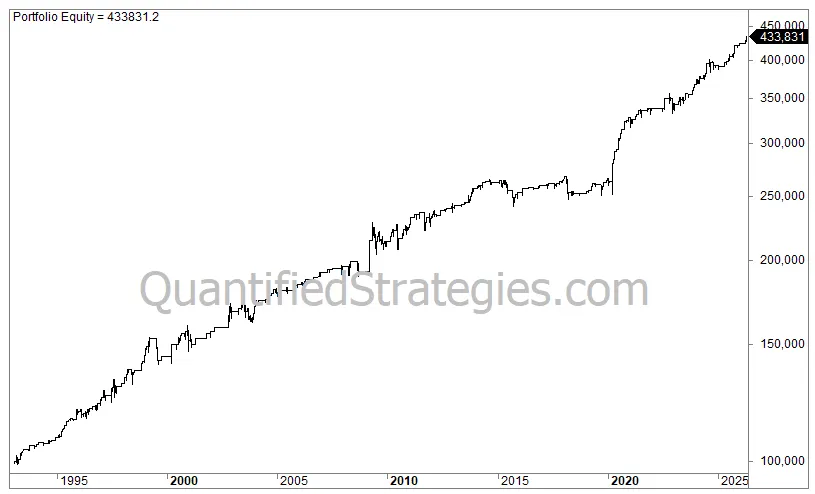
Strategy type: Pullback strategy.
Market: US stocks (SPY).
Performance
- No. of trades: 341
- Average gain per trade: 0.4%
- Win ratio: 71%
- Profit factor: 2.5
- Annual returns (CAGR): 4.5%
- Exposure/time in the market: 15%
- Risk-adjusted return: 29% (CAGR divided by time spent in the market (0.15))
- Max drawdown: 10%
Trading Rules
We backtested the following trading rules: