

NZD/CAD Trading Strategy: (Backtest, Rules And Performance)

Wondering how to succeed in NZD/CAD trading?
In this article, you’ll find crucial tips and strategies tailored for the NZD CAD pair. We’ll explore key factors affecting its exchange rate, important technical indicators, and effective trading strategies to help you make better decisions.
Key Takeaways
- Understanding the fundamentals of the NZD/CAD currency pair, including economic performance and key influencing factors like economic indicators, commodity prices, and central bank policies, is essential for effective trading.
- Technical analysis, utilizing tools such as chart patterns, indicators, and support and resistance levels, plays a crucial role in predicting future price movements for NZD CAD.
- Successful NZD CAD trading involves implementing various strategies, including short-term and long-term trading techniques, hedging to manage risks, and leveraging appropriate tools and resources such as currency converter apps, forex trading platforms, and educational content.
- NZD/CAD Trading Strategy: (Backtest, Rules And Performance)
- We show you a backtested NZD CAD forex strategy complete with trading rules and settings.
- You might also be interested in the best forex trading strategies.
Understanding NZD CAD Trading

The NZD CAD currency pair tracks the exchange rate between the New Zealand dollar and the Canadian dollar, indicating how much one currency is worth relative to the other. It is used by traders and investors to speculate on the strength of these two currencies and to convert Canadian dollars.
Essentially, it indicates how many Canadian dollars (CAD) are needed to purchase one New Zealand dollar (NZD). This pair is considered a minor currency pair, often referred to as a cross currency pair since it does not involve the US dollar. The value of New Zealand dollars in this pair is directly influenced by the economic performance of both countries.
Despite being a minor pair, the NZD CAD is reliable due to the stable and resource-rich economies of both Canada and New Zealand. Anyone looking to trade NZD CAD effectively needs to understand the fundamentals of this pair.
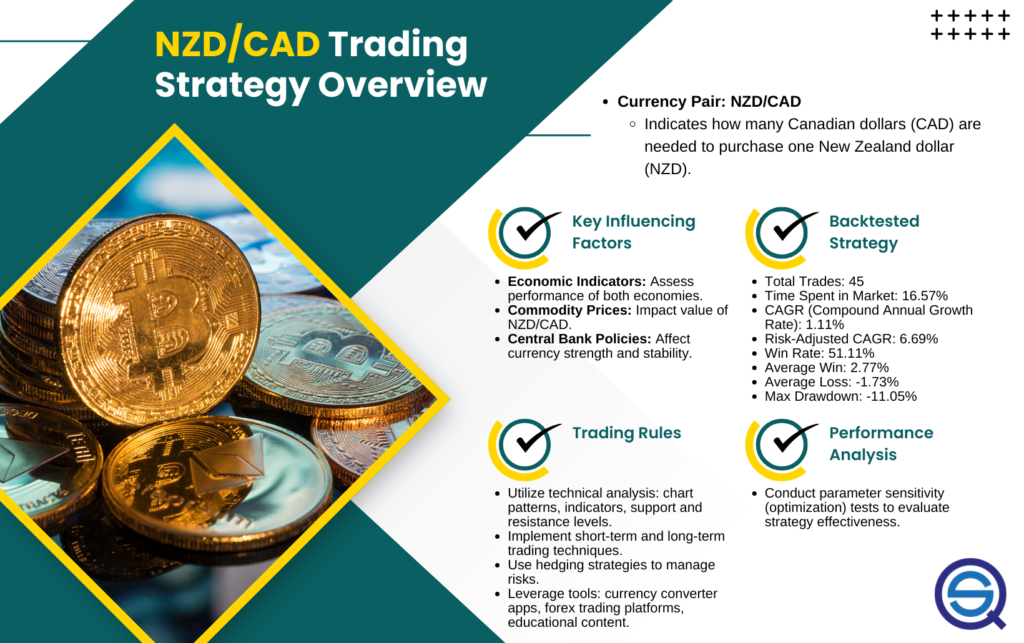
NZD CAD forex strategy – trading rules, settings, returns, and performance
Let’s show you a backtested NZDCAD forex strategy with trading rules and settings.
The trading rules are at the bottom of the article.
We backtested the strategy using the ticker symbol “NZDCAD=X” on Yahoo Finance.
These three simple trading rules produced the following equity curve (the number of trades is on the x-axis):
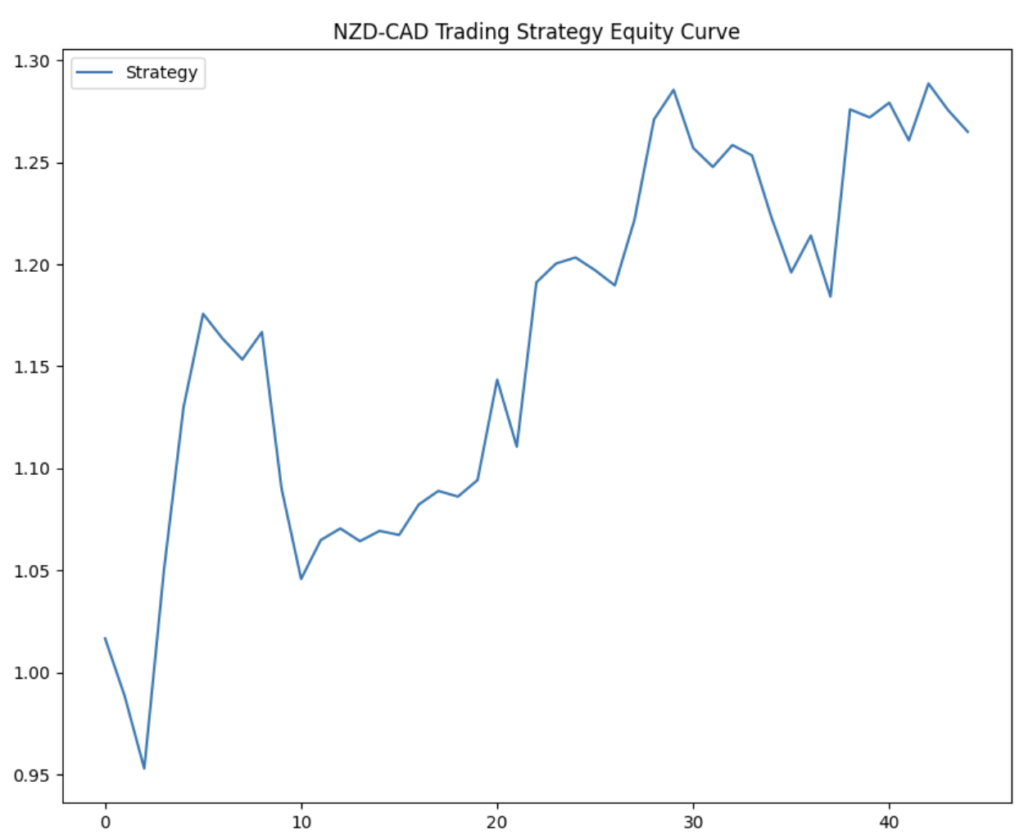
Performance metrics, returns, and statistics of the strategy read like this:
- Total Trades: 45
- Time Spent In The Market: 16.57%
- CAGR: 1.11%
- Risk-adjusted CAGR: 6.69%
- Win Rate: 51.11%
- Average Win: 2.77%
- Average Loss: -1.73%
- Max Drawdown: -11.05%
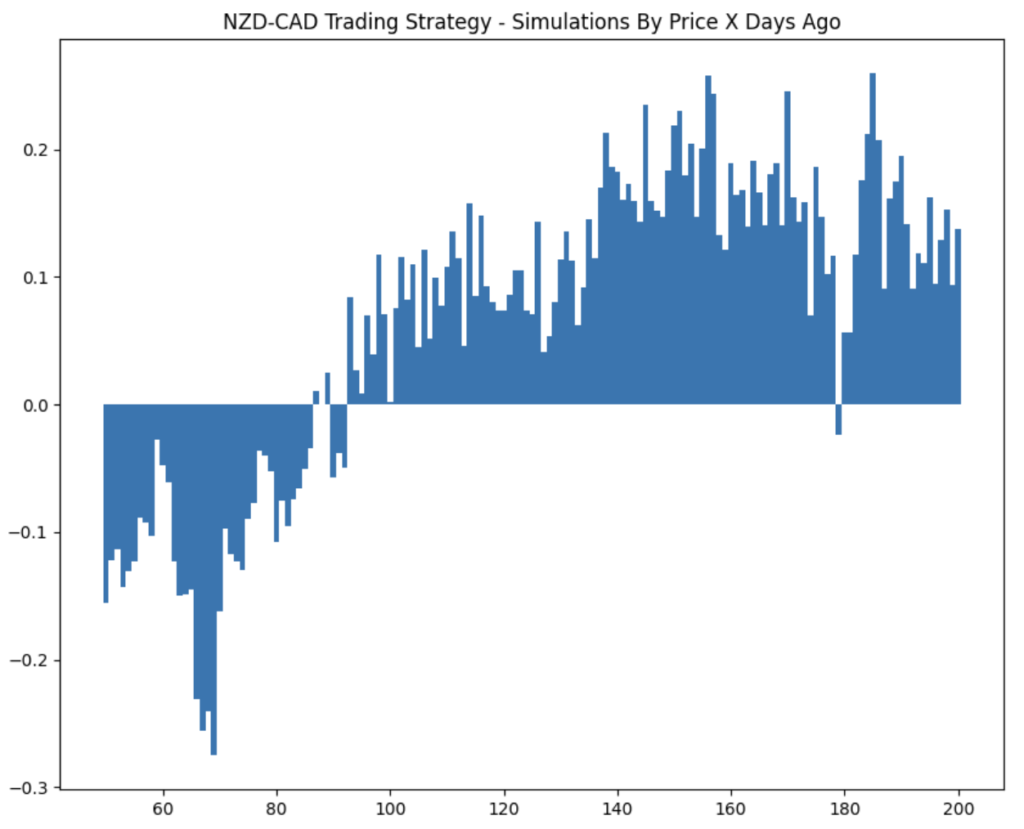
Are the parameters and settings based on luck? To find out, we did a parameter sensitivity (optimization) test of one of the parameters:

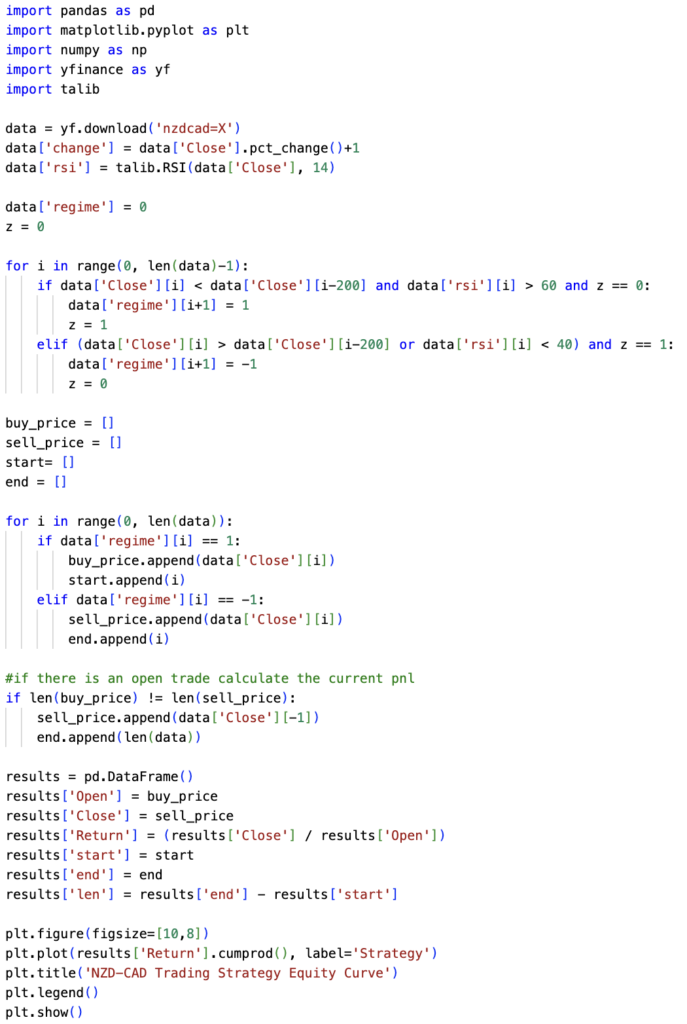
NZD CAD strategy – complete code
This backtest was done using Python. We provide you with the whole code:
Key Factors Influencing NZD CAD Exchange Rate
Several key factors influence the NZD CAD exchange rate, including economic indicators, commodity prices, and central bank policies. These elements can significantly impact the value of the New Zealand dollar against the Canadian dollar, providing trading opportunities for those who understand them.
Traders who keep an eye on these factors have a better chance at predicting market movements and making better decisions.
Economic Indicators
Economic indicators such as GDP growth, employment rates, and inflation from both New Zealand and Canada play a pivotal role in determining the NZD CAD exchange rate. For instance, New Zealand’s GDP growth rate can significantly impact the strength of its currency in relation to CAD. Similarly, Canada’s employment rate is a crucial economic indicator that affects the CAD’s value against the NZD. Traders who grasp these indicators are better positioned to anticipate possible shifts in the currency pair.
Commodity Prices
Commodity prices, particularly those of dairy and oil, have a substantial impact on the NZD CAD pair. New Zealand’s economy relies heavily on dairy exports, making global dairy prices a significant factor for the NZD. On the other hand, crude oil prices are crucial for the Canadian dollar due to Canada’s status as a major oil exporter.
Significant fluctuations in the NZD CAD exchange rate, both being commodity currencies, can result from changes in these commodity prices.
Central Bank Policies
Monetary policies from the Reserve Bank of New Zealand (RBNZ) and the Bank of Canada (BoC) are critical in influencing the NZD CAD exchange rate. Specifically:
- Interest rate decisions made by the RBNZ directly affect the NZD
- The BoC’s monetary policies, including interest rate changes, significantly impact the CAD
- Differences in interest rates between these two central banks can draw foreign investors seeking higher yields, thereby affecting the exchange rate.
Technical Analysis for NZD CAD Trading
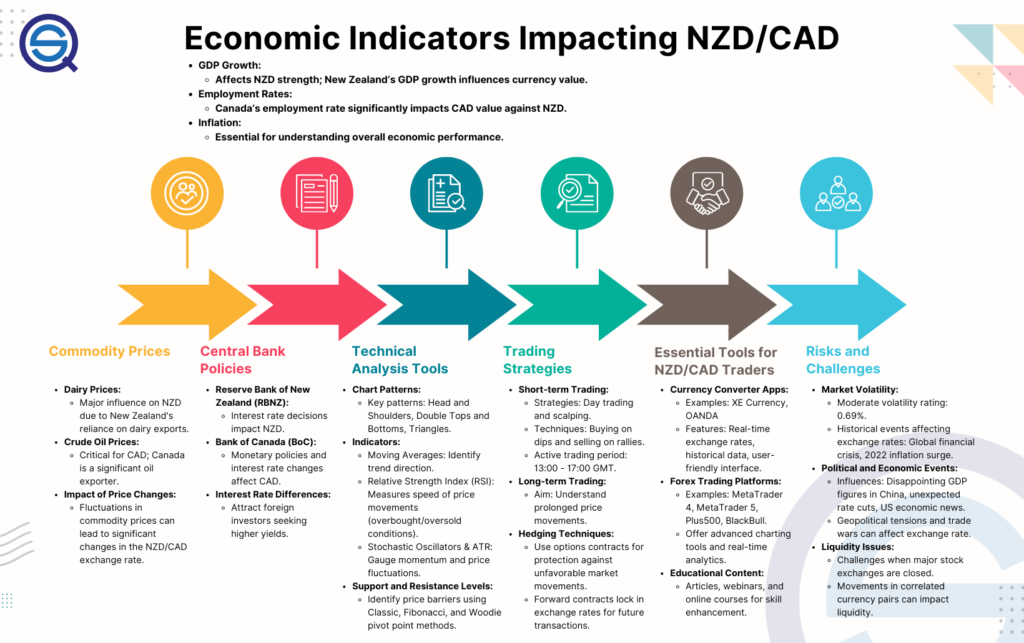
Technical analysis involves evaluating past market data, such as price and volume, to predict future price movements for the NZD CAD pair. This method employs various tools like chart patterns, indicators, and support and resistance levels to analyze market trends and make better decisions.
A thorough grasp of these techniques can significantly boost your trading performance.
Chart Patterns
Predicting NZD CAD price movements heavily relies on chart patterns. Identifying key pivot points can help recognize potential patterns such as head and shoulders, double tops and bottoms, and triangles. These patterns provide traders with visual cues about market sentiment and potential reversals or continuations.
Indicators and Oscillators
Popular technical indicators for NZD CAD trading include Moving Averages and Relative Strength Index (RSI). Moving Averages help identify the direction of the trend by smoothing out price data over a specified period. RSI measures the speed and change of price movements, helping to identify overbought or oversold conditions.
Stochastic oscillators and volatility indicators like the Average True Range (ATR) are also commonly used to gauge momentum and price fluctuations. We at Quantified Strategies recommend to backtest your ideas and strategies.
Support and Resistance Levels
Support and resistance levels are price points on a chart that tend to act as barriers, preventing the price of an asset from getting pushed in a certain direction. Support levels are where NZD CAD tends to find buying interest, while resistance levels are where selling interest appears.
Traders can benefit from identifying these levels using pivot point methods such as Classic, Fibonacci, and Woodie.
Trading Strategies for NZD CAD

Success in NZD CAD trading hinges on effective trading strategies. This section will cover short-term trading, long-term trading, and hedging techniques, providing a comprehensive overview of various approaches to suit different trading styles and objectives.
Short-term Trading
Short-term trading strategies for NZD CAD include day trading and scalping, which focus on exploiting intraday volatility to capture quick profits. Techniques like ‘buying on dips’ and ‘selling on rallies’ are common, allowing traders to benefit from short-term price movements.
The most active trading period for the NZD CAD pair is between 13:00 and 17:00 GMT.
Long-term Trading
Long-term trading strategies aim to understand and take advantage of prolonged price movements. Strategies like ‘buying on dips’ and ‘selling on rallies’ are also applicable in the long-term but require a deeper understanding of market trends and external economic factors.
These strategies aim to benefit from significant price movements over extended periods.
Hedging Techniques
Managing risks in NZD CAD trading requires the use of hedging techniques. Options contracts allow traders to exchange currency at a predetermined rate, providing protection against unfavorable market movements.
Forward contracts are another popular hedging strategy, locking in exchange rates for future transactions and ensuring stability.
Tools and Resources for NZD CAD Traders

Your NZD CAD trading experience can be significantly enhanced by leveraging appropriate tools and resources. This section highlights essential tools, including currency converter apps, forex trading platforms, and educational content.
Currency Converter Apps
XE Currency and OANDA, among other currency converter apps, provide the following features:
- Real-time exchange rates
- Historical data for multiple currencies, including NZD CAD
- User-friendly interfaces
- Up-to-date rate information
These money-related apps are invaluable tools for traders.
Forex Trading Platforms
Reliable forex trading platforms such as MetaTrader 4 and MetaTrader 5 offer advanced charting tools and real-time analytics, catering to both beginner and experienced traders in the forex market.
Platforms like Plus500 and BlackBull provide a range of trading instruments and are preferred by traders in New Zealand.
Educational Content
Improving your trading knowledge and skills necessitates educational resources. Many brokers offer articles, webinars, and online courses focused on forex trading, providing valuable insights and strategies specific to trading pairs like NZD CAD.
Risks and Challenges in NZD CAD Trading

Trading NZD CAD comes with its own set of risks and challenges, including market volatility, political and economic events, and liquidity issues. Developing effective risk management strategies and protecting your investments require an understanding of these risks.
Market Volatility
Market volatility can significantly impact NZD CAD trading. The pair is known for its moderate volatility, with a rating of 0.69%. Historical events like the global financial crisis and the 2022 inflation surge have led to significant fluctuations in the exchange rate.
Traders should ensure their brokers offer negative balance protection to avoid losses exceeding their account balance.
Political and Economic Events
The NZD CAD exchange rate is largely influenced by political and economic events. Some factors that can affect the exchange rate include:
- Disappointing GDP figures in China
- Unexpected rate cuts by the People’s Bank of China
- US economic news, due to Canada’s close economic ties with the USA
These events can add pressure to sell NZD and impact the exchange rate.
Geopolitical tensions, including trade wars and oil production disruptions, can also impact the NZD CAD pair.
Liquidity Issues
Liquidity challenges can affect NZD CAD trading, especially during periods when the London and New York stock exchanges are not open. The pair may also face liquidity issues due to movements in other correlated currency pairs like USD CAD and AUD NZD.
Traders can plan their trades more effectively by comprehending these challenges.
Summary
Mastering NZD CAD trading requires a comprehensive understanding of various factors, including economic indicators, commodity prices, and central bank policies. By applying technical analysis and developing effective trading strategies, preferably backtested ones, traders can better understand the complexities of this currency pair and capitalize on trading opportunities.
Frequently Asked Questions
What are the main factors influencing the NZD CAD exchange rate?
The main factors influencing the NZD CAD exchange rate are economic indicators, commodity prices, and central bank policies from both New Zealand and Canada. These factors play a crucial role in determining the exchange rate between the two currencies.
How do commodity prices affect the NZD CAD exchange rate?
Commodity prices affect the NZD CAD exchange rate, especially dairy and oil, have a significant impact on the NZD CAD exchange rate due to the economic reliance of New Zealand and Canada on these commodities.
What are some popular technical indicators used in NZD CAD trading?
Some popular technical indicators used in NZD CAD trading are Moving Averages, Relative Strength Index (RSI), Stochastic oscillators, and volatility indicators like the Average True Range (ATR). These indicators can help analyze price movements and identify potential trading opportunities.
What are some effective short-term trading strategies for NZD CAD?
Some effective short-term trading strategies for NZD CAD include day trading, scalping, “buying on dips,” and “selling on rallies.” These strategies can help you capitalize on short-term price movements.
What are the risks and challenges in NZD CAD trading?
Trading NZD/CAD involves risks and challenges such as market volatility, political and economic events, and liquidity issues. These factors can significantly impact trading outcomes.
Trading Rules
We used the following trading rules for this backtest: