
How to Create a Profitable Trading Plan in 2026: A Step-by-Step Guide

To create a profitable trading plan, you must define a structured framework that removes emotion from your decision-making. Follow these essential steps:
- Define Your Strategy: Choose your trading style (day, swing, or position) and identify specific entry and exit signals.
- Set Risk Management Rules: Determine your risk-per-trade (e.g., 1-2% of capital) and use stop-loss orders to protect your downside.
- Establish Financial Goals: Set realistic daily, monthly, or annual profit targets based on your starting capital.
- Keep a Trading Journal: Document every trade to analyze performance, identify patterns, and refine your edge over time.
A trading plan is crucial if you are looking to trade with purpose and control. It helps you set goals, manage risk, and make strategic decisions, avoiding costly emotional reactions. Keep reading to learn the keys to crafting a personal trading plan that brings structure and success to your trading efforts.
Key Takeaways
- A trading plan is essential for guiding traders through financial market decisions, incorporating personalized goals, risk tolerance, and strategies while mitigating emotional trading.
- Continuous refinement and backtesting are vital to a trading plan’s success, allowing traders to adjust to market changes and improve strategy effectiveness over time.
- Risk management is a critical component, involving setting risk limits, utilizing stop-loss orders, and calculating risk-reward ratios to protect capital and ensure trading longevity.
10 Different Plan Types And Strategies
Mastering the art of trading requires a well-crafted plan tailored to your unique goals and style. In this series of 10 articles, we dive into the essential elements of successful trading plans. From setting clear objectives and managing risk to choosing the right market and refining your emotional discipline, these strategies will help you build a solid foundation. Explore topics like position sizing, backtesting, and continuous improvement to sharpen your edge and boost long-term profitability. Ready to elevate your trading game? Let’s get started.
1. Goal-oriented trading
Goal-oriented trading can transform your approach by focusing on clear, actionable objectives. Effective goal-oriented trading involves setting specific, measurable goals for your entire portfolio, not just individual trades, so you can quantify desired outcomes across all your investment holdings within a defined timeframe. This insightful article explores how setting specific goals, like profit targets or risk limits, fosters discipline and sharpens decision-making. It offers practical tips for traders of all levels to align strategies with personal aspirations, making trading more intentional and effective. Whether you’re a beginner or seasoned trader, this piece humbly provides valuable guidance to refine your process and boost success without overwhelming complexity.
2. Risk Management – Trading Plan
Risk management – Trading Plan is crucial for success, and this article offers a straightforward guide to mastering it. Risk management starts with defining your risk capital—the amount of money you can afford to lose without impacting your financial stability.
Learn practical techniques to protect your capital, like setting stop-loss levels and balancing risk-reward ratios, all explained in an easy-to-grasp way. Consider how much risk you are willing to take per trade and overall, and be aware of the dangers of excessive risk, which can jeopardize your trading success and stability.
Discipline, not luck, separates the winners from the losers who blow up their accounts. Clear risk management rules should define risk per trade, maximum daily or weekly loss, and risk-to-reward ratio.
A simple guideline is the 3-5-7 rule:
- Risk 3% per trade
- 5% maximum position size
- 7% total exposure
It’s perfect for traders wanting to sharpen their skills without the fluff—just solid, actionable advice from folks who know the game. Dive in for humble insights that could quietly transform your trading approach.
3. Choosing the Right Market in a trading plan
Choosing the ideal market in a trading plan can transform your trading success by aligning strategies with your goals and risk tolerance. This insightful guide explores how to evaluate markets like stocks, forex, or futures, considering factors such as volatility, liquidity, and personal expertise. It offers practical steps to craft a tailored plan, humbly aiming to boost confidence and consistency. Perfect for traders seeking clarity, this article simplifies the process without overwhelming, making it a valuable read for all levels.
4. Trading Timeframes – Trading Plan
Trading timeframes in a trading plan explores how selecting the right timeframe can shape an effective trading strategy tailored to your goals. The amount of time you can spend each day on trading will influence whether you are better suited to being a day trader, swing trader, or another style. Day traders typically spend significant time monitoring markets and making quick decisions throughout the day, which may not suit everyone. In contrast, swing traders may only need to check charts once or twice a day, making swing trading ideal for those with limited time or who prefer a less intensive approach. This insightful article breaks down the benefits of aligning timeframes—short, medium, or long—with your risk tolerance and lifestyle. It humbly offers practical tips for crafting a trading plan that balances discipline and flexibility, making it a valuable read for traders seeking clarity. With a focus on real-world application, it’s a modest guide to improving decision-making and consistency.
5. Entry and Exit Rules – Trading Plan
Entry and exit rules form the backbone of a solid trading plan, guiding traders with clear, practical steps to boost consistency and confidence. This article gently unpacks the essentials of crafting these rules, offering simple insights for defining when to jump in or step out of trades. When setting your exit strategy, it is crucial to specify the exact price level at which you will close a trade, as this ensures discipline and consistency in your trading decisions. Perfect for beginners or seasoned traders seeking structure, it’s a quiet nudge toward sharper decision-making and a more disciplined approach, all without overwhelming jargon or complexity.
6. Position Sizing In A Trading Plan
Position sizing in a trading plan is crucial for managing risk and maximizing returns in trading, offering practical methods to determine trade size based on account size and risk tolerance. This insightful article explores various techniques, like fixed percentage and volatility-based sizing, to help traders craft a solid trading plan. It humbly provides actionable steps for beginners and seasoned traders alike, emphasizing consistency and discipline to improve performance while keeping risks in check. A must-read for refining your trading approach!
7. Developing a Trade Journal: Learning From Your Trades
Trading journal insights reveal the power of tracking your trades to boost success. This humble guide explores how a detailed trading journal sharpens decision-making, uncovers patterns, and supports a solid trading plan. Learn to set goals, monitor performance, and refine strategies with practical tips. Perfect for traders seeking discipline and growth, it quietly offers a path to consistency. In 75 words, it’s a simple, effective tool to elevate your trading game without fanfare.
8. Emotional Discipline: Sticking to Your Plan Under Pressure
Emotional discipline trading plan explores the vital role of managing emotions in successful trading, offering practical insights for staying calm under pressure. This article gently guides readers through crafting a solid trading plan that balances emotional control with clear strategies, like setting entry and exit points. With a humble nudge, it suggests how discipline can boost consistency and confidence. Successful traders are distinguished by their ability to maintain discipline and limit their risk exposure, even under pressure. In about 75 words, it’s a simple, thoughtful read for traders aiming to refine their mindset and approach.
9. Backtesting Your Trading Plan
Backtesting your trading plan is crucial for success, offering a way to evaluate strategies using historical data before risking capital. Practice and review are essential; using a demo account allows you to test your trading rules in real-time without risking real money. This insightful article explores how traders can refine their approach by testing rules, optimizing performance, and building confidence. It humbly highlights the value of a solid trading plan, emphasizing preparation and discipline as key to navigating markets effectively. In just 75 words, it delivers practical wisdom for traders aiming to sharpen their skills and boost results.
10. Continuous Improvement: Adapting and Optimizing A Trading Plan Over Time
Continuous improvement in a trading plan starts with a solid plan to refine skills and strategies over time. This insightful article explores how traders can boost performance by setting clear goals, tracking progress, and adapting to market changes. It humbly offers practical tips for building a trading plan that evolves, emphasizing discipline and self-assessment. Perfect for traders seeking a structured yet flexible approach, it’s a gentle nudge toward consistent growth and smarter decision-making in the markets.
The Essence of a Trading Plan
Think of a trading plan as a personalized map for your trading journey. It navigates your moves in the financial markets, helping you make logical decisions and avoid emotional ones, even amidst market volatility. A trading plan is tailored to your goals, risk tolerance, and motivation, setting realistic objectives that give your money a mission statement. No two traders will have the same trading process, as each plan is highly individualized. There is no such thing as a universal trading plan—what works for one trader may not work for another. It’s a comprehensive decision-making tool that helps you maintain discipline and systematically approach the markets, preemptively addressing emotional trading.
No matter your trading style, level of expertise, or risk tolerance, a trading plan remains a cornerstone of your trading journey. Most traders struggle with consistency, but professional traders stand out by maintaining detailed records, focusing on a few key markets, and having backup plans. The trading process is what separates disciplined, professional traders from the majority who may act impulsively. Even if you compare two traders, their approaches and plans will always differ, reflecting their unique strategies and perspectives.
Defining a Trading Plan
Your trading plan is your guide, your roadmap. It sets clear goals that provide focus and direction for your trading activity. These goals clarify your purpose and what you aim to achieve, serving as a benchmark to measure your progress and remind you of the bigger picture.
It combines your individual trading style, specific strategy, and risk management tactics. It’s not just about what you’re trading or when, but why. It’s the “why” that keeps you grounded when the market gets tough and helps you stay on course towards your financial goals.
Benefits of a Trading Plan

A comprehensive trading plan instills order and structure to your trading activity, thereby minimizing emotional and impulsive trades. It helps you avoid losses due to buying speculative securities or acting on emotions. Amid market volatility, your trading plan serves as an anchor, encouraging discipline and focus. It’s like a safety net, protecting you from making impulsive decisions that could lead to unnecessary losses. Some key components of a trading plan include:
- Setting clear goals and objectives
- Identifying your risk tolerance
- Developing a strategy for entering and exiting trades
- Establishing rules for position sizing and risk management
- Regularly reviewing and updating your plan
By following a well-defined trading plan, you can increase your chances of success in the market.
Implementing stop-loss orders and setting risk per trade as part of risk management can be structured through a trading plan. In essence, a trading plan is your key to disciplined, consistent, and successful trading.
Identifying Your Trading Style

Each trader possesses a distinctive combination of financial goals, risk tolerance, and available time for trading. This unique mix shapes your trading style. It’s like your trading DNA – it’s what makes you, you in the trading world. Your trading style can be anywhere on the spectrum from:
- Day trading, where trades are entered and exited within the same day
- Swing trading, which involves holding onto trades for a few days to a few weeks
- Position trading, which involves holding onto trades for weeks or even months
To pinpoint your trading style, you need to assess personal psychological attributes like patience and discipline, ensuring your chosen method resonates with your behavioral tendencies.
Different Trading Styles
There’s a trading style for every type of trader. Day trading involves profiting from intraday price movements by buying and selling securities within the same trading day, requiring constant monitoring of the market. Scalping, on the other hand, involves making numerous small trades over a short time period, leveraging quick decision-making skills and technical analysis.
If you prefer a slower pace, swing trading might be for you. It’s geared towards capturing gains from market trends over several days to weeks, ideal for those who cannot monitor the markets throughout the day. Position trading is for the patient trader. It’s a longer-term approach where traders hold positions for an extended duration to capitalize on major trend movements, demanding a solid grasp of market fundamentals.
Aligning Your Trading Style with Your Goals
Your trading style ought to mirror your objectives and lifestyle. The longer the timeline of an investment, the more time the money has to potentially grow and recover from market dips, influencing the risk associated with the trading style. Your trading plan can help you define your preferred style, such as short-term or long-term trading.
To find your fit, you can explore and determine your preferred trading style with the aid of a demo trading account before committing real funds to exchange traded funds. It’s like trying on clothes at a store – you want to make sure it fits and suits you before you take it home.
Developing a Robust Trading Strategy

Having determined your trading style and objectives, the next step is to formulate your trading strategy. This constitutes the backbone of your trading plan. A comprehensive market analysis is a crucial step in identifying trading opportunities and understanding market conditions. Your strategy should detail your approach to the markets, including trade selection criteria, specific entry and exit tactics, and rules for risk management and position sizing. It’s your game plan, outlining how you’ll navigate the financial markets.
Similar to a sports team that scrutinizes their game plan before a match, you should test your strategy employing methods like visual backtesting on diverse timeframes and confirm its validity across an array of indicators. This helps ensure its effectiveness and long-term profitability.
Analyzing Market Trends
Analyzing market trends is like observing the waves in the ocean before you go surfing. It involves using historical data like price movements and trading volumes to predict long-term market sentiment direction. There are different time horizons for trend analysis in markets, ranging from short-term to long-term. Key tools for market trend analysis include charts, news updates, and economic indicators which inform trading decisions.
Moving average crossovers and momentum indicators are examples of tools used in identifying and following market trends. By identifying these trends, you can ride the waves of the market and potentially profit from it.
Crafting Entry and Exit Rules
Formulating entry and exit rules can be likened to establishing guideposts for your trading journey. It’s an essential part of a successful trading strategy. These rules guide you on when to enter a trade, how to manage open positions, and when to exit trades entirely. For example, your rules may include taking partial profits at certain milestones to lock in gains while allowing the rest of the position to run. They provide clear markers for your journey, helping you navigate the markets and manage your trades effectively.
And just like guideposts on a road, these rules help ensure you stay on the right path, avoiding detours that could lead to unnecessary risk or loss.
Testing and Refining Your Strategy
Much like a chef who tests a recipe before offering it to diners, a trader ought to test their strategy prior to applying it in real-time trading. Backtesting is a key component of this process, helping to determine how a strategy would have performed in the past, which aids in predicting future performance. Analyzing performance metrics such as the Sortino ratio, which focuses on penalizing downside volatility and not the upside, can help identify areas for improvement.
Keep in mind, even the most accomplished traders persistently fine-tune their strategies. After all, trading is a journey of constant learning and improvement.
Implementing Risk Management Measures

Risk is an inseparable aspect of trading. However, it can be managed effectively with the right measures. A good trading plan involves understanding your risk profile, setting risk limits, and utilizing stop-loss orders. Consulting a financial advisor can help you accurately assess your risk tolerance and develop appropriate risk management strategies. These measures ensure that you’re not risking more than you can afford to lose and help protect your capital from significant losses.
Setting Risk Limits
Similar to setting speed limits while driving for safety, establishing risk limits in your trading plan aids in safeguarding your capital. These limits involve determining the amount of capital to risk on each trade based on what you can afford to lose. A common practice is to risk no more than 2% of your total trading capital on any single trade.
These limits not only control risk but also guarantee the continuation of trading activities even after suffering a few losses.
Utilizing Stop-Loss Orders
Employing stop-loss orders can be compared to using an emergency brake in your vehicle. If your car starts rolling down a hill, the emergency brake can stop it before it crashes. Similarly, stop-loss orders automatically execute a sale when a security drops to a specified price, preventing further losses.
This is especially beneficial for investors who are not able to consistently monitor their positions, such as those invested in mutual funds. It’s a safety measure that can protect your capital in volatile markets.
Calculating Risk-Reward Ratios
Calculating risk-reward ratios is an essential part of risk management. It involves comparing the amount of money risked on a trade to the potential profit. It’s like weighing the pros and cons before making a decision. A minimum risk-reward ratio of 1:1 is generally recommended. This means that for every dollar risked, you’re aiming for at least a dollar in profit.
By calculating risk-reward ratios and considering the risk undertaken, you can ensure that potential rewards justify the risks.
Maintaining Trading Discipline

Discipline is fundamental in trading. It’s the glue that holds all the elements of a trading plan together. Without discipline, a trader may abandon their plan, make impulsive decisions, and lose sight of their goals.
It’s like sticking to a diet – you need to resist the temptation of unhealthy foods and stick to your diet plan to achieve your health goals. In the same way, maintaining trading discipline involves overcoming emotional trading and staying consistent with your trading plan.
Overcoming Emotional Trading
Emotions can be a trader’s worst enemy. Fear and greed can lead to impulsive decisions, cloud judgment, and result in poor trading performance. The good news is, emotional trading can be overcome. By maintaining a trading journal and following structured approaches, you can manage your emotions effectively. It’s like learning to control your cravings when on a diet.
With discipline and the right strategies, you can overcome emotional trading and stick to your trading plan.
Staying Consistent with Your Plan
Sticking to your trading plan is like staying on a well-marked trail when hiking. Straying from the path can lead to getting lost or encountering unexpected hazards. Similarly, deviating from your trading plan can result in unnecessary risks and losses.
Staying consistent with your plan requires:
- Discipline
- Adherence to pre-established rules
- Trusting your plan
- Remaining disciplined, no matter what the market throws at you.
Evaluating and Adjusting Your Trading Plan
Your trading plan isn’t inflexible. It’s a dynamic document that should be regularly evaluated and adjusted as needed. This involves tracking your trading activity, identifying areas for improvement, and adapting to market changes.
It’s like a ship’s captain adjusting the ship’s course based on changing weather conditions and sea currents. By regularly reviewing and tweaking your trading plan, you can ensure it remains effective and aligned with your trading goals.
Tracking Trading Activity
Monitoring your trading activity can be likened to maintaining a diary of your journey. It involves maintaining a trading journal to log your trades, observations, and performance metrics. This record not only helps you track your progress but also provides valuable insights into your trading strategies and behaviors.
It’s a reflection tool that allows you to learn from your past trades, identify trends in your performance, and make necessary adjustments to your trading plan.
Identifying Areas for Improvement
Much like an athlete who scrutinizes their performance to enhance their skills, traders ought to pinpoint areas in their trading that require improvement. This involves analyzing benchmarks, learning from successes and mistakes, and building upon winning strategies. It’s about growing and evolving as a trader, constantly striving to improve your performance and achieve your trading goals.
Adapting to Market Changes
The financial market, including the stock market, is always evolving. As a trader, it’s crucial to modify your trading plan in response to these changes to stay effective. This involves evolving your trading style, updating your strategies, and adjusting your risk appetite as needed. It’s like a sailor adjusting their sails to the changing wind.
Through flexibility and adaptability, you can sail through the turbulent waters of the financial markets, staying on course towards your trading objectives.
What is a trading plan?
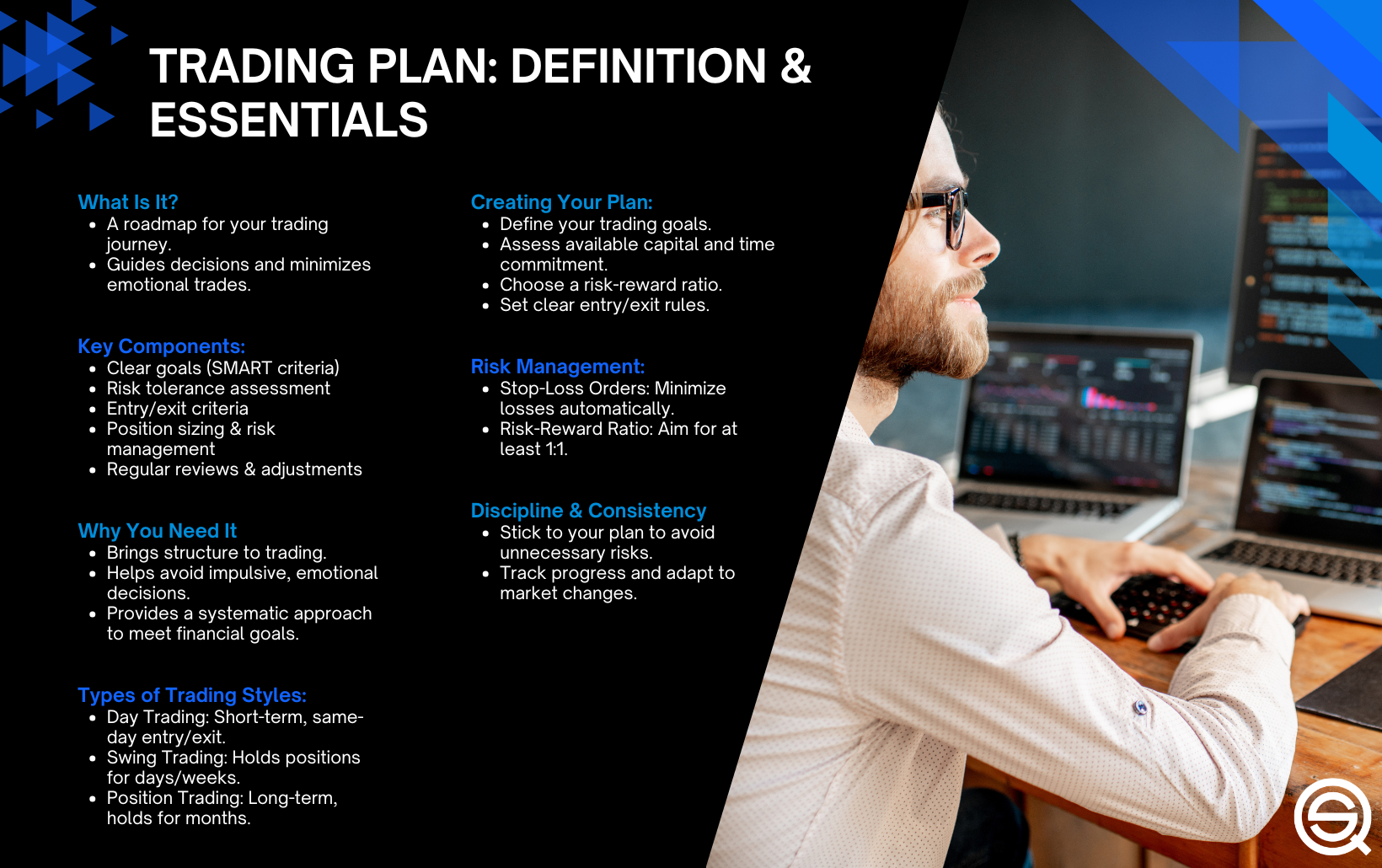
A trading plan serves as an exhaustive roadmap, curated by traders to steer their trading pursuits. It entails specific strategies, trading styles, risk management rules, and detailed criteria for entering and exiting trades. Trading plans are strategic guidelines for buying and selling assets, providing a structured approach to decision-making during market fluctuations.
It also helps traders stay on track to meet their financial objectives. So, if you’re about to embark on your trading journey, a trading plan is your essential travel companion.
Why is a trading plan important?
A trading plan acts as a compass within the wilderness of financial markets. It brings order and structure to your trading, reducing emotional and impulsive trading. It helps you avoid losses due to speculative securities or acting on emotions.
With a trading plan, you can navigate the markets with confidence, knowing that you have a solid strategy to guide you. It’s your blueprint for success in the trading world, which is why you need a trading plan.
How do I create a trading plan from scratch?
Although crafting a trading plan from scratch might appear intimidating, it’s a sequential process. Here are the steps to follow:
- Outline your motivation for trading.
- Decide on the time commitment you can dedicate to trading.
- Define your trading goals.
- Choose a risk-reward ratio.
To create a trading plan that aligns with your goals and lifestyle, follow these steps:
- Determine the capital you have available for trading.
- Assess your understanding of the markets.
- Start with a solid foundation and then add the walls, roof, and interior details, just like building a house.
- Create a clear plan and a structured approach.
By following these steps, you can create a trading plan that will help you achieve your goals and fit your lifestyle.
What are the key components of a trading plan?
A trading plan comprises numerous crucial components. It includes:
- Setting clear goals that are specific, measurable, attainable, relevant, and time-bound (SMART)
- Understanding your risk tolerance
- Outlining the time horizon for your trades
Your trading plan should include the following components:
- Criteria for entering trades
- Criteria for exiting trades
- Risk management strategies
- Position sizing guidelines
- Trading goals and objectives
By combining these components, you can create a comprehensive trading plan that guides your trading activities and helps you achieve your financial goals, including investing in the same mutual funds.
How do I set realistic trading goals in my trading plan?
Establishing realistic trading objectives in your trading plan can be likened to setting attainable fitness goals. You need to consider your current fitness level, the time you can dedicate to working out, and the resources you have available. In trading, you need to define your objectives, such as capital preservation or consistent returns, and align these objectives with your capabilities and risk tolerance. Your goals should also be specific, measurable, attainable, relevant, and time-bound (SMART).
And remember, just like in fitness, progress in trading takes time. Be patient, stick to your plan, and you’ll see progress in due course.
What role does risk management play in a trading plan?
Risk management within a trading plan can be compared to a car’s seatbelt – it’s there for your protection. It’s essential to minimize the impact of losses, protect your capital, and avoid major financial setbacks during market downturns. This involves:
- Setting stop-loss and take-profit orders
- Diversifying your portfolio
- Calculating your position sizes based on the amount of capital allocated to each trade.
It’s about making better decisions, managing your risks, and ensuring you can keep trading even when the market takes an unexpected turn.
How can I identify my trading style in my trading plan?
Determining your trading style within your trading plan can be likened to selecting your outfit for the day. It depends on your personal preferences, the occasion (or market conditions in this case), and how comfortable you are with the outfit (or trading style). You need to consider your risk tolerance, your trading goals, and the time you can commit to trading.
You should also explore different trading styles, such as:
- Day trading
- Swing trading
- Position trading
- Long-term investing
Choose one that suits your preferences and lifestyle. And remember, just like with fashion, there’s no one-size-fits-all in trading. Your trading style should reflect your individuality.
How do I select suitable financial instruments for my trading plan?
Choosing appropriate financial instruments for your trading plan can be compared to selecting the correct tools for a construction project. You need to understand the project requirements (your trading goals), the materials you’re working with (the financial markets), and your personal skills and preferences. You need to evaluate the risk-reward profile of different financial instruments, consider their volatility, and identify key events that could affect their performance.
It’s about finding the right tools that can help you construct a solid trading portfolio and achieve your financial goals.
What strategies can I incorporate into my trading plan?
Integrating strategies within your trading plan can be likened to charting a route for a road trip. You need to identify your starting point (your current financial situation), your destination (your trading goals), and the best route to get there (your trading strategy). Your strategy should include parameters for entering and exiting trades, the amount of money at risk, and a strategy for profit-taking.
It’s your roadmap for your trading journey, guiding you towards your destination while helping you navigate the twists and turns of the financial markets.
How do I determine entry and exit points in my trading plan?
Establishing entry and exit points in your trading plan can be compared to understanding when to enter a game and when to retire. It’s about identifying the right moments to make a move in order to maximize your profits and minimize your losses. Traders often use moving averages to determine these points, with entry indicated when the stock price rises above the moving average, and exit signaled when it falls below.
It’s about timing your moves correctly to make the most out of your trades.
What tools and resources can help me execute my trading plan effectively?
Similar to a carpenter requiring a set of tools to construct a house, a trader needs an assortment of tools and resources for effective execution of their trading plan. These include:
- Technical analysis tools that help traders evaluate patterns in trading data
- Trading platforms that provide advanced charting, technical indicators, and backtesting capabilities
- Trading communities that offer support and feedback
Like a carpenter choosing the right tool for the job, selecting the right tools and resources for your trading can enhance your performance and help you achieve your trading goals.
How often should I review and update my trading plan?
Much like a car requires frequent maintenance for smooth operation, your trading plan necessitates regular reviews and updates for continued effectiveness. Depending on your trading style, you might review your trades daily, weekly, or even monthly. Regular reviews help you identify patterns, areas of struggle, and opportunities for improvement.
It’s about fine-tuning your trading plan, making necessary adjustments, and ensuring it remains aligned with your trading goals.
What should I do if my trading plan isn’t working?
If your trading plan is falling short, it’s time to pause and evaluate the situation. First, take a break from the market and avoid making impulsive decisions. Then, conduct an honest assessment to understand why significant losses occurred. This could involve a lack of strategy, emotional control, or insufficient risk management.
It’s about learning from your mistakes, refining your strategies, and getting back on track with a more effective trading plan.
How do I handle emotions and psychology in my trading plan?
Managing emotions and psychology within your trading plan can be likened to controlling your emotions during an intense debate. It’s about staying calm, rational, and focused, even when the pressure is on. Establishing personal trading rules can assist in managing emotions by setting specific risk/reward tolerance levels for entering and exiting trades.
Reducing trade size can also lessen the emotional impact of trades. It’s about maintaining control and staying disciplined.
What are the common mistakes to avoid in a trading plan?
The creation and execution of a trading plan can be riddled with potential pitfalls. Some traders execute trades without a comprehensive trading plan, leading to decisions based on impulse rather than strategy. Others overtrade or trade prematurely, increasing their risk without adequate market experience.
Ignoring investment time horizons can result in mismatched trading strategies and goals, leading to potential failures. Learning to avoid these common mistakes can help you create a more effective and successful trading plan.
How do I stay disciplined and stick to my trading plan?
Maintaining discipline and adhering to your trading plan might present challenges, but it’s vital for successful trading. It’s like sticking to a diet or workout plan – it requires commitment, discipline, and a strong will to resist temptations.
Setting clear, realistic goals helps maintain focus and discipline in trading. Adhering to a well-defined trading plan and predetermined rules is critical for consistency and discipline. And remember, discipline is like a muscle – the more you use it, the stronger it gets.
What role does backtesting play in refining a trading plan?
Backtesting can be compared to rehearsing a play prior to the actual performance. It involves testing your trading strategy using historical data to see how it would have performed in the past. This not only helps you refine your strategy but also gives you an idea of its potential effectiveness in real trading.
By identifying potential flaws and areas for optimization, backtesting can help you fine-tune your trading plan and increase your chances of success in the markets.
How do I adjust my trading plan for different market conditions?
Much like a sailor who alters their sails in response to shifting winds, a trader needs to adapt their trading plan to varying market conditions. This involves evolving your trading style, updating your strategies, and adjusting your risk appetite as needed. Understanding market conditions like trends, ranges, and volatility helps traders adapt their strategies effectively.
Through flexibility and adaptability, you can sail through the turbulent waters of the financial markets, staying on course towards your trading objectives.
What are the best practices for journaling trades in my trading plan?
Keeping a trading journal can be likened to maintaining a diary of your trading journey. It helps you track your trades, observe patterns, and reflect on your actions. A trading journal should include details of each trade, such as:
- The date
- The financial instrument traded
- The reason for the trade
- The entry and exit points
- The outcome
Regularly reviewing your trading journal can provide valuable insights into your trading strategies and behaviors, helping you identify areas for improvement and enhance your trading plan.
How can I measure the success of my trading plan?
Assessing the success of your trading plan can be compared to gauging your progress on a fitness journey. It involves tracking various metrics, such as:
- Absolute and relative drawdown
- Average win vs. loss size
- Profit factor
- Win percentage
It’s about tracking your progress, identifying areas for improvement, and celebrating your successes.
By regularly evaluating your performance, you can ensure your trading plan is on track and making progress towards your financial goals.
What are the benefits of following a trading plan consistently?
Consistency is of the essence in any pursuit, including trading. Following a trading plan consistently:
- Simplifies trading
- Provides clear criteria for making trading decisions
- Reduces uncertainty and distractions
- Enhances objective decision-making
- Reduces the influence of emotions, which can negatively impact trades and capital.
By sticking to your trading plan, you can navigate the markets with confidence, knowing that you have a solid strategy to guide you.
How do I incorporate macroeconomic factors into my trading plan?
Integrating macroeconomic factors within your trading plan can be compared to checking the weather forecast before organizing a picnic. It involves understanding the economic and political factors of different countries, focusing on elements like:
- interest rates
- domestic and international policies
- trade
- currency exchange rates
What should I consider when developing a contingency trading plan?
Formulating a contingency trading plan involves:
- Conducting a business impact analysis
- Prioritizing potential risks based on their likelihood and impact
- Establishing clear triggers for when the contingency plan should be initiated
This helps prepare for unexpected events that could affect your trading and ensures you have a backup plan in place.
By having a contingency plan, you can ensure that you’re prepared for whatever the market throws at you.
How do I handle unexpected losses or drawdowns in my trading plan?
Managing unforeseen losses or drawdowns in your trading plan can be compared to tackling obstacles on a hiking trail. It involves:
- Staying level-headed
- Refraining from making rushed decisions
- Reviewing the circumstances leading to losing money
- Learning from the experience
- Refining your strategies
- Moving forward
Remember, every setback is a setup for a comeback.
What role does continuous learning play in improving my trading plan?
Continuous learning in trading can be likened to honing a knife. It allows traders to expand their knowledge base, stay current with market trends and practices, and improve their trading strategies. By staying informed about economic indicators and market developments, traders can identify profitable opportunities ahead of others.
Continuous learning is about growing and evolving as a trader, constantly striving to improve your performance and achieve your trading goals.
How can I seek feedback and guidance to enhance my trading plan?
Soliciting feedback and guidance to improve your trading plan can be compared to seeking directions when you’re lost. It involves engaging with a trading mentor or community, using trading tools for analytical feedback, and setting SMART goals to measure progress. It’s about learning from others, leveraging tools and resources, and continuously striving for improvement.
By seeking feedback and guidance, you can enhance your trading plan and navigate your trading journey more effectively.
How do you make a trading plan?
Crafting a trading plan is a sequence of steps. It starts by:
- Defining your motivations for trading
- Determining the time and resources you can dedicate to trading
- Defining your trading goals
- Choosing a risk-reward ratio that aligns with your risk tolerance
- Determining the capital you have available for trading
- Assessing your understanding of the markets
By following these steps, you can create a comprehensive trading plan that will guide your trading activities.
Finally, you should start a trading diary to document your trades and learn from your experiences. It’s a comprehensive process, but with a clear plan and a structured approach, you can create a trading plan that aligns with your goals and lifestyle.
What is a trading plan example?
Let’s consider a basic trading plan example. Suppose you’re a swing trader who prefers to trade in the forex market. Your trading plan might include rules for entering a trade, such as buying a currency pair when its price rises above a certain moving average. Your plan might also specify that you should exit the trade when the price falls below another moving average.
You might also have a rule that you will never risk more than 2% of your total trading capital on any single trade. By following this plan consistently, you ensure that you’re trading based on a structured approach rather than on impulse or emotion.
Can you trade without a trading plan?
Trading without a plan can be compared to embarking on a journey devoid of a map. You might eventually reach your destination, but it’s likely to be a long, inefficient, and possibly stressful journey. A trading plan provides a roadmap for your trading activities, guiding you towards your financial goals while helping you navigate the often turbulent waters of the financial markets.
Without a defined plan, your trading journey could be fraught with unnecessary risk, emotional decisions, and potential losses. So, can you trade without a trading plan? Technically, yes. But it’s certainly not recommended.
How to create a trading plan?
Crafting a trading plan entails a series of steps. First, you need to outline your motivation for trading. Are you trading to supplement your income, or are you aiming to become a full-time trader? Next, decide how much time you can dedicate to trading. Are you able to monitor the markets throughout the day, or will you be trading part-time?
To create a trading plan, follow these steps:
- Set clear trading goals. What are you hoping to achieve through trading?
- Determine your risk tolerance and decide how much capital you’re willing to risk on each trade.
- Choose your preferred trading style.
- Start a trading diary to track your trades and learn from your experiences.
With these steps, you can create a trading plan that is tailored to your goals and lifestyle.
What should a trading include?
A trading plan ought to encompass numerous vital components. Here are some key elements to include:
- Clear and realistic goals that align with your financial objectives
- Definition of your trading style
- Outline of your approach to the markets, including your strategies for entering and exiting trades
By including these elements in your trading plan, you can increase your chances of success in the markets.
A trading plan should include the following components:
- Rules for identifying and entering trades
- Rules for managing risk, including position sizing
- Rules for exiting trades, including profit targets and stop-loss levels
- A mechanism for reviewing and analyzing your trading performance
With these components, your trading plan can serve as a comprehensive guide for your trading activities, helping you navigate the markets and achieve your trading goals.
What is a trading plan in forex?
A forex trading plan is a comprehensive strategy that guides traders on when and how to buy and sell currency pairs. It includes:
- Specific strategies
- Trading styles
- Risk management rules
- Detailed criteria for entering and exiting trades.
A forex trading plan also involves detailed research and is documented to facilitate decision-making in forex trading. It helps traders anticipate and prepare for potential market scenarios and determines appropriate actions when those scenarios occur. It’s a strategic guideline for forex trading, providing a structured approach to decision-making during market fluctuations.
How to create a trading plan in forex?
Formulating a trading plan in forex entails a sequence of steps. Here are the steps to follow:
- Start by defining your trading objectives. Are you aiming for capital growth or income generation?
- Next, determine your risk tolerance. How much of your capital are you willing to risk on each trade?
- Then, decide on your trading style. Are you a day trader, swing trader, or position trader?
By following these steps, you can create a solid trading plan for forex.
To create a comprehensive forex trading plan, follow these steps:
- Determine your trading goals and risk tolerance.
- Educate yourself about the forex market and trading strategies.
- Choose the currency pairs you want to trade and research their market behavior.
- Define your trading strategy, including your criteria for entering and exiting trades, and your approach to managing risk.
By following these steps, you can create a forex trading plan that is tailored to your goals and risk tolerance.
How to stick to a trading plan?
Adhering to a trading plan demands discipline and consistency. Start by setting clear, realistic goals. These will serve as your guiding light, keeping you focused and disciplined in your trading activities. Make sure your trading plan is realistic and aligns with your risk tolerance and trading preferences.
Avoid making impulsive decisions and stay true to your plan, especially during market volatility. And most importantly, be patient. Trading is a marathon, not a sprint. It takes time to achieve your trading goals, so stick to your plan, stay disciplined, and keep moving forward.
Why is it hard to follow a trading plan?
Adhering to a trading plan may present multiple challenges. For one, the financial markets are unpredictable, and it’s human nature to want to react to unexpected market movements. Additionally, emotions like fear and greed can cloud judgment and lead to impulsive decisions.
Some traders may also struggle with the uncertainty inherent in trading and may find it difficult to stick to a plan that doesn’t guarantee certain outcomes. However, despite these challenges, maintaining discipline and sticking to a trading plan is crucial for long-term trading success.
Summary
Trading in the financial markets can be a challenging yet rewarding endeavor. A robust trading plan serves as your roadmap, guiding your trading activities and helping you navigate the turbulent waters of the markets. From setting clear goals and identifying your trading style to developing a robust trading strategy and implementing risk management measures, a trading plan encompasses every aspect of your trading activities. It’s a dynamic document that should be regularly reviewed and adjusted to remain effective and aligned with your trading goals. So, whether you’re a novice trader just starting your trading journey or a seasoned trader looking to enhance your trading performance, a well-thought-out trading plan is your key to trading success.
Frequently Asked Questions
What is a trading plan?
A trading plan is a detailed roadmap that traders use to guide their trading activities, including specific strategies, risk management rules, and criteria for entering and exiting trades.
Why is a trading plan important?
A trading plan is important because it provides a structured approach to decision-making during market fluctuations, helping traders stay on track to meet their financial objectives and reducing the influence of emotions on trade choices.
How do I create a trading plan from scratch?
To create a trading plan from scratch, you should define your trading goals, choose a risk-reward ratio, determine your available capital, identify your trading style, and keep a trading diary to track your progress. This will help you establish a solid foundation for your trading strategy.
How often should I review and update my trading plan?
You should review your trading plan depending on your trading style, such as daily, weekly, or monthly, to identify patterns and areas for improvement. Regular reviews are essential for refining your trading approach.
How can I measure the success of my trading plan?
To measure the success of your trading plan, track metrics like drawdown, win/loss size, profit factor, and win percentage. Regular evaluation helps ensure your plan is progressing toward your financial goals.