

What Happens To Stocks When Bonds Go Up? (Backtest And Historical Analysis)

What happens to stocks when bonds go up? Any stock investor or trader should have a basic understanding of the relationship between stocks and interest rates.
Why?
Because the interest rates influence investors’ risk appetite. When you buy a bond, you are essentially lending money to governments, municipalities, and corporations in exchange for regular interest payments and the promise of getting your initial investment, known as the principal amount, back at maturity. The principal amount is repaid to the investor at the bond’s maturity date.
When bonds go up and interest rates go down, stocks perform well. A higher price for the bond means that the yield and interest rates go down. The coupon rate is the fixed interest rate set at issuance, which determines the regular interest payments bondholders receive. When interest rates go down, it’s more attractive to own risky assets like stocks. We do a simple backtest to illustrate this relationship.
Introduction to the Bond Market
The bond market is a cornerstone of the global financial system, offering investors a way to lend money to governments, municipalities, and corporations in exchange for regular interest payments and the promise of getting their initial investment back at maturity. When you invest in bonds, you’re essentially providing a loan to the issuer, who agrees to pay you a fixed or variable interest rate—known as the coupon—over a set period.
A key concept for bond investors to understand is the inverse relationship between bond prices and interest rates. When interest rates rise, the prices of existing bonds fall. This happens because new bonds are issued with higher yields, making older bonds with lower yields less attractive in comparison.
As a result, if you want to sell your existing bonds before maturity in a rising rate environment, you may have to accept a lower price. Conversely, when interest rates fall, bond prices rise, since existing bonds with higher coupon rates become more valuable than newly issued bonds offering lower yields.
This dynamic is crucial in the bond market, as it directly affects the value of your investment. Many investors monitor interest rate trends closely, knowing that changes can impact both the regular interest payments they receive and the market value of their bonds.
Understanding how bond prices move in response to interest rates helps investors make informed decisions, whether they’re seeking steady income, capital preservation, or opportunities to profit from shifts in the financial markets.
The inverse relationship between bonds and stocks

It all comes down to interest rates. As an investor, all you’re doing is putting up a lump-sump payment for a future cash flow.
First, you need to understand the theoretical relationship between bonds and stocks. These are two asset classes that often move in opposite directions, providing diversification benefits. They tend to correlate to one another. When bond prices are up, stocks tend to rise. Higher prices in bonds mean that the yield goes down which is positive for stocks. When bond prices go down, the yield increases, which is not good for stocks.
Let us explain:
An issued bond pays the same coupon until maturity (the coupon is the annual payment to the bond owners). For example, if a bond has a coupon of 5% it will pay this coupon until the bond matures (or is called in), let’s say 20 years. A company or sovereign state might issue a one billion bond and pay 5% annually – 50 million in annual interest payments.
However, during such a long period, the market’s interest rate expectations are not fixed at the same rate. The rates vary – a lot. If the interest rates go down, the 5% loan gets more attractive and as a result, the price of the bond goes up. But the coupon is still 50 million a year, meaning the bond trades with a lower effective interest rate, perhaps 4.5%. For a bond with a coupon of 5% to yield 4.5%, its price needs to go up. Bond prices and yields have an inverse relationship.
Bonds are less risky than stocks when interest rates are stable
Bonds are less risky than stocks. Government bonds, especially US Treasury bonds, are considered virtually risk free due to their government backing, while high yield bonds (also known as junk bonds) carry higher risk but offer higher returns. When a company goes bankrupt, bondholders are paid before equity owners (of what is left).
Lower risk typically correlates with lower returns, and most investors adjust their stock-to-bond ratio based on their risk tolerance and investment goals. A common rule of thumb is that the percentage of stocks in your portfolio should equal 100 minus your age. As you approach retirement age, you can protect your nest egg from wild market swings by allocating more funds to bonds and less to stocks.
When rates go down (bonds go up), it gets more attractive to own stocks. When interest rates go up, owning riskier assets like stocks, gold, and Bitcoin is less attractive.
The relationship between stocks and bonds is not constant but varies from time to time. We believe it’s safe to anticipate a higher correlation between bonds and stocks when inflation goes up. We have witnessed a 40-year bullish run with falling rates, in many countries even all the way to negative nominal rates, and as of writing, we are seeing inflation rates at 8% in many Western markets.
We are not fond of anecdotal evidence so let’s do a backtest.
Our backtest is formed on the hypothesis that rising bond prices are positive for stocks. Let’s do a simple backtest to see if we are right or wrong. We backtest the following hypothesis:
We are long stocks (SPY) when bonds (TLT) are above the N-day moving average, and we sell when it’s below the moving average.
For example, when TLT crosses above its 20-day moving average, we buy SPY at the close. When the close of TLT crosses below its 20-day moving average, we sell SPY at the close and are out of the market until TLT later crosses above its 20-day moving average.
SPY is the ETF of the S&P 500 and TLT is the ETF of the US 20-year Treasury bonds. When TLT goes up in price, the interest rates go down.
We backtest by optimizing the N-day moving average from 5 days up to 100 with 5-day intervals (in total 20 backtests). The results look like this:

The first column shows the number of days in the moving average. The first row (5) shows the result of being invested in SPY when TLT is above its 5-day moving average (and being out when TLT is below the 5-day moving average).
If we look at the fourth column, we see that the profit factor is pretty high at all moving averages except for the shortest. Let’s look at a random average of like 15 days: When TLT is above its 15-day moving average, we are long SPY.
If we backtest this strategy, the equity curve looks like this from 2003:
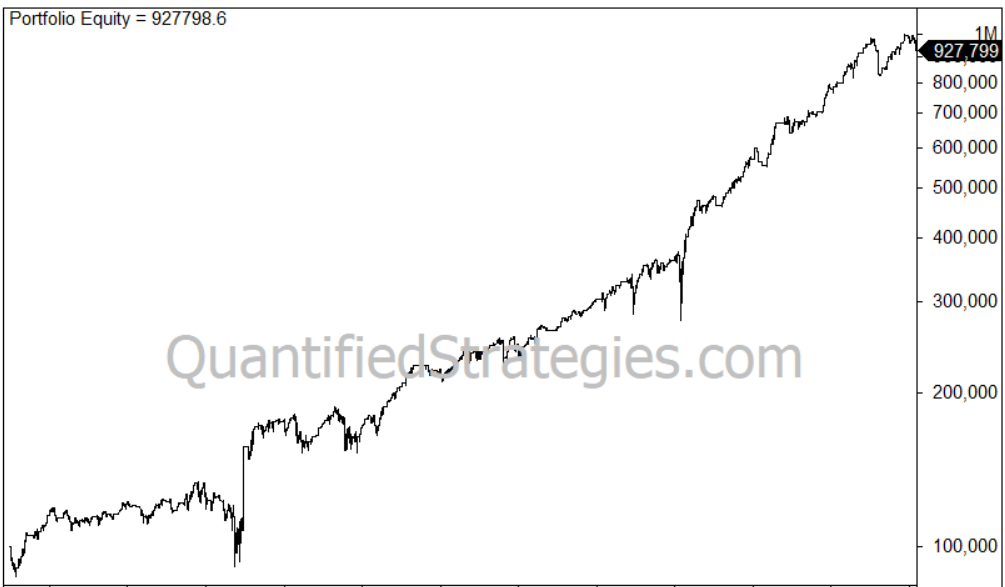
There are 354 trades, the average gain per trade is 0.47%, CAGR is 8.11%, and max drawdown is 31%.
This is what happens when we flip the strategy:
What happens to stock when bonds go down?
What Happens To Stocks When Bond Prices Go Up? Conclusions
The financial theory states that there is an inverse relationship between stocks and interest rates. Historically, stocks tend to generate higher returns than bonds over the long term, but bonds bring income, stability, and diversification to your portfolio as fixed income investments. As we have explained in this article, this means that stocks and bonds go up at the same time. When bonds go up, stocks go up.
There is a trade off between risk and return when choosing between stocks and bonds, and fixed income assets like bonds play a key role in balancing this trade off in a diversified portfolio.
Our backtest shows what happens to stocks when bonds go up: stocks perform better than any average period when long-term Treasuries go up. According to financial theory, this proves that it’s best to own risky assets like stocks when bonds go up.
FAQ:
How do stocks perform when bonds go up?
The relationship between stocks and interest rates is fundamental, with interest rates influencing investors’ risk appetite.
When bonds go up and interest rates go down, stocks tend to perform well. This is because higher bond prices lead to lower yields and make risky assets like stocks more attractive to investors. During periods of market volatility or economic uncertainty, investors often sell riskier assets like stocks and move their money into safer assets like government bonds. Investors may shift capital from equity portfolios into bonds to secure higher, safer yields, reducing demand for stocks.
Bonds can help reduce volatility in a portfolio, making them a key consideration for portfolio construction. The stock market, stock prices, a company’s shares, and individual stocks all play a role in portfolio diversification and risk management.
What Happens To SPY When TLT Go Up?
When TLT goes up, it usually means bond prices are rising and interest rates are falling. Lower rates make borrowing cheaper and can help stocks, so SPY often goes up too.
But it’s not always that simple. Sometimes TLT goes up because investors are scared and moving money into safer bonds, and in that case SPY can go down. So they can move together or in opposite directions depending on why bonds are rising. SPY tracks the S&P 500 (big U.S. companies), while TLT tracks long-term U.S. government bonds.
When TLT goes up, SPY often goes down.
Why:
- TLT tracks long-term U.S. government bonds.
- When bonds go up, it usually means interest rates are falling or investors are playing it safe.
- That “risk-off” mood often makes stocks (SPY) less attractive.
So:
Not always, but this is the typical pattern.
TLT up = money moving to safety → SPY often down
What happens to stocks when bond prices go down?
Bonds are considered less risky than stocks because, in the event of a company going bankrupt, bondholders are paid before equity owners, providing a level of security.
When bond prices go down and interest rates go up, it becomes less attractive to own risky assets like stocks. When bond prices fall, it is often due to rising interest rates, which can lead to higher yields and reduced demand for stocks as investors seek safer, higher-yielding bonds.
Higher yields increase borrowing costs for companies, reducing profitability and making fixed-income investments more attractive. Rising yields signal higher interest rates for corporate loans and mortgages, squeezing profit margins for companies. When rates rise, newly issued bonds pay higher coupons, making older bonds with lower coupons less attractive. Interest rates and inflation expectations are the main factors that can move bond prices.
Bond investors with a shorter-term view may be forced to sell at a discount to par value when interest rates rise, due to interest rate risk. Selling stocks can trigger capital gains taxes, and investors can lose money if they sell stocks or bonds for less than their purchase price.
What happens to TLT when bonds go up?
When bond prices go up, TLT usually goes up as well.
Why: TLT holds long-term U.S. Treasury bonds, so its price moves in the same direction as bond prices — and in the opposite direction of yields.
TLT is especially sensitive to interest rate changes because it holds long-duration bonds So:
- Yields ↓ → bond prices ↑ → TLT ↑ (often strongly)
- Yields ↑ → bond prices ↓ → TLT ↓
How does the relationship between stocks and bonds vary over time?
The relationship between stocks and bonds is not constant and can vary. Anticipating a higher correlation between them during periods of inflation is suggested.
Inflation can influence the correlation between stocks and bonds. A higher correlation is anticipated during periods of rising inflation. During periods of economic downturns, bonds have historically provided positive returns when equities have posted losses, acting as a buffer for investors.
Higher interest rates raise the cost of capital, lowering corporate profits and reducing the valuation of growth stocks, and small-cap stocks are often more sensitive to rising interest payments. Past performance is not a reliable indicator of future results, and negative returns for both stocks and bonds are rare but can occur during major economic shocks.
Monetary policy decisions by the Federal Reserve, such as raising or cutting interest rates, have a significant impact on both bond and stock markets, especially during periods of high inflation or economic downturns. Inflation expectations, future inflation, and other factors such as supply and demand dynamics can influence bond prices.
Short term bond funds are generally less sensitive to interest rate changes and inflation expectations than long-dated bonds. The correlation between stocks and bonds can turn positive (positive territory) during certain economic shocks, but over the long term, they generally move in opposite directions.
