
Daily Rhythm Day Trading Strategy

In finance, markets are generally believed to be efficient, meaning predictable patterns should quickly vanish through arbitrage. However, groundbreaking research by Heston et al. (2010, 2011) uncovered a peculiar regularity: the intra-day stock return periodicity puzzle.
This puzzle describes a tendency for stocks that exhibit higher-than-average returns during a specific half-hour interval on one day to show higher-than-average returns during the same half-hour period on subsequent days. This pattern was found to be statistically significant for at least 40 trading days.
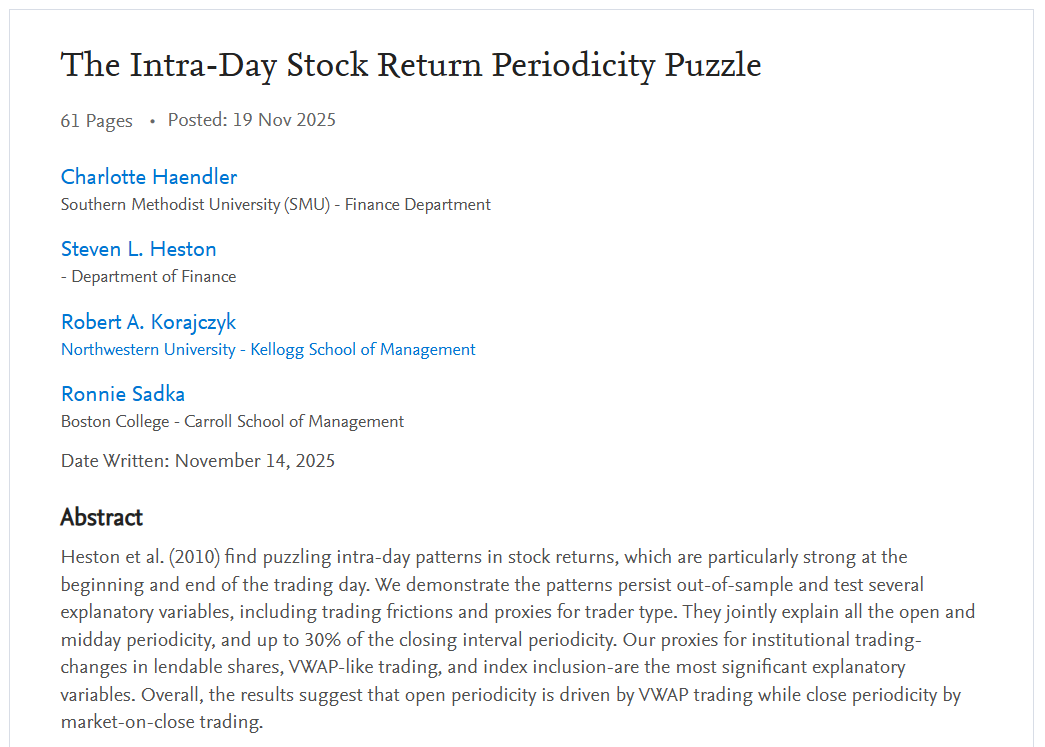
The goal of the study, “The intra-day stock return periodicity puzzle” by Charlotte Haendler, Steven L. Heston, Robert A. Korajczyk, and Ronnie Sadka, was two-fold: to demonstrate the persistence of these patterns in contemporary markets and to identify the specific variables that explain this puzzling predictability, focusing primarily on different types of trading behavior.
Out-of-Sample Validation: The Puzzle Persists
A key concern with financial anomalies is whether they disappear once published (a phenomenon often called data snooping). This study addresses that by confirming that the intra-day patterns persist over a completely out-of-sample time frame, from January 2012 to December 2020.
This persistence suggests that the pattern documented previously is neither a product of data snooping nor one that was fully arbitraged away post-publication.
Consistent with the original findings, the research confirms that periodicity is strongest at the beginning (open) and end (close) of the trading day (9:30 to 10:00 and 15:30 to 16:00), though it remains present but weaker in mid-day and overnight intervals.
Pinpointing the Drivers: Institutional Investors Lead the Way
The researchers tested several categories of explanations for the predictable intra-day movements, including trading frictions, retail activity, news, and institutional trading. The results decisively point toward institutional trading proxies as the most significant explanatory variables.
These institutional proxies collectively explain nearly all the periodicity observed at the open, mid-day, and overnight intervals.
1. Driving the Open: VWAP Trading
The strong predictability observed during the market opening appears to be primarily driven by VWAP-like trading activity (Volume-Weighted Average Price).
- VWAP algorithms are commonly used by institutional investors to break up large orders and minimize market impact by matching the overall stock volume distribution throughout the day.
- The research found that VWAP-like trading significantly increases periodicity, particularly in the opening period. In fact, controlling for this activity drove out more than 100% of the opening period periodicity.
- Stocks identified as having VWAP-like trading behavior also have significantly higher institutional ownership (64% compared to 40% on average).
2. Explaining the Close: Index Inclusion and Passive Investing
The predictable patterns seen at the closing bell are largely linked to market-on-close trading activities.
- The mechanism behind this is index inclusion: passive index funds and ETFs are highly motivated to execute trades near the closing price to minimize their tracking error relative to their benchmarks.
- The evidence is consistent with the hypothesis that higher predictability at the close is linked to assets held in passive index products.
- Index inclusion is significantly related to intra-day periodicity throughout the day, except overnight. This effect is particularly pronounced on index rebalancing days.
Other Institutional Factors
Other institutional proxies also contributed to the explanation:
- Institutional Trading: Measured by changes in securities lending activity, this proxy was significant in all intra-day periods.
- ETF Creation/Redemption: This measure was significant, but only for the closing period.
Secondary Factors: Frictions and Retail Traders
While institutional behavior explained the majority of the predictability, the study examined other factors hypothesized to maintain the puzzle’s existence:
- Trading Frictions: Illiquidity, measured by the Amihud (2002) proxy, significantly increases periodicity at the opening and closing periods. The cost of short selling was also studied, showing consistency with impeded downside arbitrage (larger periodicity after negative returns) at the open and overnight intervals, though it did not fully subsume the initial periodicity effect.
- Retail Trading: Retail activity, while statistically significant for the open and mid-day intervals, explains only a small fraction of the overall effect. For the opening period, retail trading explained roughly 14% of the periodicity, making its impact substantially smaller than that of VWAP-like institutional trading.
- News: The periodicity of news releases showed no observable influence on return predictability at daily lags.
The Unsolved Mystery at the Close
The joint analysis shows that when accounting for all identified variables, especially institutional trading, the periodicity at the open, mid-day, and overnight intervals is largely driven out.
However, even after factoring in all tested variables (frictions, institutional behavior, retail trading, and news), a significant amount of unexplained periodicity remains at the close. This final piece of the intra-day periodicity puzzle may still be related to the incentives of institutions, such as index funds, to execute trades near the closing price.
In essence, the study successfully peeled back the layers of this financial anomaly, revealing that the clockwork mechanism driving daily stock movements is largely dictated by the predictable, programmed execution strategies of major institutional players