
Best Currency Pairs for Trading (Complete Guide for Forex Traders)

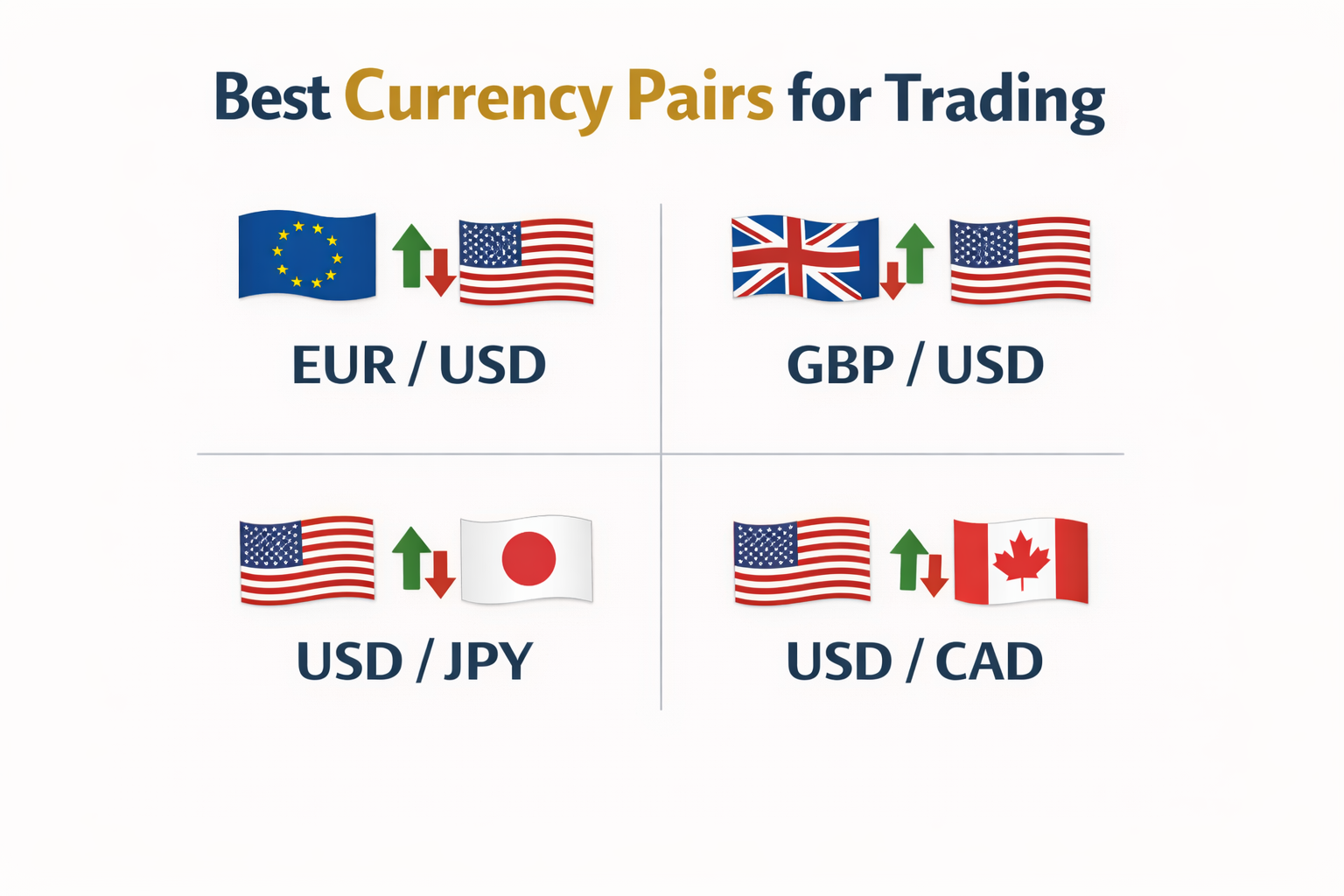
The best currency pairs for trading are the “majors”—EUR/USD, USD/JPY, GBP/USD, USD/CHF and AUD/USD, as they offer the highest liquidity, tightest spreads, and lowest volatility, making them ideal for beginners and consistent, technical strategies. EUR/USD is the most traded pair, while USD/JPY is known for safe-haven, trend-driven moves.
Many traders fail not because their system is bad, but because they apply the right strategy to the wrong currency pair.
Choosing the best currency pairs for trading is one of the most important decisions a forex trader can make. Strategy, risk management, and psychology all matter — but the instrument you trade directly affects win rate, drawdown, spreads, volatility exposure, and overall consistency.
Top 5 Currency Pairs for Trading
- EUR/USD (Euro / US Dollar): The “King of Forex” with the highest liquidity and tightest spreads. Ideal for all trading styles due to its stability and responsiveness to technical analysis.
- USD/JPY (US Dollar / Japanese Yen): A popular safe-haven pair, often used to hedge against market instability. Known for strong, sustained trend movements.
- GBP/USD (British Pound / US Dollar): Known as “Cable,” it is more volatile than EUR/USD, offering higher potential returns but requiring greater risk management.
- AUD/USD (Australian Dollar / US Dollar): Known as a commodity-linked currency, it is highly influenced by commodity prices (copper, gold) and risk sentiment.
- USD/CAD (US Dollar / Canadian Dollar): Closely tied to oil prices, making it ideal for trading commodity-related economic data.
This guide breaks down:
- Which forex pairs are best — and for what style of trading
- How liquidity and volatility affect performance
- The difference between majors, crosses, and exotics
- Which pairs trend, which range, and which explode during news
- Direct links to pair-specific strategy breakdowns for deeper study
Why Currency Pair Selection Matters
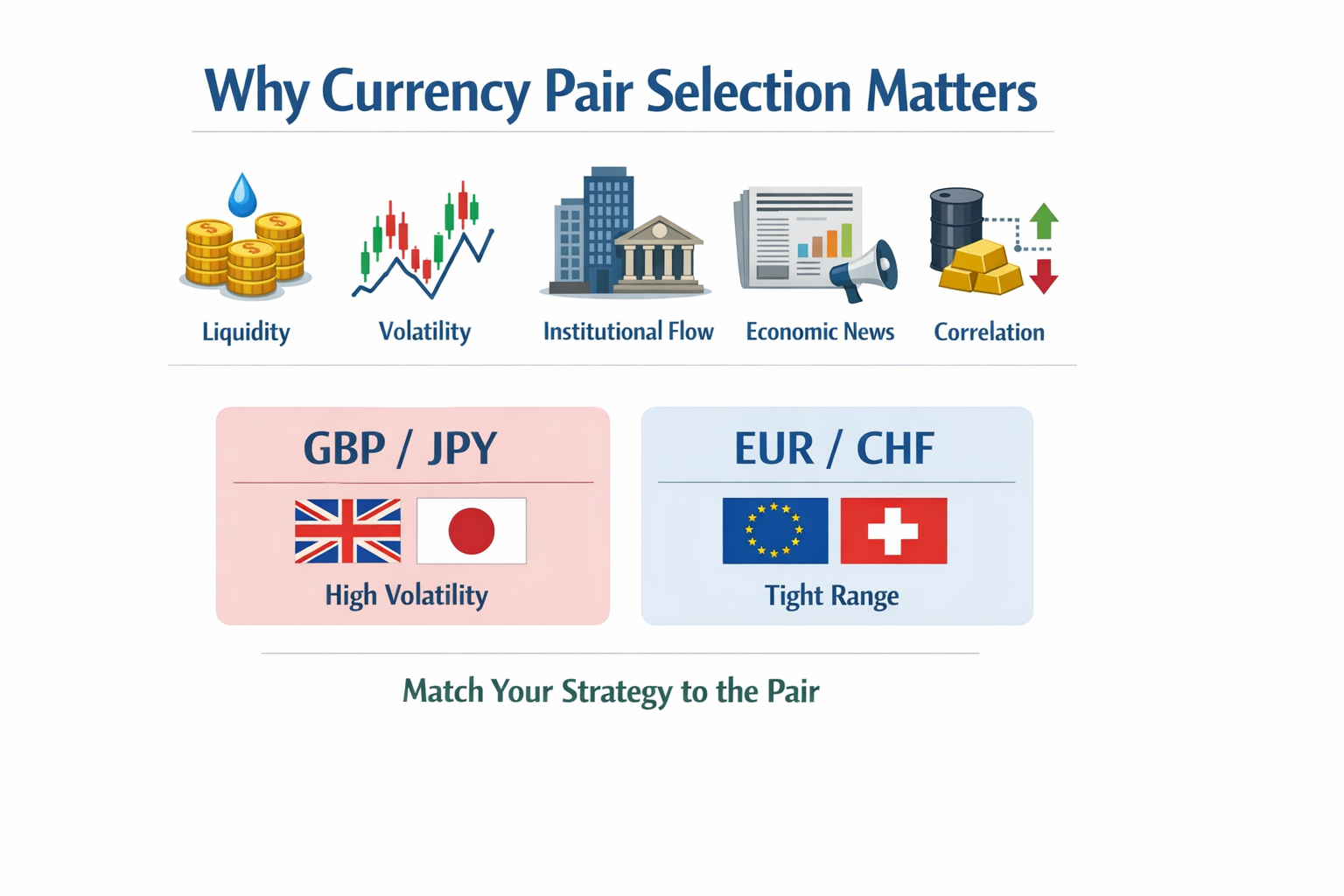
Not all currency pairs behave the same. Each pair has a unique:
- Liquidity profile
- Volatility structure
- Institutional participation level
- Reaction to economic news
- Correlation to commodities or risk sentiment
Trading an AUD JPY strategy is not the same as trading an EUR CHF strategy. One is a volatility engine; the other often compresses into tight ranges.
Your strategy must match the pair’s natural behavior.
What Makes a Currency Pair “Good” to Trade?
1. Liquidity
Liquidity determines how easily trades are executed.
High liquidity means:
- Tighter spreads
- Less slippage
- Cleaner technical levels
- Better performance for scalping and algos
Pairs with the highest liquidity:
- EUR USD
- USD JPY
- GBP USD
2. Volatility
Volatility defines opportunity.
Low volatility:
- Smaller moves
- Better for range strategies
High volatility:
- Larger profit potential
- Requires wider stops and emotional control
3. Session Activity
Each pair moves most during certain sessions.
| Session | Pairs That Move Most |
|---|---|
| London | EUR, GBP pairs |
| New York | USD, CAD pairs |
| Asia | JPY, AUD, NZD pairs |
Major Currency Pairs (Best for Most Traders)
These are the most traded pairs globally. They offer tight spreads and strong institutional participation.
EUR USD forex strategy
The most liquid pair in the world.
- Best for scalping, day trading, and technical systems
- Clean reactions to support/resistance
- Moderate volatility
GBP USD forex strategy
Higher volatility than EUR USD.
- Strong directional moves
- Excellent for breakout and trend traders
USD JPY forex strategy
Safe-haven currency dynamics.
- Smooth trends
- Strong moves during risk-on / risk-off environments
USD CHF forex strategy
Defensive currency pair.
- Moves during uncertainty
- Often trends with lower noise
USD CAD forex strategy
Oil-driven currency.
- Volatile during US and Canadian news
- Great for intraday traders
AUD USD forex strategy
Commodity and China-linked currency.
- Clear trends
- Good for swing traders
NZD USD forex strategy
Similar to AUD USD but slightly thinner liquidity.
- Clean moves
- Good risk-to-reward structure
Cross Currency Pairs (More Movement, Bigger Opportunity)
Crosses don’t include USD. They often trend more strongly and move further.
Euro Crosses
- EUR GBP forex strategy – slower, technical pair
- EUR JPY forex strategy – trending, risk sentiment driven
- EUR CHF forex strategy – often ranges
- EUR AUD forex strategy – large directional moves
- EUR CAD forex strategy – volatile during commodities cycles
- EUR NZD forex strategy – big swings, good for swing trading
Pound Crosses (High Volatility)
- GBP JPY forex strategy – “the dragon,” explosive moves
- GBP CHF forex strategy – aggressive trends
- GBP AUD forex strategy – volatile and directional
- GBP NZD forex strategy – extreme volatility
These pairs are best for experienced traders.
Commodity Crosses
These pairs are influenced by global growth cycles and commodity prices.
Safe Haven Currency Pairs
Safe-haven currencies strengthen during uncertainty.
- USD CHF forex strategy
- USD JPY forex strategy
- EUR CHF forex strategy
- CAD CHF forex strategy
These pairs are excellent during geopolitical events or stock market drops.
Commodity-Driven Pairs
Currencies tied to natural resources.
| Pair | Commodity Influence |
|---|---|
| USD CAD | Oil |
| AUD USD | Metals, China demand |
| NZD USD | Agriculture |
| CAD JPY | Oil + risk sentiment |
High Volatility Pairs (Advanced Traders)
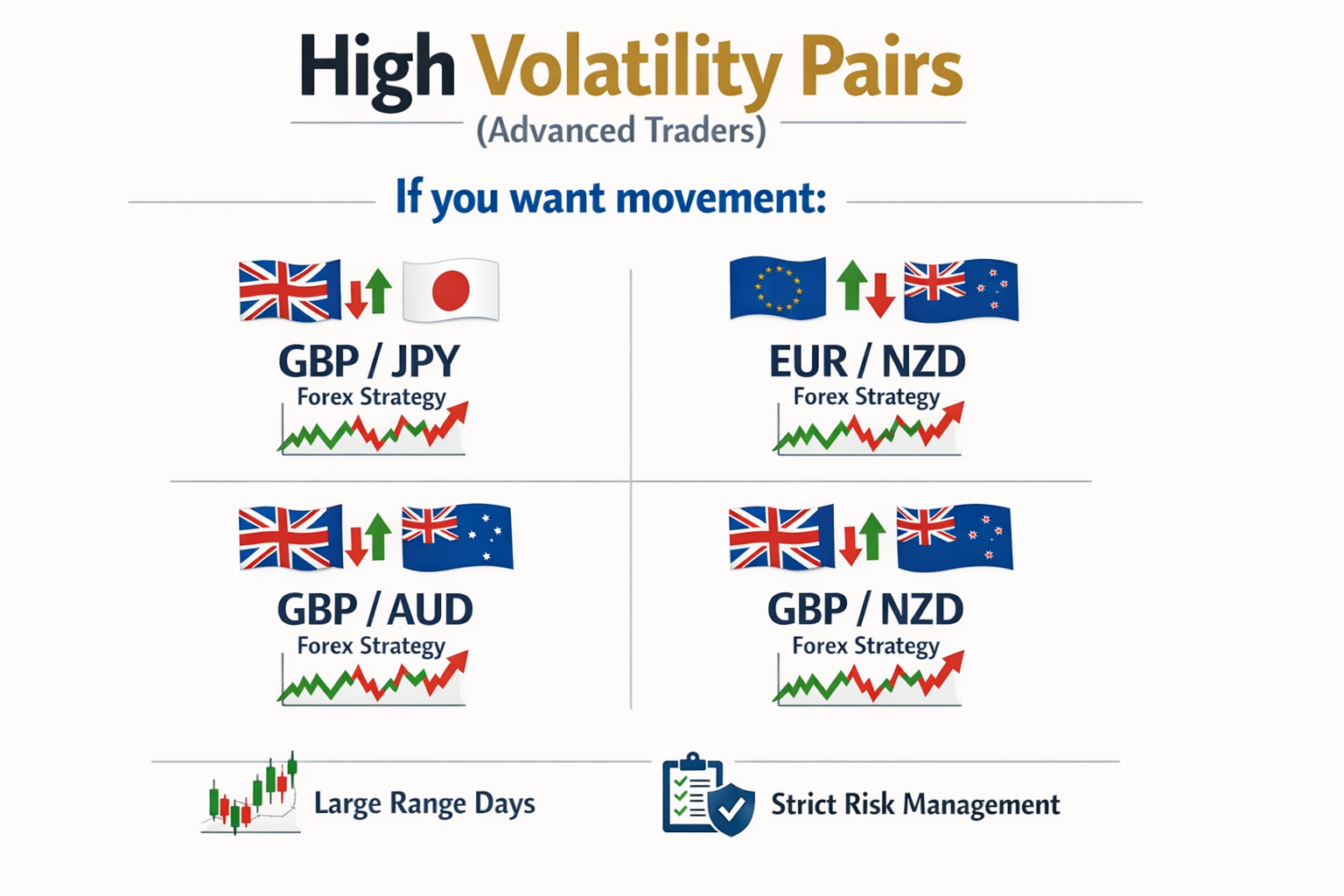
If you want movement:
- GBP JPY forex strategy
- EUR NZD forex strategy
- GBP AUD forex strategy
- GBP NZD forex strategy
These pairs provide large range days but require strict risk management.
Exotic & Emerging Market Pairs
USD RUB forex strategy
- Political and oil-driven
- Large spreads
- News-sensitive
- Only for advanced traders
Best Pairs by Trading Style
Scalping
- EUR USD
- USD JPY
Trend Trading
- GBP JPY
- EUR NZD
- AUD USD
Range Trading
- EUR CHF
- AUD NZD
News Trading
- GBP USD
- USD CAD
Best Pairs for Beginners
- EUR USD
- USD JPY
- GBP USD
These offer:
- Stable spreads
- Predictable behavior
- Strong liquidity
Common Mistake: Trading Too Many Pairs
Professional traders specialize.
Master:
- 2–4 pairs maximum
- Learn how they move
- Study session behavior
- Track news impact
Consistency improves when familiarity increases.
How Professionals Choose Currency Pairs
Institutions evaluate:
- Liquidity pools
- Volatility cycles
- Macroeconomic drivers
- Correlations with bonds, commodities, equities
Retail traders should simplify this into:
- Spread
- Movement
- Technical respect
- Session timing
Final Thoughts: What Is the “Best” Currency Pair?
There is no universal best pair. The correct answer is:
The best pair is the one that matches your strategy, risk tolerance, and trading session.
If you are:
- A scalper → EUR USD
- A momentum trader → GBP JPY
- A swing trader → AUD USD or EUR NZD
- A conservative trader → USD CHF
Master your pairs instead of chasing everything.
Next Step
Use the linked strategy guides above for each currency pair to understand:
- Entry behavior
- Stop placement
- Volatility expectations
- News sensitivity
That is how you turn pair selection into a trading edge.
📊 Forex Trading FAQ: Choosing the Best Currency Pairs
1. What are the best currency pairs for beginners to trade?
The best pairs for beginners are the “Majors,” specifically EUR/USD, USD/JPY, and GBP/USD. These pairs offer the highest liquidity, lowest spreads (transaction costs), and the most “predictable” price action, making them ideal for those learning technical analysis.
2. Why is EUR/USD considered the “King of Forex”?
EUR/USD is the most traded currency pair in the world. It provides the tightest spreads and highest liquidity, meaning you can enter and exit trades instantly with minimal cost. It is highly responsive to standard support and resistance levels.
3. Which currency pairs are the most volatile?
If you are looking for large price swings, the Pound Crosses are typically the most volatile. Pairs like GBP/JPY (known as “The Dragon”), GBP/NZD, and GBP/AUD can move hundreds of pips in a single day. While they offer high profit potential, they require strict risk management.
4. What are “Commodity Currencies”?
Certain currencies are heavily influenced by the price of natural resources.
- AUD/USD: Highly tied to gold and iron ore prices.
- USD/CAD: Strongly correlated with the price of Crude Oil.
- NZD/USD: Influenced by agricultural exports and global growth.
5. What is the difference between a “Major” and a “Cross” pair?
- Majors: Pairs that include the US Dollar (e.g., EUR/USD, USD/JPY). They have the lowest fees and highest volume.
- Crosses: Pairs that do not include the US Dollar (e.g., EUR/GBP, GBP/JPY). These often trend more strongly but can have slightly higher spreads.
6. When is the best time to trade specific pairs?
Currency pairs move most when their respective “home” markets are open:
- London Session: Best for EUR and GBP pairs.
- New York Session: Best for USD and CAD pairs.
- Asian Session: Best for JPY, AUD, and NZD pairs.
7. Which pairs should I trade for my specific style?
- Scalping: EUR/USD or USD/JPY (low spreads are vital).
- Trend Trading: GBP/JPY or AUD/USD (they tend to hold directions longer).
- Range Trading: EUR/CHF or AUD/NZD (they often bounce between horizontal levels).
8. How many currency pairs should I trade at once?
Professional traders recommend specializing in 2 to 4 pairs. Trading too many instruments leads to “analysis paralysis” and poor execution. It is better to master the unique personality and news sensitivity of a few pairs than to trade everything poorly.
9. Which currency pair is the best to trade?
EUR/USD (Euro / US Dollar): The “King of Forex” with the highest liquidity and tightest spreads. Ideal for all trading styles due to its stability and responsiveness to technical analysis.
USD/JPY (US Dollar / Japanese Yen): A popular safe-haven pair, often used to hedge against market instability. Known for strong, sustained trend movements.
GBP/USD (British Pound / US Dollar): Known as “Cable,” it is more volatile than EUR/USD, offering higher potential returns but requiring greater risk management.
AUD/USD (Australian Dollar / US Dollar): Known as a commodity-linked currency, it is highly influenced by commodity prices (copper, gold) and risk sentiment.
USD/CAD (US Dollar / Canadian Dollar): Closely tied to oil prices, making it ideal for trading commodity-related economic data.
