

Overnight Trading Strategy 2026

The overnight trading strategy in the S&P 500 involves entering a trade at the market’s close and exiting it at the following day’s open. Overnight trading refers to buying and selling financial instruments outside of the standard market hours. For example, the overnight trading session for US stocks and ETFs typically runs from 8:00 PM to 3:50 AM Eastern Time. This strategy relies on specific criteria like the Average True Range (ATR) and the IBS ratio to determine when to enter and exit positions. However, it’s important to note that this strategy is tailored for long positions, as attempting to apply it to short positions doesn’t produce positive outcomes.
This article presents an overnight trading strategy in the S&P 500. Overnight means entering at the close of the trading day with a buy order and exiting at the next day’s open with a sell order, regardless of price movement during the night session. After-hours trading occurs when you buy and sell between the official stock market hours, while overnight trading involves holding positions from the close to the next day’s open. Understanding the specific trading hours and rules of the stock market exchanges you are dealing with is essential for overnight trading.
We have previously written about other overnight trading strategies plus described the night trading session:
- Night trading strategies (overnight edges/strategies)
- The 5-Day Low Overnight Trading Strategy
- 4 overnight trading strategies in the S&P 500

Overnight trading is accessible to various types of traders, including retail traders, institutional investors, and professional money managers. Liquidity tends to be lower in overnight markets, as fewer buyers and sellers are actively participating, which can lead to larger bid-ask spreads and potentially more expensive trades. Overnight trading allows investors to react promptly to market-moving events and corporate news that happen outside regular trading hours. Traders involved in overnight trading aim to leverage global market influences, such as currency exchange rates or overseas market movements, which can affect the opening prices of domestic markets.
Overnight trading strategy in the S&P 500
Let’s look at the trading rules in plain English:
THIS SECTION IS FOR MEMBERS ONLY. _________________ BECOME A MEBER TO GET ACCESS TO TRADING RULES IN ALL ARTICLES CLICK HERE TO SEE ALL 400 ARTICLES WITH BACKTESTS & TRADING RULES
You are holding SPY, which tracks the S&P 500 index, for 24 hours, and we get the following nice equity curve when we backtest from inception in 1993 until today. The S&P 500 is a widely followed index representing the performance of 500 leading U.S. companies and is commonly used for overnight trading strategies due to its liquidity and historical performance:
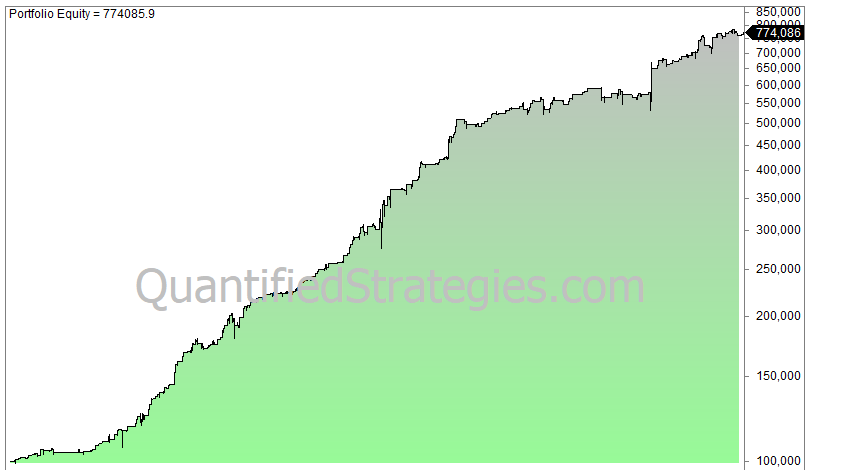
We believe this is good equity for short for owning SPY just 24 hours. There are 688 trades and the average gain is 0.31% per trade. The strategy aims to make money by capitalizing on overnight price movements. One key advantage of overnight trading strategies is the statistical edge: historically, all the gains in the S&P 500 have come from owning the index from the close to the open the next day.
Vice versa, for short, does not work. That is expected because you are fighting the upward trend in the markets.
The mechanics of the strategy involve using charts to analyze price movements and identify key levels for entry and exit. The strategy involves placing buy orders at the close and sell orders at the next open, and using limit orders is essential to manage execution risks due to lower liquidity. Successful overnight trading strategies often revolve around specific techniques such as scalping (making quick, small trades to capture minor price movements), breakout trading (entering trades when a security breaks through a defined support or resistance level), and range trading (identifying securities that trade within a specific price range and capitalizing on predictable price movements). For example, a trader might use a breakout strategy to buy SPY if it breaks above a key resistance level during the overnight session.
Overnight trading involves holding positions beyond the normal trading session, which can lead to increased risks and volatility. It is riskier due to lower liquidity, resulting in larger gaps and wider spreads, so effective risk management is critical. Traders should conduct thorough research on the securities they plan to trade before engaging in overnight trading, and continuous learning is essential for staying ahead in the ever-changing trading environment.
———————–
If you would like to have the code for any of these strategies plus 70+ other free trading strategies published on this website, please click on this link:
For more trading strategies, please click here:
- Monthly trading edges (subscription service)
What is an overnight trading strategy, and how does it work in the S&P 500?
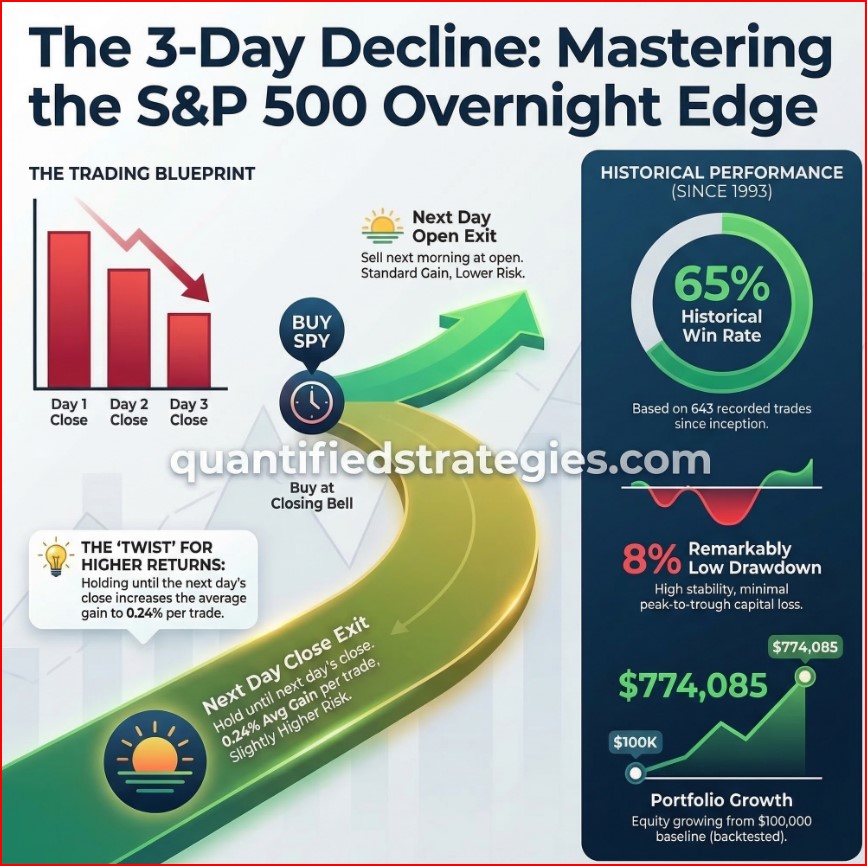
An overnight trading strategy involves entering a trade at the market’s close and exiting it at the following day’s open. In the case of the S&P 500, this strategy uses specific criteria, such as Average True Range (ATR) and the IBS ratio, to determine entry and exit points.
What are the key criteria used in the S&P 500 overnight trading strategy?
The criteria include calculating the ATR (a 25-day average of the High minus Low), the high of the last 10 days, the IBS (C-L)/(H-L) ratio, and a band below the 10-day high. If the SPY closes below this band and the IBS is below 0.5, a long position is entered at the close and exited at the next open.
Is the overnight trading strategy in the S&P 500 applicable to both long and short positions?
The strategy is designed for long positions, and an approach that is vice versa for short positions does not yield favorable results.
Managing Risks in Overnight S&P 500 Trading
Managing risks in overnight S&P 500 trading is essential due to the unique dynamics that set overnight trading apart from regular trading hours. When you hold positions beyond the close of the regular trading session, you expose your portfolio to after hours trading conditions, which are often characterized by lower liquidity and wider spreads. These factors can lead to increased volatility and unexpected price movements, making a robust trading strategy and risk management plan crucial.
One of the primary challenges of overnight trading is the reduced trading volume during after hours sessions. With fewer buyers and sellers in the market, price fluctuations can be more pronounced, and executing trades at desired prices becomes more difficult. This is especially true when significant news, such as earnings reports or economic data releases, is announced after the market closes. Such events can trigger sharp moves in the S&P 500 and related financial instruments, often before most traders have a chance to react during regular market hours.
Global market influences also play a significant role in overnight trading. Developments in other countries, geopolitical events, and economic data releases from different time zones can all impact the S&P 500 overnight. Traders must stay informed about important events and relevant information that could affect global markets, as these can lead to heightened volatility and rapid price changes. Wall Street and other major financial centers often set the tone for overnight markets, but activity in Asia and Europe can also drive price movements before the U.S. market reopens.
To manage risk effectively, traders should utilize technical analysis tools such as moving averages, technical indicators, and real-time data to monitor market conditions and identify potential entry and exit points. Historical data can provide valuable context for understanding how the S&P 500 has reacted to similar events in the past. Using limit orders is another key risk management technique, allowing traders to specify the maximum price they are willing to pay or the minimum price they are willing to accept, which helps protect against unfavorable price swings in low-liquidity environments.
Electronic communication networks (ECNs) enable both institutional investors and individual traders to access overnight markets, but it’s important to recognize that trading volume is typically lower than during regular trading hours. This can result in wider spreads and the need to act quickly when important news breaks. By holding positions overnight and trading in different time zones, traders can potentially capitalize on price movements that occur outside the regular trading session, but they must remain vigilant and ready to adjust their strategy as new information becomes available.
In summary, managing risks in overnight S&P 500 trading requires a combination of technical analysis, real-time monitoring, and a solid understanding of global market influences. By staying informed, using the right trading tools, and employing effective risk management techniques, traders can navigate the challenges of after hours trading and potentially benefit from the unique opportunities that overnight markets present. Whether you are trading stocks, futures, or other financial instruments, a disciplined approach to risk management is key to achieving your investing goals in the overnight session.
Conclusion
The overnight trading strategy in the S&P 500 focuses on entering trades at the market’s close and exiting them at the following day’s open. This strategy relies on specific criteria like the Average True Range (ATR) and the IBS ratio to determine entry and exit points. However, it’s important to note that while this strategy is effective for long positions, attempts to apply it to short positions have not been successful. Overall, this approach offers a structured method for trading in the S&P 500 market, providing potential opportunities for traders to capitalize on market movements.
I’ve got an Msc from Heriot-Watt University, Edinburgh (1996), in addition a to a business administration degree the Norwegian School of Management (BI – 1994). Did my mandatory military service in between.
After university, I worked two years as an auditor (1996-1998).
I co-founded Aksjeforum.com in 1998/99 – one of the first websites about trading and investing in Norway. It was later acquired by Digi.no in 2001.
I have written 4 books about trading (in Norwegian). One of them has sold 30,000 copies, a record for a financial book in Norway.
From 2001 until 2018 full-time independent prop trader (Series 7 in 2001) and investor.
2018-today: Investor, writer, analyst.
