

The Easter Holiday Effect in Trading (Good Friday & Holy Thursday)

Easter is a Christian holiday celebrated across the world. But does it affect trading on the U.S. stock exchanges and other financial markets? We look at how the stock market performs before and after the Easter holiday. Additionally, we specifically look at the performance of stocks the day before Good Friday – Holy Thursday.
Easter is a Christian holiday celebrated on a Sunday. It is not a federal holiday in the US, so no weekday is marked to observe the holiday. As such, it does not affect trading on the weekday before or after it (except for Good Friday which is a non-trading day). The Easter Holiday week is very positive while the week after Good Friday performs more or less like any random week. Holy Thursday, the day before Good Friday, is an exceptionally strong day for stocks. The NYSE and Nasdaq are closed on Good Friday, which is a federal holiday in the US.
When discussing trading days around Easter, it’s important to note that the stock market is not open on Good Friday, but the stock market open occurs on the days before and after Good Friday.
Let’s look at how the S&P 500 performs before and after the Easter holiday. The S&P 500 has averaged a 0.66% to 0.77% gain during the full “Holy Week” over the last 60 years.
Easter is also a major economic event. 92% of consumers plan to purchase candy for Easter, making it the most popular spending category, and retail spending for Easter in the U.S. is projected to reach a record $24.9 billion in 2026.
Introduction to Stock Market Holidays
Stock market holidays are specific days when the stock market is closed and no trading takes place. In the United States, the stock market—including major exchanges like the New York Stock Exchange (NYSE) and Nasdaq—follows a set holiday schedule that typically aligns with federal holidays. Understanding the stock market holiday schedule is crucial for investors and traders, as it directly impacts trading hours, market liquidity, and the timing of investment decisions.
The US stock market observes several major holidays throughout the year, such as Martin Luther King Jr. Day, Independence Day, Good Friday, and Christmas Day. On these dates, the markets are closed, and even the stock market takes a break from its usual activity. In addition to these, new holidays like Juneteenth National Independence Day have recently been added to the calendar, reflecting evolving federal holiday observances. While some holidays, like Easter Monday, are not observed by the US stock market and trading continues as usual, others—such as Good Friday—result in a full market closure.
It’s important to note that investing involves risk, and market closures can influence trading volumes and volatility both before and after a holiday. For example, the day before a major holiday may see reduced trading activity, while the day after can sometimes experience increased volatility as markets react to news or events that occurred during the closure. Additionally, on certain days like the day after Thanksgiving, the stock market may close early, so it’s essential to be aware of these early closures to avoid unexpected disruptions to your trading plans.
Bond markets and other financial markets may follow a slightly different holiday schedule, as recommended by organizations like the Securities Industry and Financial Markets Association (SIFMA). Therefore, it’s wise to consult the official calendars of the New York Stock Exchange and other relevant stock exchanges to stay up-to-date on trading hours and holiday schedules.
Key takeaways for investors include the importance of planning investment strategies around the stock market holiday schedule, understanding how holidays can affect trading volumes and volatility, and staying informed about any changes to the calendar—such as the addition of new federal holidays. By keeping track of when markets are closed and how the holiday schedule may impact your investments, you can make more informed decisions and better navigate the complexities of the financial markets. Whether you’re a seasoned investor or just starting out, being aware of the stock market holiday schedule is an essential part of successful investing.
- The article examines the “Easter Holiday Effect” in U.S. stock trading, focusing on the period leading up to Good Friday, particularly Holy Thursday.
- The strategy involves purchasing stocks at the close of the Friday preceding Easter week and selling at the close of Holy Thursday, which is the day before Good Friday.
- Long-Term Returns: Over a 63-year period, this approach yielded an average return of 0.77% per trade.
- Recent Performance: Since the year 2000, the average return increased to 1.49% per trade, indicating a strengthening of this seasonal effect in recent decades.
- Risk Profile: The strategy exhibits a favorable risk-reward ratio, with gains typically outweighing losses.
- Holy Thursday Strength: Holy Thursday stands out as an exceptionally strong day for stocks, contributing significantly to the overall positive performance during Easter week.
- Post-Easter Week: The week following Easter does not display any consistent or notable trading patterns, performing similarly to any random week in the market.
- Contextual Factors
- Market Closure: Good Friday is a federal holiday in the U.S., during which stock markets are closed. Good Friday typically falls on a Friday in April (friday april). The stock market is closed for 10 holidays each year, with Good Friday being one of them.
- Investor Sentiment: The positive returns observed during Easter week may be attributed to factors such as increased investor optimism, reduced trading volumes, and institutional behaviors surrounding the holiday period.

Easter stocks
Easter is a Christian holiday that celebrates the belief in the resurrection of Jesus Christ, the founder of the Christian religion. The holiday concludes the commemoration of “the Passion of Jesus Christ” — a series of events and celebrations that begins with Lent (a 40-day period of fasting, prayer, and sacrifice) and ends with Holy Week, which includes Good Friday (the day Jesus died) and Easter Sunday.
While Good Friday is a federal holiday in the US, Easter is not. Easter is celebrated on that Easter Sunday by Christians who observe it, but no weekday is set aside for its observance.
When is it?
Easter is celebrated on the first Sunday following the Paschal Full Moon that occurs on or just after the ecclesiastical spring equinox — March 21. The timing of Easter also determines the scheduling of following days, such as Good Friday and Easter Monday, which can impact trading schedules. Easter 2022 took place on Sunday, April 17, 2022. The Easter holiday of 2023 will be on Sunday, April 9, 2023.
Is the day before or after it a trading day?
Easter is a Christian holiday celebrated on a Sunday. It is not a federal holiday in the US, so no weekday is marked to observe the holiday. Since Easter always falls on a weekend, the stock market is not open on that day. As such, the day after it, Easter Monday, is a trading day. The stock market typically operates from 9:30 a.m. ET to 4:00 p.m. ET, Monday through Friday.
However, the weekday before it is the Good Friday, which is a federal holiday in the US and, therefore, not a trading day.
What is Holy Thursday?
Holy Thursday, also called Maundy Thursday, is a Christian observance day in the United States and also a public holiday in a few protestant countries, like Norway for example. In the US this is a trading day and a very good one for that.
Backtesting the Holy Thursday strategy
Let’s first backtest the day before Good Friday: Holy Thursday. Our backtest is really simple:
We buy at the close of Wednesday before Holy Thursday and sell at the close on Holy Thursday. This is all there is to it! We use the S&P 500 as a proxy for the stock market.
The equity curve since 1960 looks like this:

Stock market Easter
The average gain per trade is 0.35%, the win rate is 68%, the profit factor is 4.1, and the max drawdown is a tiny 2%. These are pretty good trading metrics! We would assume that Holy Thursday is one of the best trading days of the year.
Let’s also backtest if we buy at the close on Wednesday and sell at the open on Holy Thursday. We don’t have opening quotes before 1993, and thus test from 1993:

Easter stock market
The average gain is 0.25% and the win rate is 63%. This compares to 0.44% if you held onto the close during the same period.
If you would like to have the Amibroker code for our Holy Thursday trading strategy you can purchase it by becoming a member.
Hence, we can safely conclude that the Holy Thursday trading strategy is among the best trading days of the year!
The week after Easter holiday
How have stocks performed the week after the Easter holiday?
We backtest the following strategy:
- We buy the close of Holy Thursday, the before Good Friday
- We exit at the close 5 trading days later on Friday
This is what the equity curve looks like since 1960:

Trading Good Friday
Performance in the new millennium has been good, while it was pretty poor before that. The average gain has been 0.2, approximately the same as any random week.
The Easter holiday week performance
The stock market tends to perform pretty well during Holidays. How do stocks perform during the Easter holiday week?
We backtest the following strategy:
- We buy at the close on the Friday before Easter holiday week (the Friday one week before Good Friday)
- We exit at the close of Holy Thursday four trading days later
The result can be seen in the curve below:
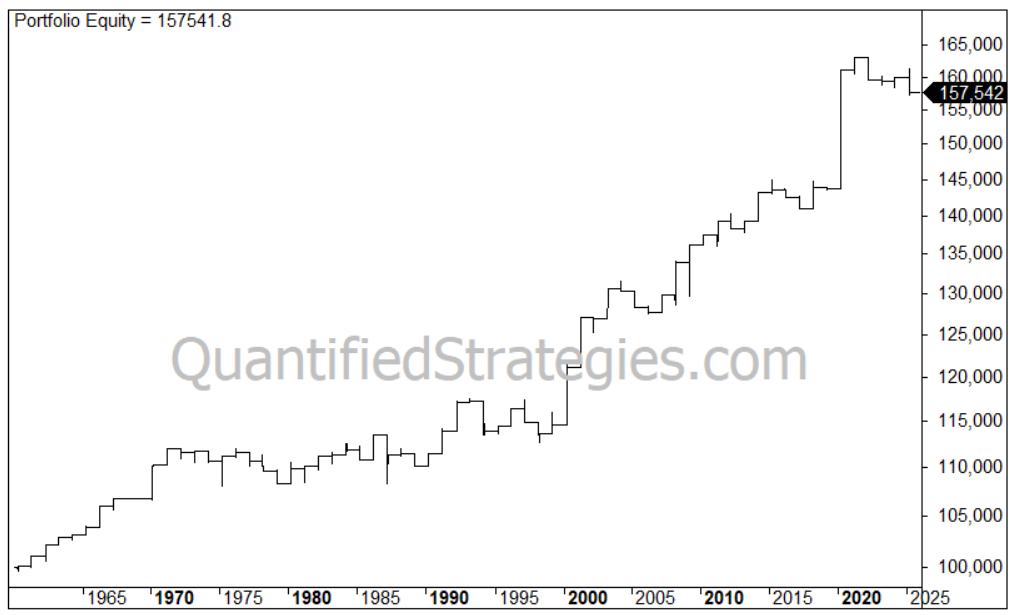
As you can see, stocks perform very well during the Easter holiday: the average gain per trade is a solid 0.7% over the 66-year period, and it has been 1.3% since the year 2000. Losses are relatively small, while gains tend to be larger.
Holiday effects in the stock market
We have covered all the US stock market holiday effects in trading. Stock market holidays occur throughout the year, including in January (New Year’s Day, Martin Luther King Jr. Day), February (Presidents’ Day), June (Juneteenth National Independence Day), July (Independence Day), September (Labor Day), November (Thanksgiving, Black Friday), and December (Christmas Day, Christmas Eve). Veterans Day is another federal holiday that can affect trading schedules.
When a holiday falls on a weekend, such as a Saturday, the stock market generally closes on the Friday before or the Monday after. This adjustment ensures that trading schedules align with federal holiday observances. For example, Christmas Eve is a day when the stock market often closes early, and similar early closures can occur around other major holidays in November and December.
It is important to conduct thorough research and consult primary sources, such as official exchange calendars, to verify the exact holiday schedule for each year.
The Easter holiday effect in trading
Our backtests reveal that the Easter holiday effect has a pretty strong positive bias or seasonality. Holy Thursday is particularly strong—probably one of the best trading days of the year.
FAQ:
What is the significance of Easter in the context of financial markets?
Easter has discernible impact on market volatility and liquidity; trading volumes tend to decrease or increase around the Easter holiday, and how this may affect price movements. Easter, a Christian holiday symbolizing the resurrection of Jesus Christ, might influence investor sentiment and trading patterns on U.S. stock exchanges and financial markets.
Are there other holiday effects in the U.S. stock market?
Various holiday effects in the U.S. stock market, providing links to specific articles on Martin Luther King Jr. Day, President’s Day, Memorial Day, Independence Day, Labor Day, Thanksgiving, Black Friday, and the End of the Year Rally, showcasing the diverse influences on market behavior.
How does the Easter holiday effect contribute to stock market seasonality?
The Easter holiday effect contributes to stock market seasonality, emphasizing its role in creating a positive bias over the 63-year period and particularly since the year 2000. Provide insights into the reasons behind the observed seasonality, such as investor behavior and market sentiment during the Easter holiday.
