

Triple RSI Trading Strategy: Boost Your Win Rate to 90%

The Triple RSI trading strategy is a modified version of the RSI strategy with four key variables, three of which are based on the RSI. It focuses on mean reversion, and the trading rules involve conditions related to RSI readings, the 200-day moving average, and buying/selling signals.
In the world of trading, the Relative Strength Indicator (RSI) stands as a timeless beacon of analysis. Invented by Welles Wilder in the 1970s, it has become a cornerstone of trading strategies.
Today, we unveil a fresh perspective on RSI with the Triple RSI Trading Strategy. This innovative approach harnesses the power of RSI in a new and modified form, boasting an impressive 90% win rate.
With just 83 trades since 1993, it may seem conservative, but each trade delivers a robust 1.2% gain on average.
The RSI indicator

If you are unfamiliar with RSI, we recommend you read our RSI guide before continuing reading.
Let’s explain the trading rules and logic behind the strategy before we backtest it:

Trading strategy with a 90% win rate
Is it possible to find a trading strategy with a 90% win rate? Can we make a 90 win rate trading strategy?
Fortunately, yes, you also have to consider the average win vs the average loss. Even a high win rate strategy can have a negative expectation if the losers are very big. However, a trading strategy with 90% win rate does most likely have a positive expectation because of the very high win rate.
Triple RSI trading rules
Most traders use RSI as a mean reversion oscillator. There is a good reason for that, especially if you are looking to trade stocks or the stock market and are looking for an indicator with a high win rate. Since 1985, stocks have reverted to the mean. We can only guess why, but we believe program trading is one of the main reasons.
The Triple RSI trading strategy is also based on mean reversion. The trading rules are inspired by Larry Connors’ R3 strategy, but we have modified them. These are the trading rules:
- The 5-day RSI is below 30, and
- The 5-day RSI reading is down for the third day in a row, and
- The 5-day RSI reading was below 60 three trading days ago, and
- The close is higher than the 200-day moving average, and
- If 1-4 are true, then buy at the close.
- Sell at the close when the 5-day RSI crosses above 50.
Triple RSI trading system example
The chart below shows an example trade of the triple RSI strategy. The blue area shows three down days with lower RSI readings, and the red line shows the 200-day moving average. The green arrow signals a trade, and the red arrow signals when we exit (with a small profit).

Triple RSI trading strategy backtest
We backtest SPY – the ETF that tracks the S&P 500. When we put the trading rules above into Amibroker, we get the following equity curve:
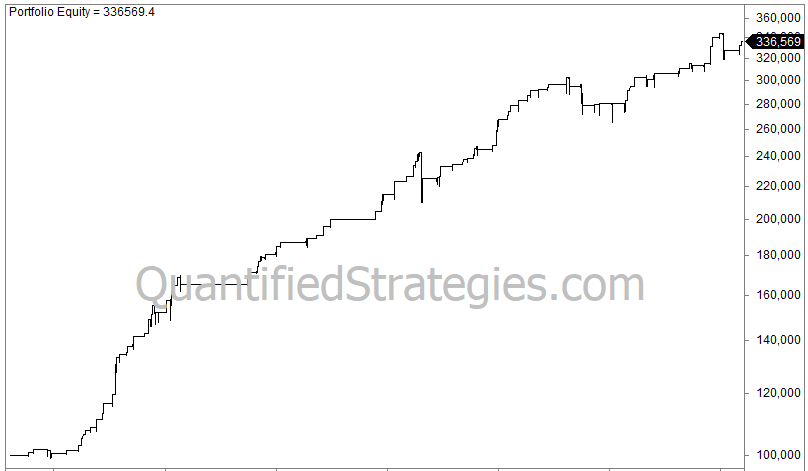
The 103 trades since 1993 are few, but the average gain is a solid 1.2% per trade. The win rate is 90%, and the profit factor is 4. It is a trading strategy with a high win rate. In a previous article, we argued the win rate is an underappreciated trading metric because a low win rate in most cases leads to behavioral trading mistakes – biases.
The statistics and performance metrics are excellent, but the number of trades is low. However, if you play around with the trading rules, you can increase the number of trades and avoid sitting too much on the sidelines.
Alternatively, you can use the strategy as leverage to your long-term buy-and-hold portfolio. If you have, for example, several positions or holdings in your account and you have a margin account, you can use the strategy to “boost” returns by using a small amount of leverage (not much!).
Triple RSI trading strategy video
We placed the Triple RSI video at the top of the article.
Trading strategies with high win rates
We have written over 2500 articles on this blog since we started in 2012. Many articles contain specific trading rules that can be backtested for profitability and performance metrics. Some of these have trading code and trading rules in plain English, and many other articles are behind paywall.
For a list of our services, please have a look at the member options. Most of the strategies are taken from our landing page, where you can find any basic trading strategy.
Forex strategy 90 win rate
It’s easier to find a trading strategy with 90% win rate in stocks than in forex: a forex trading strategy with 90 win rate is very hard to find. The reason is that stocks drift upward over time due to inflation and productivity gains. Forex does not have this tailwind: Forex is a zero-sum game. Thus, you are unlikely to find a forex strategy 90 win rate.
FAQ:
What is the Triple RSI trading strategy, and how does it work?
The Triple RSI trading strategy is a modified version of the RSI strategy with four key variables, three of which are based on the RSI. It focuses on mean reversion, and the trading rules involve conditions related to RSI readings, the 200-day moving average, and buying/selling signals.
What are the backtesting results for the Triple RSI trading strategy?
The backtest results for the strategy on the SPY ETF (S&P 500) show a solid 1.4% average gain per trade, a 90% win rate, and a profit factor of 5. These metrics indicate the strategy’s historical performance. Mean reversion trading strategies, including the Triple RSI strategy, involve trading based on the expectation that prices will revert to their historical average.
How can I implement the Triple RSI trading strategy in my portfolio?
You can use the strategy to complement a long-term buy-and-hold portfolio. It can be applied with caution and, if you have a margin account, potentially boost returns with a small amount of leverage.
Are high win trading strategies good?
High win rate strategies are good if the average losing trades are not too big, so they neutralize the winning trades.
What is the success rate of triple RSI?
The success rate of triple RSI is 90%.
What is Larry Connors RSI 3 strategy?
Larry Connors’ RSI3 strategy is a short-term mean-reversion trading strategy popularized by Larry Connors. It became widely known after being described in his book Short Term Trading Strategies That Work.
What is the 3-5-7 rule in trading strategy?
The 3-5-7 rule is not one single universal trading system. Instead, it’s a practical risk- and trade-management framework used by many short-term traders to control position size, losses, and profit expectations.
What is the RSI 14 30 70 strategy?
The RSI 14 30 70 strategy is the classic way traders use the Relative Strength Index to identify overbought and oversold conditions. It was originally introduced by J. Welles Wilder Jr. in his book New Concepts in Technical Trading Systems. 14 is the number of days in the lookback period. The 30 and 70 levels are threshold zones. Buy when RSI drops below 30 and sell when it reaches 70. However, backtests show that this is not a very good strategy, at least not in stocks.